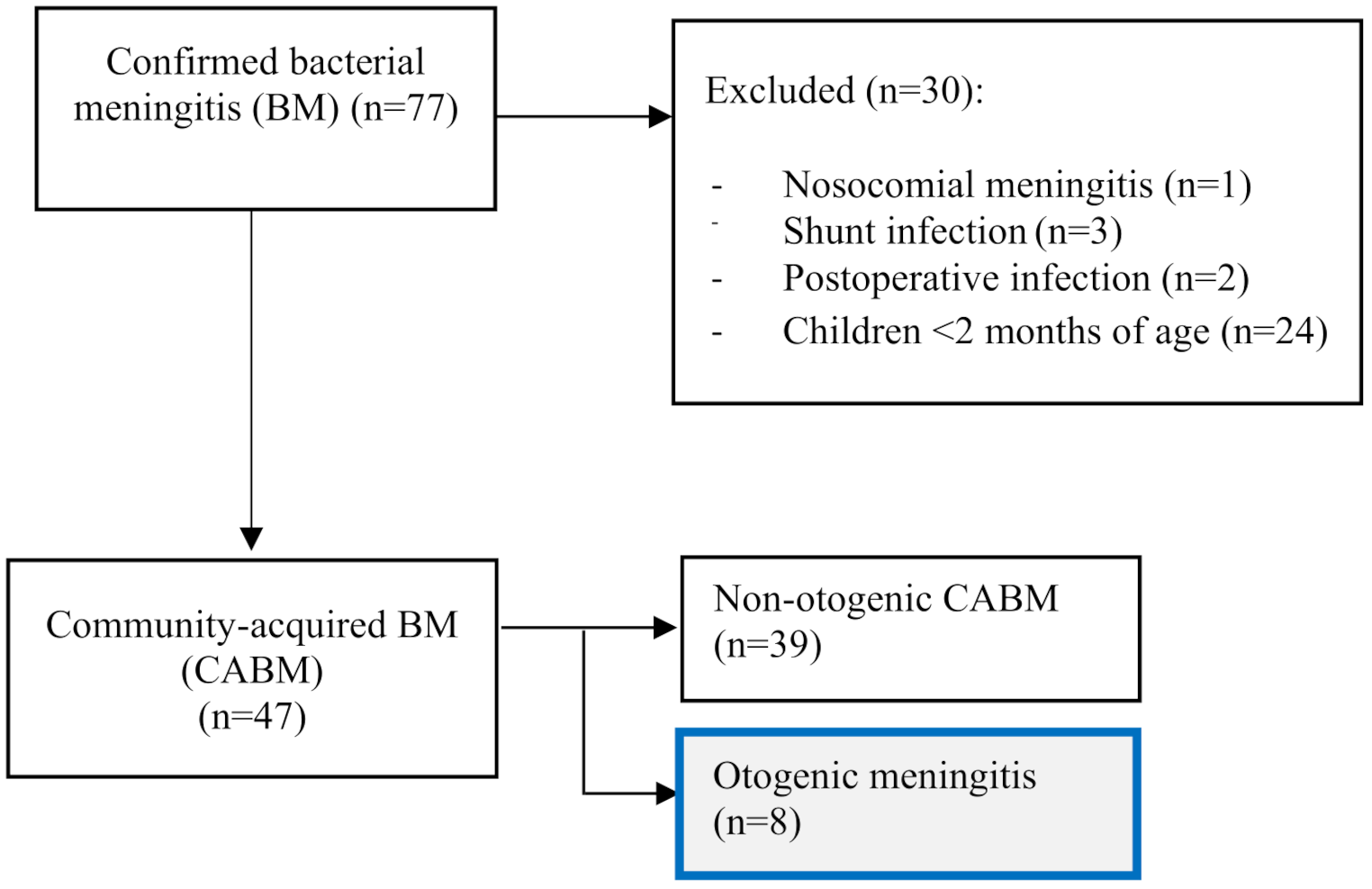
In this retrospective cohort study of children with BM over 11 year-period in Southern Finland, 17% of the BM cases had an otogenic origin. Despite national guidelines, otoscopic examinations were not performed for all BM patients [2, 6]. In our cohort, 34/47 (72%) children had records of otoscopy. In our cohort, one-third of the children’s ears were not examined despite national guidelines recommending such assessment. This issue has also been noted by Swedish study group, who reported that otoscopic examinations are not performed for all bacterial meningitis patients. The Bjar et al. found that only 54% (116 of 216) had any record of otoscopy or otomicroscopy [2]. In this light, the incidence of otogenic meningitis may be underrecognized in literature. For 3 children, the concomitant OM/AM was inferred from MRI findings.
Our data cohort is small, but it still provides some perspective regarding the incidence of childhood otogenic meningitis. Children with otogenic meningitis may not present with clear otologic signs, which may delay diagnosis and treatment. Notably, none of the children with otogenic meningitis in our study complained of ear pain, likely due to their young age (median age of 1.3 years). Nausea or vomiting were the most frequent symptoms, occurring in 5/8 (63%) of the children with otogenic meningitis before hospitalization, thereby emphasizing the importance of checking middle ear status in all sick children [2]. The available literature indicates that nausea and/or vomiting is a frequent (74–91%) symptom in children diagnosed with BM [9, 14], whereas vomiting is less common in OM, occurring in 4–9% in children and neonates [19, 20]. Our data indicates a greater prevalence of vomiting/nausea in our otogenic children than has been reported in previous studies.
The incidence of otogenic meningitis was 0.3/100 000/year in our cohort, which is in line with a study from the United Kingdom [21]. Previously published studies provided only scanty data regarding the proportion of concomitant OM in cases of childhood BM or about the clinical findings and outcomes of otogenic versus non-otogenic meningitis. Two Danish studies reported that 21% and 45% of children with BM (< 16 years of age) had concomitant OM [4, 5]. These results are quite in line with our finding that 17% of our BM cases had an otogenic origin.
In our study, S. pneumoniae was the leading pathogen detected in CSF cultures in 88% of patients with otogenic meningitis. Only one child with an otogenic background had other Gram-positive cocci in the CSF. Bjar et al., in a study that ran from 2000 to 2017, reported that S. pneumoniae was the most common pathogen identified in CSF in all age groups of children < 16 years of age, whereas N. meningitidis was predominant in teenagers [2]. According to the Finnish national vaccination program, the Haemophilus influenzae type b (Hib) vaccines have been administered at the ages of 3, 5, and 12 months since 1993, while the 10-valent pneumococcal conjugate vaccine (PCV10), which covers the S. pneumoniae serotypes 1, 4, 5, 6B, 7 F, 9 V, 14, 18 C, 19 F, and 23 F. PCV10 has been given following the same schedule as the Hib vaccine since the autumn of 2010. Interestingly, three children in our cohort with otogenic meningitis had S. pneumoniae serotypes 23 F, 19 F, and 14, which should have been covered by PCV10. Unfortunately, vaccination status was mentioned only in the part of medical records. Four children with otogenic meningitis had a note in their medical records indicating receipt of PCV before their current illness.
In our study, we noted that 4 of 7 (57%) otogenic pneumococcal serotypes were non-vaccine-type. PCV vaccines are effective against invasive pneumococcal disease, and they have caused a decline in tympanostomies in children [22, 23]. The pneumococcal serotypes causing deafness are 23 F and 10 A, but serotype 10 A is not included in PCV10. A recent pneumococcal meningitis study reported that 23 F serotype caused hearing loss in 10% of adult patients with BM [24]. In general, however, the prevalence of hospital admissions for pediatric acute otitis media/otogenic complications and pneumococcal meningitis associated with otitis media has declined since the introduction of pneumococcal vaccination [25].
Hearing loss was the most common sequela after BM in our cohort, as reported in the literature. However, in our data, the incidence of post-meningitis hearing loss in children was surprisingly low (10%) when compared with rates of 14–35% in previous reports [4, 9, 10, 26]. In the long-term follow-up of 36 children with BM, only 2 (7%) were diagnosed with deafness and both had otogenic meningitis. During follow-up, no cases of severe, moderate, or mild hearing loss were identified in our data. As previously published, bilateral severe to profound hearing loss has been reported in approximately 1–5% of BM survivors, which is in line with the 7% detected in our study [12, 27]. Hearing loss is usually associated with S. pneumoniae [9, 26,27,28], as was the case with both of our patients with profound hearing loss. Hearing rehabilitation plays a crucial role in every child’s social and educational development.
In our study, hearing was tested in 64% of the children, which is less than ideal. This needs to be given more attention in the future. Although national guidelines recommend hearing tests for children with BM, this is not always followed in practice. Monitoring hearing after diagnosis of BM is crucial because associated bacterial labyrinthitis may lead to partial or total ossification of the labyrinth, making subsequent cochlear implantation very challenging even as soon as 2 months of diagnosis [29]. This was the case in our two patients with profound hearing loss. If cochlear implantation seems likely, imaging should be performed promptly, as the best results using cochlear implants for a deaf ear are obtained when the procedure is performed without significant delay [30]. Performing hearing tests within 2 weeks of a BM diagnosis would be advisable.
In cases of otogenic meningitis, tympanostomy was chosen for 3 out of 8 patients (38%), with all procedures performed after discharge. The timing and necessity of surgical intervention have become contentious topics, with some sources recommending urgent mastoidectomy, while others suggesting myringotomy as the only required procedure [7, 31]. In our study, no mastoidectomies were performed. Earlier, in cases of intracranial complications of OM, mastoidectomy was the gold standard of care [31]. One animal study showed that hearing loss in pneumococcal meningitis is linked to the bacterial load in the middle ear, suggesting that draining middle ear infections may reduce the risk of hearing loss [32]. This underscores the importance of thorough ear examinations in children diagnosed with BM. Early ear, nose and throat (ENT) consultation is crucial, highlighting the importance of performing myringotomy or tympanostomy with culture at the onset of otogenic disease. Based on our experience with otogenic meningitis, we recommend ENT consultation and performing myringotomy/tympanostomy, as well as considering mastoidectomy in case of complications and strong disease symptoms.
Our study’s main limitation was its retrospective nature, but the treatment protocol for BM is considerably standardized in our tertiary center. Another limitation was the small sample size, which was influenced by the country’s small population and the low incidence of BM. Also, 5 of the 47 children with BM were lacking an ear status. Our data cohort is small, but it provides a perspective on the incidence of childhood otogenic meningitis. As a strength, our study adds to the presently scanty data that has been published previously regarding otogenic versus non-otogenic BM. European studies on otogenic meningitis fail to provide information on how the diagnosis of otitis media was established (whether by otoscopy / otomicroscopy / ENT consultation / CT / MRI), nor do they specify how many patients had their middle ear status evaluated [4, 5, 33]. Considering this, our results provide important context when assessing the reported incidence of otogenic meningitis in children.

Comments (0)