The results of our prospective analysis offer novel insights into the real-world use of ICIs in patients with advanced UC, with a particular focus on the real-world outcomes of avelumab and pembrolizumab. Notably, our data reveal that, despite differences in treatment indications and timing—maintenance after chemotherapy in the case of avelumab versus second-line therapy post-progression for pembrolizumab—median PFS and OS in patients with CR and PD were surprisingly comparable across the two agents. These findings prompt a series of reflections on the biology of UC, patient selection and the urgent need for predictive biomarkers to personalise immunotherapy [8,9,10].
In the JAVELIN Bladder 100 trial, avelumab demonstrated a significant improvement in OS when used as maintenance therapy in patients without disease progression following first-line platinum-based chemotherapy. The authors of this study reported a median OS of 21.4 months with avelumab plus best supportive care (BSC), compared to 14.3 months with BSC alone (hazard ratio [HR] 0.69, 95% CI 0.56–0.86) [5]. In contrast, pembrolizumab was evaluated in a distinct clinical context: the phase III KEYNOTE-045 trial enrolled patients with progression during or after platinum-based chemotherapy, and showed a median OS of 10.3 months with pembrolizumab versus 7.4 months with chemotherapy (HR 0.73, 95% CI 0.59–0.91) [4].
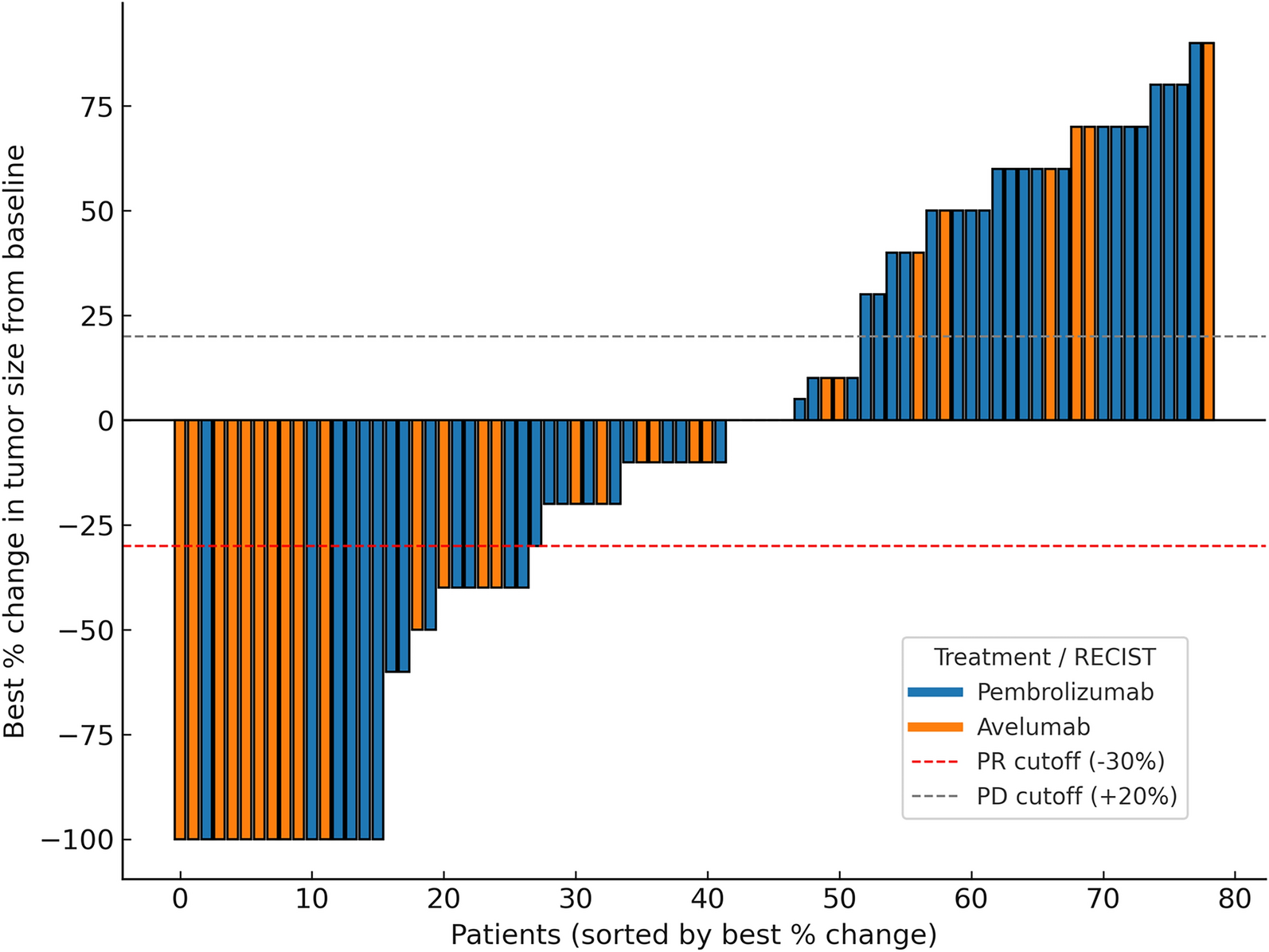
In our cohort, in the avelumab group, the DCR was 84.4% and the CR rate was 34.4%, while in the pembrolizumab group, the DCR was 55.3% and the CR rate was 12.8%, consistent with the more favourable clinical status of the former population—namely, patients who had not progressed on prior chemotherapy. However, perhaps the most impressive finding was the similarity in median PFS and OS in patients with CR and PD across both treatment groups. While disease control and partial responses differed as expected based on patient selection, the similarity in median PFS and OS in CR and PD rates raises several important biological and clinical considerations (Table 3).
First, this observation supports the hypothesis that a subset of patients with UC may be intrinsically sensitive or resistant to immune checkpoint inhibition, regardless of prior chemotherapy response [11]. In theory, patients receiving avelumab as maintenance are expected to have more indolent disease and better immune fitness, whereas those receiving pembrolizumab are often in a state of progression and potentially of immune exhaustion. This may suggest that ICI responsiveness is not strictly determined by timing of administration or disease kinetics but rather by underlying tumour biology and immune contexture [11].
Second, our findings underscore the limitations of current clinical criteria in guiding ICI use. Factors such as performance status, prior chemotherapy response and metastatic burden, while useful for treatment decisions, may not adequately predict immunotherapy benefit [12]. Instead, there is a growing consensus that molecular and immunological biomarkers—such as tumour mutational burden (TMB), PD-L1 expression, T-cell inflamed gene signatures and the composition of the tumour microenvironment—are necessary to identify true responders and avoid futile treatment in resistant individuals [13]. The clinical trials that led to the approval of avelumab and pembrolizumab did attempt to explore such biomarkers, but the results were inconclusive. In KEYNOTE-045, PD-L1 expression did not correlate strongly with benefit, while in JAVELIN Bladder 100, PD-L1 positivity was associated with better outcomes, but benefit was still observed across all subgroups [4, 5]. From a translational perspective, these findings highlight the urgent need to develop and validate predictive biomarkers for ICI responsiveness in UC [10, 14,15,16]. While ongoing studies are exploring circulating tumour DNA (ctDNA), T-cell receptor repertoire analysis and microbiome profiling, none of these tools are as yet ready for clinical implementation. Additionally, the heterogeneity of UC—across anatomical sites, histological variants and molecular subtypes—adds further complexity to biomarker discovery [8,9,10].
Although the relatively small sample size represents a limitation of our study, the real-world nature of these data provides meaningful insights into the use of avelumab and pembrolizumab after first-line chemotherapy. Such evidence complements the results of clinical trials by reflecting the outcomes of patients treated in routine clinical practice, where selection criteria and management may differ from controlled study settings. In addition, we acknowledge the relatively small sample size, which also prevented us from performing meaningful analyses of correlations between clinical parameters and treatment response. Such exploratory investigations, although potentially informative, would require larger patient cohorts to provide reliable results. Another limitation of our study is the unbalanced sex distribution, with substantially more males than females. We did not conduct sex-disaggregated efficacy analyses due to the small number of female participants, which would render such comparisons underpowered. Nonetheless, this male predominance is consistent with published epidemiologic data in advanced UC. Future studies should aim for larger and more balanced cohorts are awaited. Finally, there is a lack of disaggregated race/ethnicity data. Since all participants were of white European descent (Italian origin), our findings may not be generalisable to populations with different racial or ethnic backgrounds. Future studies should investigate whether race/ethnicity may influence the observed outcomes.

Comments (0)