In this study, we developed and validated two protein-based models using 22 proteins for EOMI risk prediction. Protein-based models substantially improved risk prediction when combined with basic model, whereas the addition of PRS resulted in little improvement in the prediction of EOMI. The combination of conventional risk factors and protein panel demonstrated the highest predictive capacity for EOMI risk. Moreover, we demonstrated that protein panel model outperformed conventional risk factors and PRS for the prediction of EOMI in adults aged 50 years or younger.
Cases of MI in young adults exhibit distinct risk factor profiles compared to those in older adults [9,10,11]. While traditional cardiovascular risk factors such as hypertension, cigarette smoking, and obesity have been shown to be more prevalent in early-onset cases [8], some nontraditional risk factors, such as substance use and high socioeconomic vulnerability, have been proposed as important contributors to early-onset cases [9, 10]. Thus, traditional methods of assessing risk factors provide a basic framework for cardiovascular risk assessment but may not be sufficiently accurate to predict early-onset cases. Additionally, the comprehensive assessment of traditional factors typically involves multimodal data collection approaches (e.g., verbal interviews, laboratory analyses, and medical record reviews) and necessitates various trained healthcare personnel. The process may also present standardization challenges due to the inherent subjectivity, representing a relatively low-efficiency approach for EOMI risk stratification.
PRS has emerged as a promising tool for assessing lifetime CVD risk [14]. By including 4 PRSs generated from 194, 46 K, 1.5 M, and 6 M SNPs along with conventional risk factors, Isgut et al. reported that highly elevated PRSs were better predictors for MI risk early in life than later [12]. However, in the current study, the addition of PRS to the basic model yielded only a 3% improvement in C-index. The suboptimal performance of PRS in the current study may be due to our use of the universal PRS for total CAD, while EOMI may have a stronger genetic predisposition than late-onset MI. On the basis of the whole-genome sequencing of 1,239 Koreans with 596 EOMI cases, a genome-wide analyses study identified distinct genomic loci associated with EOMI, which is absent in the previous PRS for CAD/MI [26]. Thus, future studies utilizing age-stratified PRS or models incorporating gene-by-age interaction terms may yield better performance for predicting early-onset cases. Evidence is also available that PRS should be combined with traditional risk factors for optimal risk discrimination [12, 14], as relying solely on genetic information may not provide sufficient accuracy. However, in the current study, the C-index was similar before and after adding the PRS to the conventional risk model (0.817 vs. 0.814).
To date, several prospective studies have examined the relationship between broad proteomic profiling and the risk of MI, but they did not consider the timing of MI events (i.e., early-onset vs. late-onset) [15, 16]. Given that EOMI is not merely a younger version of late-onset MI but a distinct entity [18, 19], it is necessary to study EOMI as a separate endpoint. Further, atherosclerosis, the underlying pathology of most MI events, is recognized to begin in early adolescence, with subclinical vascular changes detectable in young individuals long before clinical symptoms [27]. Previous evidence also revealed that a substantial group of proteins change systematically with aging [28]. In the current study, we excluded individuals older than 50 years at baseline, which is helpful for the identification of proteins that are specifically associated with the initiation and progression of atherosclerosis in its earlier stages, rather than those reflecting the cumulative burden of aging and chronic disease.
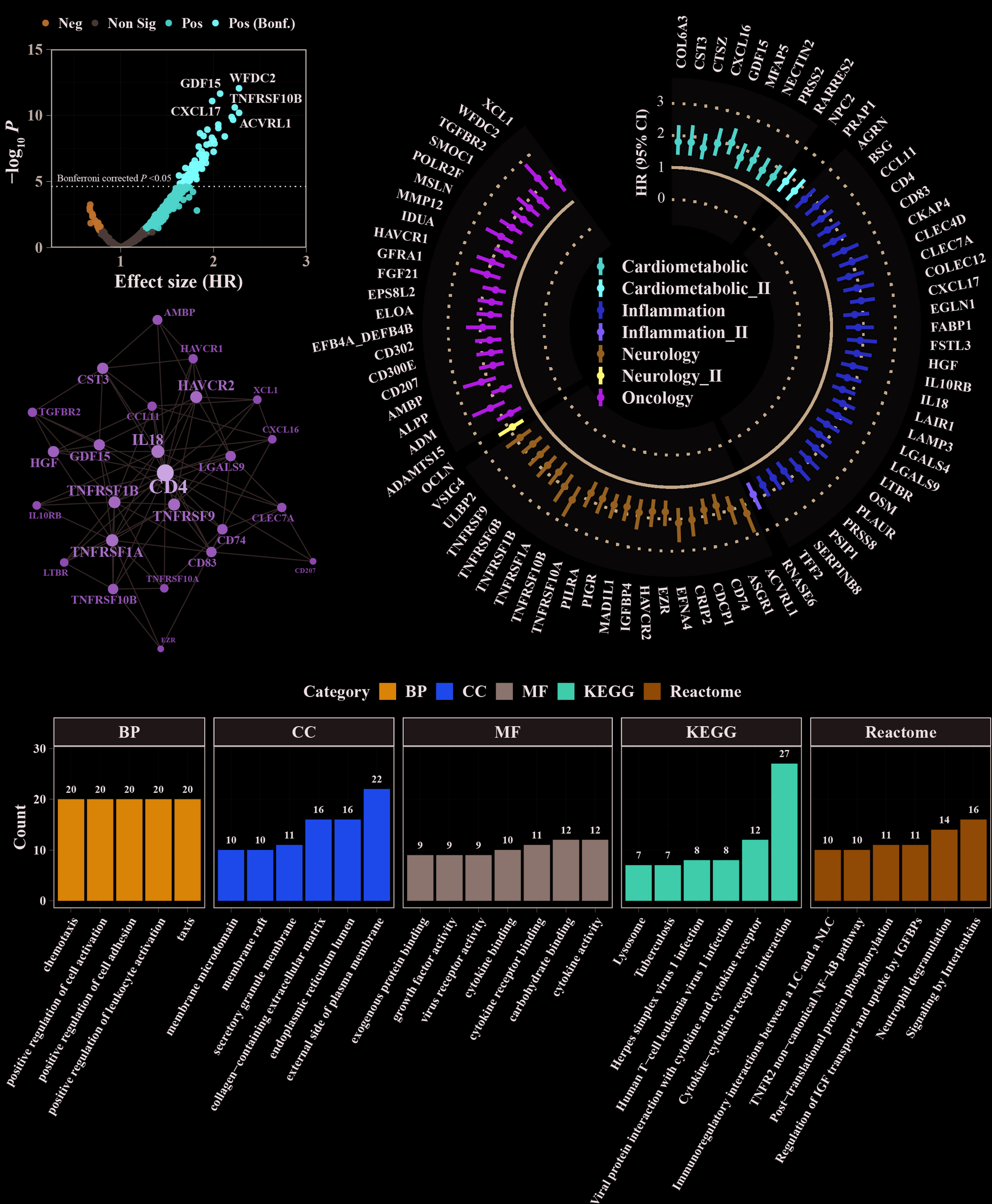
Previous studies on proteomics and lifespan MI often included a larger number of cases, providing greater statistical power to identify a broader range of proteins, potentially including those specific to EOMI. Nevertheless, this does not preclude the comparison between our and the previous findings, since the primary focus of our study was the utility of proteomics for EOMI prediction. Indeed, there are some overlaps between the 22 important proteins identified in the present study and those key proteins highlighted in previous studies using the Olink platforms [15, 29], including GDF15, MMP12, and CDCP1. Besides these proteins, our findings highlighted the important role of PRAP1 in the prediction of EOMI in adults aged 50 years or younger. The sole addition of PRAP1 to the basic model improved the C-index from 0.660 to 0.739. As a lipid-binding protein involved in lipid absorption, PRAP1 facilitates triglyceride transport through interactions with microsomal triglyceride transfer protein, influencing lipid metabolism [30]. Although evidence directly linking PRAP1 to MI is still limited, a previous in vitro study also suggested its role in maintaining vascular integrity [31].
To assess the combined power of the proteins, we developed two protein-based predictive models using the 22 LASSO-selected proteins. Interestingly, the model incorporating the unweighted protein panel demonstrated superior performance compared to the LASSO-weighted protein risk score. This may indicate that the penalization applied by LASSO, while necessary for feature selection, slightly underestimated the collective strength of the protein-outcome associations. A relatively simple model combining basic covariates (i.e., age, sex, and race/ethnicity) with the protein panel demonstrated predictive superiority, slightly surpassing the model based on conventional risk factors while maintaining a remarkable advantage over the model that included basic covariates and the PRS. The findings can be interpreted in light of the distinct nature of these biomarkers. The PRS represents a static, lifelong genetic predisposition. Conventional risk factors are clinical phenotypes that are routinely available. In contrast, the plasma proteome offers a dynamic snapshot of ongoing biological processes, integrating genetic predisposition, environmental exposures, and current subclinical pathophysiological changes leading to myocardial ischemia [32]. Some traditional risk factors like smoking may exert their deleterious effects partly by upregulating pro-inflammatory proteins (e.g., CCL11, CXCL16) and proteolytic enzymes (e.g., MMP-12), which are key drivers of plaque vulnerability and rupture [33,34,35], the most common etiology for acute MI in young adults [18]. Consequently, the proteomic signature might identify individuals with a heightened biological response to these conventional insults, thereby explaining the heterogeneity in risk among individuals with similar traditional risk factor profiles. Notably, the protein panel can provide sufficient accuracy in predicting EOMI (C-index ≈ 0.85) without requiring supplementary of conventional risk factors or PRS. Hence, protein-based models reduce reliance on complex clinical data collection, making them potentially practical for resource-limited settings.
While the absolute improvement in C-index appears modest (ΔC-index ≈ 0.05) when adding the protein panel to conventional risk factors, incremental improvements in discrimination can be clinically meaningful for risk stratification, particularly for a condition like EOMI where early intervention is critical. Meanwhile, given its excellent reclassification ability, the integration of proteomic panels into clinical practice could be more appropriate for comprehensive risk assessment when resources permit, particularly in high-risk population. Nevertheless, the practical aspects of implementing a protein-based predictive model (e.g., cost, turnaround time, and scalability) are essential considerations for real-world adoption. Our protein-based models have already represented a significant reduction from the initial 2,093 proteins to a focused panel of 22 proteins, substantially lowering the analytical burden and cost compared to the full proteomic profiling. Given that targeted assays (e.g., multiplex immunoassays) are increasingly available and cost-effective for measuring a limited number of proteins [36], future research should explore whether a further refined panel could maintain predictive performance with fewer proteins, which would advance genuine clinical translation.
Strengths of our study include the long follow-up period and the high-throughput proteomic analysis of a large, community-based sample. The exclusion of individuals over 50 years can enhance the specificity of protein identification. Additionally, we employed LASSO to select a smaller subset of proteins for predicting EOMI, and performed internal validation to minimize the risk of overfitting. Despite its merits, several limitations should be acknowledged. First, although internal validation demonstrated robust performance, the relatively low event-per-variable ratio remains a limitation, and further validation in larger external cohorts is warranted. Second, plasma proteins from the Olink platform were measured in relative (as opposed to absolute) concentrations, limiting the ability to identify a clinically relevant protein levels from these data. Finally, the participants in the current study were predominantly of White European ancestry. This significantly limits the generalizability of our findings, as the prevalence of risk factors, genetic architecture, and proteomic profiles can vary substantially across different ancestral groups. It is therefore crucial that our findings are validated in independent, multi-ethnic cohorts before any potential clinical application.


Comments (0)