
Remember me

The FDA recommends a risk-based approach for immunogenicity assessment across all therapeutic modalities, including protein therapeutics and ONTs (3, 32). While the foundational principles of this framework are consistent, ONTs exhibit unique molecular and mechanistic characteristics that necessitate tailored considerations during the risk assessment process. Specifically, GalNAc-siRNA therapeutics have several unique product-related characteristics such as chemical modifications (e.g., 2'-OMe or 2′-F), delivery vehicles (e.g., GalNAc conjugation for liver targeting), and mechanisms of action, all of which reduce immunogenicity potential. It is important to initiate the immunogenicity risk assessment early in development to guide the immunogenicity testing strategy.
GalNAc-conjugated siRNA therapeutics are designed for liver-specific targeting. The GalNAc moiety facilitates the liver delivery of siRNA molecules by binding to the asialoglycoprotein receptor (ASGPR), which is highly expressed on liver cells. This receptor-mediated uptake ensures efficient and selective delivery to the liver, therefore minimizing drug systemic exposure and reducing immunogenicity. Additionally, chemical modifications to the siRNA backbone, such as 2'-OMe or 2'-F substitutions further mitigate the risk of immunogenicity. Although immune responses to the GalNAc moiety may occur, the formation of ADA is generally low, and unlikely to affect drug uptake due to the natural origin and small size of GalNAc. To date, approved GalNAc-siRNA therapies have not shown clinically significant innate immune activation, and clinical experience indicates low ADA incidence rates (≤ 6%), with no observed impact on PK, PD, efficacy and/or safety. Consequently, the immunogenicity risk of GalNAc-siRNA therapeutics is considered low. However, standard safety monitoring such as liver function test should be included in the study design.
This low-risk profile is also likely to be observed across other small-molecule-conjugated siRNA therapeutics. For example, C16-conjugated siRNA employs palmitate, a natural occurring fatty acid, to enhance siRNA lipophilicity, improving pharmacokinetics and tissue distribution. The immunogenicity risk of C16 conjugation is generally low, because palmitate is a ubiquitously present fatty acid in the body and also because C16-siRNA is often administered intrathecally for CNS targeting into an immune-privileged environment (25). Emerging data consistently shows that simple chemically conjugated siRNA therapeutics exhibit low immunogenicity across various delivery platforms. However, this favorable immunogenicity profile may not necessarily extend to larger, more complex conjugates, such as those involving protein or peptide conjugation. Therefore, immunogenicity risk assessment must remain molecule-specific, taking into account the molecular properties, delivery platform, and route of administration.
A Proposal for Streamlined Immunogenicity AssessmentFor GalNAc- or lipid-conjugated siRNA therapeutics, which are anticipated to have a low risk of immunogenicity, manuscript advocates adopting a “collect and hold” immunogenicity assessment strategy during early clinical trials and potentially throughout the drug development process, This approach involves collecting ADA samples at designated timepoints and banking them for retrospective testing if evidence emerges of altered PK, PD, or immune-mediated adverse events, which aligns with the FDA 2024 guidance (3). The development of Neutralizing antibody (NAb) assay is generally not relevant for GalNAc-siRNA immunogenicity assessment, and this perspective may also extend to other ONTs. In the context of ONTs, circulating NAbs may potentially interfere with binding to cell surface receptor and internalization into endosomes. However, in the low pH endosomal environment, any internalized ADA is unlikely to remain bound and therefore should not affect endosomal escape or downstream intracellular drug activity. The delivery vehicles, such as GalNAc or lipids, are of natural origin and exhibit low immunogenic potential, so the impact on drug delivery is low. Moreover, PK and PD data, which are routinely collected, can provide valuable insights into potential neutralizing activities, offering an efficient and robust alternative to direct NAb testing.
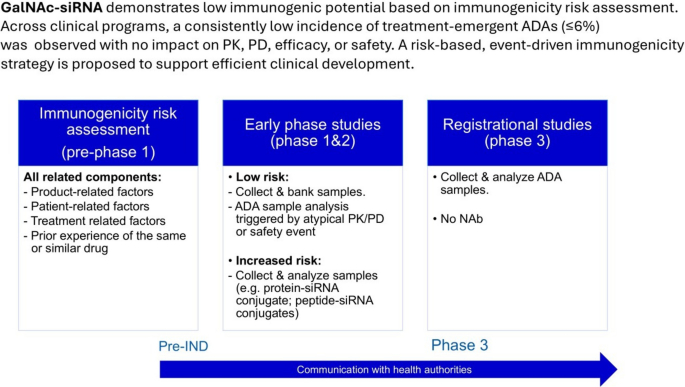
Early engagement with regulatory agencies is essential to ensure alignment on immunogenicity risk assessment and the proposed testing strategy. This is particularly important for novel therapeutics like ONTs, where regulatory expectations may be less established compared to traditional protein-based therapies (Fig. 3).
Fig. 3 The alternative text for this image may have been generated using AI.
The summary of immunogenicity assessment strategy for siRNA therapeutics. The strategy involves initiating immunogenicity risk assessment early in the program development cycle, with ongoing updates as new data becomes available. For low-risk molecules, such as GalNAc- or lipid-conjugated siRNA, ADA samples can be collected at predefined timepoints during early-phase studies and banked for retrospective testing. This testing would be triggered only if evidence of altered PK, (PD), or immune-mediated adverse events are observed. Early and transparent communication with regulatory authorities regarding the immunogenicity assessment strategy is essential to ensure alignment and clarity
Immunogenicity of Single Stranded ONTsWhile GalNAc- or lipid-conjugated siRNA therapeutics generally exhibit low incidence of ADA formation, antisense oligonucleotides (ASOs) often show higher rates. Several approved ASOs have demonstrated notable ADA incidences, including mipomersen (38% in 6 month phase 3 trails and 72% in open-label extension trial, approved in 2013) (48), inotersen (30%, 2018) (49), volanesorsen (30%, 2019) (50), tofersen (58.4%, 2023) (51), eplontersen (37%, 2023) (52), and olezarsen (42%, 2024) (53). This difference may be attributed to structural nature of the ASOs. ASOs are single-stranded oligonucleotides which make them more prone to interacting with PRRs, increasing immunogenic potential compared to the double-stranded siRNA. In addition, some ASOs included DNA-bases (e.g., mipomersen, inotersen), which inherently more immunogenic than RNA as extracellular or cytoplasmic DNA is often associated with infection or cellular damage, signaling potential threats to the immune system (54). Furthermore, single stranded oligos require high phosphorothioate content to confer metabolic stability, which can introduce risk of increased TLR-mediated proinflammatory response (55). While some ASOs may be quite immunogenic (e.g. ADA incidence up to 72%), the overall impact on clinical efficacy and safety is generally limited. The presence of ADAs has been associated with altered plasma PK by reducing drug clearance for certain programs, such as tofersen, olezarsen. Notably, no discernible effects on drug efficacy or safety in target organs were observed, as plasma is not the primary site of action for ASOs.
Several approved ONTs including casimersen (56), defibrotide (57), eteplirsen (58), and golodirsen (59), have been subjected to post-marketing requirements (PMRs) from regulatory agencies. These PMRs typically mandate the development and application of binding and neutralizing antibody assays on patient samples from pivotal clinical trials. While siRNA therapeutics have not yet received similar PMRs, this does not diminish the overall risk. This highlights the importance of conducting immunogenicity risk assessments early in the clinical development process to address regulatory expectations and ensure patient safety.
Comments (0)