Curriculum IntegrationEmbedding Research Training into Residency Programs
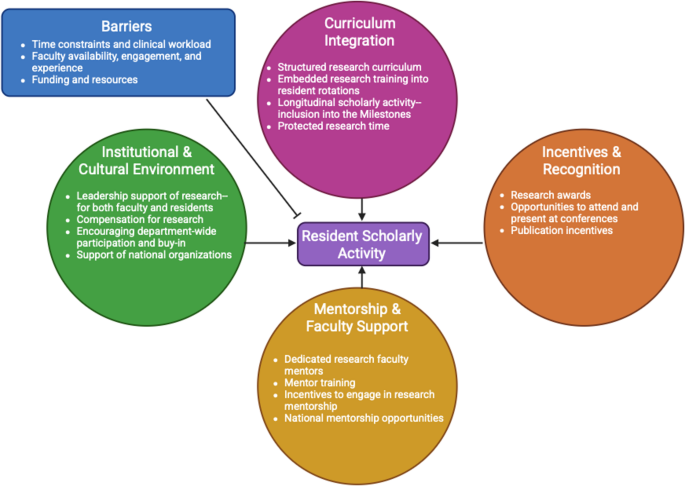
One of the most critical components for promoting resident engagement in research is actively embedding research training into the residency program. As discussed above, residents are increasing reluctant to pursue additional years of training, therefore, we cannot rely on dedicated research years during residency or even fellowship for research experience as we once did. Therefore, programs must find innovative and creative ways to integrate research into the traditional 5-year urology curriculum without compromising core clinical training or adding excessive work outside of clinical time which may contribute to burnout. While this may seem challenging, it is feasible and important.
One possible approach is the development of a longitudinal research curriculum. Rather than adding extra years to training, programs can consider implementing structured research education which spans the entirety of training. This might include incorporating research seminars, biostatistics classes, and lessons in peer review into existing didactic schedules. Additionally, journal clubs can serve as a platform to teach crucial skills in critical appraisal of the literature [6].
In other medical specialties, this has been done well. Numerous publications suggest that a formal research curriculum increases resident scholarly productivity [18]. In emergency medicine, implementing a formal longitudinal research program with milestones throughout training lead to higher publication rates, more presentations, and increase in first-author manuscripts by the end of training [19]. This program included a didactic curriculum, specific benchmarks, research funding, statistical support, and a dedicated research coordinator. While a program this comprehensive may be cost-prohibitive for many departments, adopting some key elements—including structured timelines, integrated teaching, and mentorship models—could be used to substantially enhance research engagement. Making research part of the schedule and not an afterthought is key.
Finally, to enhance accountability and standardization, it is worth considering whether research could be formally integrated into the Milestones and be linked to resident promotion throughout training. Although the ACGME requires that residents must participate in scholarly activity, current urology Milestones do not specify research-related benchmarks linked to resident promotion. Linking advancement to tangible research output is one way to encourage consistent engagement and skill development—such as requiring proposal submission, data collection, presentations at conferences, and/or manuscript submission by certain levels of training.
Protected Research Time
Protected time to conduct research is critical for fostering residency scholarly activity. While full research years significantly increase productivity, even limited protected time embedded within existing rotations or clinical schedules has the potential to substantially improve research engagement and output. In Lee et al.’s study of 36 urology programs, the authors were able to categorize duration of research experience into 3–4 months, 6 months, and 12 months effectively demonstrating a significant dose-response with increasing productivity given more time and confirming that even incremental change can make a difference [12].
Programs should plan rotation schedules with research in mind. Chhor et al. described this in radiology residency, implementing one half-day of research per week as part of existing rotations [20]. Authors demonstrated this lead to a 14% increase in abstract presentations as well as an impressive 67% increase in publications and 275% increase in textbook chapters. The increase in conference presentations was more subtle, perhaps because that was a more attainable goal prior to the addition of this designated time. However, authors note that apart from a pure numeric increase, research engagement in this longitudinal fashion resulted in deeper engagement and more robust academic output in the form of first author publications and book chapters. These findings align with other literature as well. For example, a 2025 study across multiple specialties found that residents may seek out systematic review and observational studies, traditionally considered to be of lower academical rigor but more reasonable goals in truncated timeframes [21].
Rather than expecting residents to complete research during nights or weekends—an approach that risks burnout and limits resident buy-in—programs should integrate research time into the clinical schedule. Although a short block alone may not allow completion of a major research project, we do not need to expect urology residents to run clinical trials or do strictly bench research to have a meaningful research experience in training. When combined with a longitudinal curriculum, these intervals can propel projects towards deepened engagement and productivity. Finally, it is ultimately up to the faculty educators and program leadership to advocate for this integration; without deliberate design of training programs and advocating for protected time, expectations for resident scholarly productivity are unrealistic.
Mentorship and Faculty Support
Adequate faculty mentorship is essential for resident research success. Programs must have faculty who are activity engaged in research themselves, possess relevant expertise, and are available and willing to provide guidance to trainees. Beyond its role in reducing burnout, improving career satisfaction, and supporting diversity, mentorship can directly influence research productivity [22]. Faculty mentorship for research is a critical component for identification of research opportunities, research productivity, and cultivating future interest in pursuing academic careers. However, barriers to this also exist. One recent study of practicing urologists to assess the factors or barriers that encourage or limit faculty research mentorship, 20% reported never being a research mentor, with lack of sufficient time and lack of institutional support limiting faculty’s ability to provide research mentorship to residents [23]. Departments can help mitigate these challenges by incentivizing mentorship to residents—whether through RVU compensation, bonus pay, or compensating or protecting time for research mentorship. Likewise, departments may consider providing mentorship training to faculty to encourage effective mentor-mentee relationships. Finally, having a faculty point person, a research director, can also be effective. Having one person to help oversee all resident productivity can help keep everyone on track.
For programs who do not have faculty who are experienced in research available and/or willing to provide mentorship, there are numerous multi-institutional efforts in urology to help foster mentorship relationships across institutions. These include UnderRepresented Trainees Entering Residency (UReTER) program, societal mentorship programs through Society of Women in Urology (SWIU) and the R. Frank Jones Urological Society, and efforts through the AUA via leadership and mentorship programs. If inadequate support for research exists, program leadership should aim to connect residents with external research mentors.
Incentives and Recognition
The benefits of engaging in research can be less tangible than other aspects of residency training. For example, in surgical skills acquisition the progress may be immediately visible—by doing more challenging cases and gaining increased autonomy. The benefits of research, however, are often more abstract and delayed, without immediate gratification felt in the same way.
Even with time, curriculum, and mentorship in place, incentives can be an effective measure to increase resident research engagement. Monetary rewards for publications have been shown to increase productivity [24]. Other incentives can also be considered to provide tangible motivation—departmental funding for conference travel, academic awards, rewards, or time off. Therefore, offering an immediate recognition and rewards can bridge this gap and sustain resident commitment to scholarly activity.
Institutional and Cultural Environment
Finally, a strong institutional and departmental culture of fostering innovation and inquiry is essential. Departmental leadership must prioritize research as a core component of training, not an optional endeavor. Faculty—whether active in research themselves or not—should support the department’s initiatives that allow residents protected time for scholarly work. National organizations in urology, such as the AUA and the Society of Academic Urologists (SAU) promote research during training, offer mentorship and leadership opportunities, and promote funding for trainees; however, it is important for residents to see these same values reinforced at the local leadership level. As discussed above, integrating a research curriculum into departmental didactics is an excellent way to involve all faculty in the department in scholarly initiatives, and help promote a culture of inquiry and innovation. Holding research forums to highlight the research being conducted within the department or having a departmental poster contest after residents present at national meetings can all help to highlight resident research initiatives and create a positive culture around research.


Comments (0)