van Geen, F.-J., van de Wetering, E. H. M., Nieuwhof-Leppink, A. J., Klijn, A. J. & de Kort, L. M. O. Dysfunctional voiding: exploring disease transition from childhood to adulthood. Urology 177, 60–64 (2023).
Article
PubMed
Google Scholar
Matta, R. et al. Healthcare utilization during transition to adult care in patients with spina bifida. Can. Urol. Assoc. J. 17, 191–198 (2023).
Article
PubMed
PubMed Central
Google Scholar
Kovell, R. C., Skokan, A. J. & Wood, D. N. Transitional urology. Urol. Clin. North. Am. 45, 601–610 (2018).
Article
PubMed
Google Scholar
Colver, A. et al. How well do services for young people with long term conditions deliver features proposed to improve transition? BMC Health Serv. Res. 18, 337 (2018).
Article
CAS
PubMed
PubMed Central
Google Scholar
Coyne, B., Hallowell, S. C. & Thompson, M. Measurable outcomes after transfer from pediatric to adult providers in youth with chronic illness. J. Adolesc. Health 60, 3–16 (2017).
Article
PubMed
Google Scholar
Liu, J. S., Greiman, A., Casey, J. T., Mukherjee, S. & Kielb, S. J. A snapshot of the adult spina bifida patient — high incidence of urologic procedures. Cent. European J. Urol. 69, 72–77 (2016).
PubMed
PubMed Central
Google Scholar
Routh, J. C. et al. Bladder reconstruction rates differ among centers participating in national spina bifida patient registry. J. Urol. 199, 268–273 (2018).
Article
PubMed
Google Scholar
Corbett, H. J. et al. A consensus process to identify research priorities in paediatric urology in the United Kingdom. J. Pediatr. Urol. 20, 240.e1–240.e8 (2024).
Article
PubMed
Google Scholar
Zillioux, J. M., Jackson, J. N., Herndon, C. D. A., Corbett, S. T. & Kern, N. G. Caring for urologic transition patients: current practice patterns and opinions. J. Pediatr. Urol. 14, 242.e1–242.e5 (2018).
Article
CAS
PubMed
Google Scholar
Moran, G. W., Kurtzman, J. T., Badalato, G. M., Joice, G. A. & Carpenter, C. P. National trends in transitional urology clinics at academic centers in the United States. Urol. Pract. 10, 534–536 (2023).
Article
PubMed
Google Scholar
Agrawal, S., Slocombe, K., Wilson, T., Kielb, S. & Wood, H. M. Urologic provider experiences in transitioning spina bifida patients from pediatric to adult care. World J. Urol. 37, 607–611 (2019).
Article
PubMed
Google Scholar
Oxford English Dictionary. Transition. OED https://www.oed.com/dictionary/transition_n (2026).
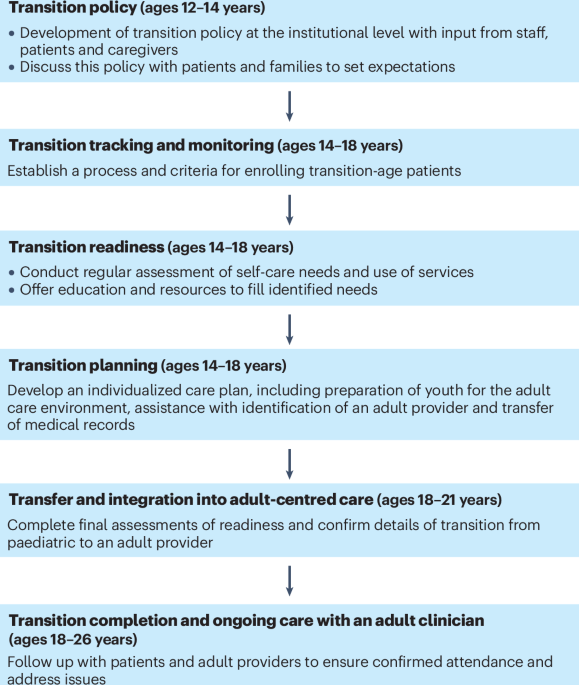
Got Transition. Six core elements of transition. Got Transition https://www.gottransition.org/six-core-elements (2014).
Ginsberg, D. A. et al. The AUA/SUFU guideline on adult neurogenic lower urinary tract dysfunction: diagnosis and evaluation. J. Urol. 206, 1097–1105 (2021).
Article
PubMed
Google Scholar
Bert, F. et al. Transitional care: a new model of care from young age to adulthood. Health Policy 124, 1121–1128 (2020).
Article
PubMed
Google Scholar
Hettel, D., Tran, C., Szymanski, K., Misseri, R. & Wood, H. Lost in transition: patient-identified barriers to adult urological spina bifida care. J. Pediatr. Urol. 14, 535.e1–535.e4 (2018).
Article
PubMed
Google Scholar
Szymanski, K. M., Cain, M. P., Hardacker, T. J. & Misseri, R. How successful is the transition to adult urology care in spina bifida? A single center 7-year experience. J. Pediatr. Urol. 13, 40.e1–40.e6 (2017).
Article
PubMed
Google Scholar
Summers, S. J. et al. Urologic problems in spina bifida patients transitioning to adult care. Urology 84, 440–444 (2014).
Article
PubMed
Google Scholar
Wajchendler, A., Anderson, P. & Koyle, M. A. The transition process of spina bifida patients to adult-centred care: an assessment of the Canadian urology landscape. Can. Urol. Assoc. J. 11, S88–S91 (2017).
Article
PubMed
PubMed Central
Google Scholar
Hwang, C. K., Harris, K. T. & Wood, D. Barriers to transitional care in spina bifida. Urol. Clin. North. Am. 51, 187–196 (2024).
Article
PubMed
Google Scholar
Showalter, V. C., Salazar, A. C., Wilson, J. M. & Ming, J. M. Pediatric urology patient transition to adulthood: brief report on the barriers and shortcomings in a resource poor state. Health Care Transit. 2, 100062 (2024).
Article
PubMed
PubMed Central
Google Scholar
Stein, R. et al. EAU/ESPU guidelines on the management of neurogenic bladder in children and adolescent part I diagnostics and conservative treatment. Neurourol. Urodyn. 39, 45–57 (2020).
Article
PubMed
Google Scholar
International Children’s Continence Society. Paediatric Continence Care. ICCS https://i-c-c-s.org/e-learning (2025).
Skott, M. et al. Summary of the European Association of Urology/European Society of Paediatric Urology guidelines on transition in urology. J. Pediatr. Urol. 22, 105632 (2026).
Article
PubMed
Google Scholar
National Institute for Health and Care Excellence. Transition from children’s to adults’ services for young people using health or social care services. NICE https://www.nice.org.uk/guidance/ng43/chapter/recommendations (2016).
Cooley, W. C. & Sagerman, P. J. Supporting the health care transition from adolescence to adulthood in the medical home. Pediatrics 128, 182–200 (2011).
Article
PubMed
Google Scholar
Bower, W. F. et al. The transition of young adults with lifelong urological needs from pediatric to adult services: an international children’s continence society position statement. Neurourol. Urodyn. 36, 811–819 (2017).
Article
PubMed
Google Scholar
Leva, N. V., Copp, H. L., Quanstrom, K. & Hampson, L. A. Demographics and baseline care among newly transitioning adult congenital urology patients. J. Pediatr. Urol. 16, 476.e1–476.e6 (2020).
Article
PubMed
PubMed Central
Google Scholar
International Children’s Continence Society. E-Learning modules. ICCS https://i-c-c-s.org/e-learning (2022).
White P. H. et al. Supporting the health care transition from adolescence to adulthood in the medical home. Pediatrics 143, e20183610 (2019).
Google Scholar
Joseph, D. B. et al. Urologic guidelines for the care and management of people with spina bifida. J. Pediatr. Rehabil. Med. 13, 479–489 (2020).
PubMed
PubMed Central
Google Scholar
Stephany, H. A. et al. Transition of urologic patients from pediatric to adult care: a preliminary assessment of readiness in spina bifida patients. Urology 85, 959–963 (2015).
Article
PubMed
Google Scholar
Lai, L. Y. et al. Access and utilization of health care by adults with spina bifida. Urology 181, 174–181 (2023).
Article
PubMed
PubMed Central
Google Scholar
Holmbeck, G. N., Kritikos, T. K., Stern, A., Ridosh, M. & Friedman, C. V. The transition to adult health care in youth with spina bifida: theory, measurement, and interventions. J. Nurs. Scholarsh. 53, 198–207 (2021).
Article
PubMed
PubMed Central
Google Scholar
Roth, J. D., Szymanski, K. M., Ferguson, E. J., Cain, M. P. & Misseri, R. Transitioning young adults with neurogenic bladder — are providers asking too much? J. Pediatr. Urol. 15, 384.e1–384.e6 (2019).
Article
CAS
PubMed
Google Scholar
Betz, C. L. & Coyne, I. T. (eds) Transition from Pediatric to Adult Healthcare Services for Adolescents and Young Adults with Long-Term Conditions (Springer, 2020).
Wood, D. L. et al. The Transition Readiness Assessment Questionnaire (TRAQ): its factor structure, reliability, and validity. Acad. Pediatr. 14, 415–422 (2014).
Article
PubMed
Google Scholar
Zhang, L. F., Ho, J. S. & Kennedy, S. E. A systematic review of the psychometric properties of transition readiness assessment tools in adolescents with chronic disease. BMC Pediatr. 14, 4 (2014).
Article
PubMed
PubMed Central
Google Scholar
Wood, D., Rocque, B., Hopson, B., Barnes, K. & Johnson, K. R. Transition Readiness Assessment Questionnaire Spina Bifida (TRAQ-SB) specific module and its association with clinical outcomes among youth and young adults with spina bifida. J. Pediatr. Rehabil. Med. 12, 405–413 (2019).
PubMed
Google Scholar
Rague, J.


Comments (0)