Kirkwood, T. B. L. Evolution of ageing. Mech. Ageing Dev. 123, 737–745 (2002).
Article
PubMed
Google Scholar
Hamilton, W. D. The moulding of senescence by natural selection. J. Theor. Biol. 12, 12–45 (1966). This paper derived the formal mathematical expressions for the age-dependent decline of natural selection on survival and fertility, providing the quantitative foundation for evolutionary theories of ageing.
Article
CAS
PubMed
Google Scholar
Charlesworth, B. Evolution of Age-Structured Populations (Cambridge Univ. Press, 1980). This book provides a population-genetic treatment of age-structured selection and remains the canonical mathematical reference for the evolutionary genetics of ageing.
Flatt, T. & Partridge, L. Horizons in the evolution of aging. BMC Biol. 16, 93 (2018).
Article
PubMed
PubMed Central
Google Scholar
Partridge, L. & Gems, D. Mechanisms of ageing: public or private? Nat. Rev. Genet. 3, 165–175 (2002). This article frames ageing mechanisms as ‘public’ (conserved) versus ‘private’ (lineage-specific), arguing that although ageing itself is not a programmed process, its rate modulators — notably insulin/IGF-1 signalling and nutrient-sensing — are strikingly public.
Article
CAS
PubMed
Google Scholar
Rechsteiner, C., Morandini, F., Kim, S. J., Seluanov, A. & Gorbunova, V. Unlocking longevity through the comparative biology of aging. Nat. Aging 5, 1686–1703 (2025).
Article
PubMed
Google Scholar
Gurven, M., Kaplan, H. & Supa, A. Z. Mortality experience of Tsimane Amerindians of Bolivia: regional variation and temporal trends. Am. J. Hum. Biol. 19, 376–398 (2007).
Article
PubMed
Google Scholar
Burger, O., Baudisch, A. & Vaupel, J. W. Human mortality improvement in evolutionary context. Proc. Natl Acad. Sci. USA 109, 18210–18214 (2012).
Article
CAS
PubMed
PubMed Central
Google Scholar
Benton, M. L. et al. The influence of evolutionary history on human health and disease. Nat. Rev. Genet. 22, 269–283 (2021).
Article
CAS
PubMed
PubMed Central
Google Scholar
Campisi, J. et al. From discoveries in ageing research to therapeutics for healthy ageing. Nature 571, 183–192 (2019).
Article
CAS
PubMed
PubMed Central
Google Scholar
Partridge, L. The new biology of ageing. Phil. Trans. R. Soc. Lond. B 365, 147–154 (2010).
Article
Google Scholar
Fisher, R. A. The Genetical Theory of Natural Selection (Clarendon Press, 1930).
Medawar, P. B. Unsolved problem of biology. Med. J. Aust. 1, 854–855 (1953). This paper articulates the mutation accumulation hypothesis — that late-acting deleterious alleles escape purifying selection — as one of the two foundational evolutionary explanations for why ageing evolves.
Article
Google Scholar
Williams, G. C. Pleiotropy, natural selection, and the evolution of senescence. Evolution 11, 398–411 (1957). This publication proposes the antagonistic pleiotropy theory, in which alleles with early-life benefits and late-life costs are maintained by selection, providing the evolutionary rationale for ageing-related trade-offs.
Article
Google Scholar
Austad, S. N. & Hoffman, J. M. Is antagonistic pleiotropy ubiquitous in aging biology? Evol. Med. Public Health 2018, 287–294 (2018).
Article
PubMed
PubMed Central
Google Scholar
Long, E. & Zhang, J. Evidence for the role of selection for reproductively advantageous alleles in human aging. Sci. Adv. 9, eadh4990 (2023).
Article
PubMed
PubMed Central
Google Scholar
Xiang, Y. et al. Early menarche and childbirth accelerate aging-related outcomes and age-related diseases: evidence for antagonistic pleiotropy in humans. eLife 13, RP102447 (2025).
Article
PubMed
PubMed Central
Google Scholar
Li, S., Vazquez, J. M. & Sudmant, P. H. The evolution of aging and lifespan. Trends Genet. 39, 830–843 (2023).
Article
CAS
PubMed
PubMed Central
Google Scholar
Yu, Z. et al. Comparative analyses of aging-related genes in long-lived mammals provide insights into natural longevity. Innovation 2, 100108 (2021).
CAS
PubMed
PubMed Central
Google Scholar
Kenyon, C. J. The genetics of ageing. Nature 464, 504–512 (2010).
Article
CAS
PubMed
Google Scholar
Farré, X. et al. Comparative analysis of mammal genomes unveils key genomic variability for human life span. Mol. Biol. Evol. 38, 4948–4961 (2021).
Article
PubMed
PubMed Central
Google Scholar
Dato, S., Crocco, P., Rambaldi Migliore, N. & Lescai, F. Omics in a digital world: the role of bioinformatics in providing new insights into human aging. Front. Genet. 12, 689824 (2021).
Article
CAS
PubMed
PubMed Central
Google Scholar
Lemaître, J.-F., Moorad, J., Gaillard, J.-M., Maklakov, A. A. & Nussey, D. H. A unified framework for evolutionary genetic and physiological theories of aging. PLoS Biol. 22, e3002513 (2024).
Article
PubMed
PubMed Central
Google Scholar
Franck, M. et al. Nonuniversality of inflammaging across human populations. Nat. Aging 5, 1471–1480 (2025).
Article
CAS
PubMed
Google Scholar
Byars, S. G. & Voskarides, K. Genes that improved fitness also cost modern humans: evidence for genes with antagonistic effects on longevity and disease. Evol. Med. Public Health 2019, 4–6 (2019).
Article
PubMed
PubMed Central
Google Scholar
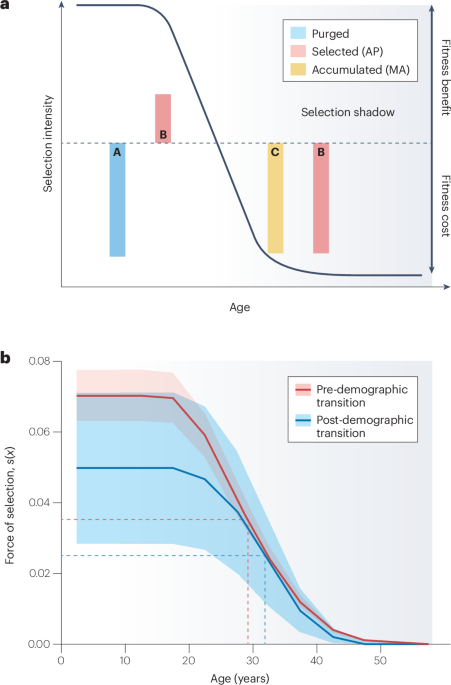
Dönertaş, H. M. & Partridge, L. The evolution of human ageing under the shadow of demographic transition. Preprint at bioRxiv https://doi.org/10.64898/2025.12.03.691940 (2025).
Vaupel, J. W. Biodemography of human ageing. Nature 464, 536–542 (2010).
Article
CAS
PubMed
PubMed Central
Google Scholar
Partridge, L. & Barton, N. H. Optimality, mutation and the evolution of ageing. Nature 362, 305–311 (1993).
Article
CAS
PubMed
Google Scholar
Sgrò, C. M. & Partridge, L. A delayed wave of death from reproduction in Drosophila. Science 286, 2521–2524 (1999).
Article
PubMed
Google Scholar
Anderson, J. L., Reynolds, R. M., Morran, L. T., Tolman-Thompson, J. & Phillips, P. C. Experimental evolution reveals antagonistic pleiotropy in reproductive timing but not life span in Caenorhabditis elegans. J. Gerontol. A 66, 1300–1308 (2011).
Article
Google Scholar
Zwaan, B., Bijlsma, R. & Hoekstra, R. F. Direct selection on life span in Drosophila melanogaster. Evolution 49, 649–659 (1995).
Article
PubMed
Google Scholar
Dönertaş, H. M., Fabian, D. K., Valenzuela, M. F., Partridge, L. & Thornton, J. M. Common genetic associations between age-related diseases. Nat. Aging 1, 400–412 (2021).
Article
PubMed
PubMed Central
Google Scholar
Rodríguez, J. A. et al. Antagonistic pleiotropy and mutation accumulation influence human senescence and disease. Nat. Ecol. Evol. 1, 55 (2017). This study tests the predictions of mutation accumulation and antagonistic pleiotropy using human GWAS data on age-stratified diseases, finding higher risk-allele frequencies for late-onset diseases and an excess of antagonistically pleiotropic variants.
Article
PubMed
Google Scholar
Brigos-Barril, E. et al. Why do we get sick? Genetic evidence for evolutionary trade-offs between fertility, longevity, and disease. Preprint at medRxiv https://doi.org/10.1101/2025.06.18.25329754 (2025).
Charlesworth, B. & Hughes, K. A. Age-specific inbreeding depression and components of genetic variance in relation to the evolution of senescence. Proc. Natl Acad. Sci. USA 93, 6140–6145 (1996).
Article
CAS
PubMed
PubMed Central
Google Scholar
Swindell, W. R. & Bouzat, J. L. Inbreeding depression and male survivorship in Drosophila: implications for senescence theory. Genetics 172, 317–327 (2006).
Article
CAS
PubMed
Goog

Comments (0)