Chien, Y. H., Meyer, C. & Bonneville, M. γδ T cells: first line of defense and beyond. Annu. Rev. Immunol. 32, 121–155 (2014).
Article
CAS
PubMed
Google Scholar
Pellicci, D. G., Koay, H. F. & Berzins, S. P. Thymic development of unconventional T cells: how NKT cells, MAIT cells and γδ T cells emerge. Nat. Rev. Immunol. 20, 756–770 (2020).
Article
CAS
PubMed
Google Scholar
Lee, S. W., Park, H. J., Van Kaer, L. & Hong, S. Role of CD1d and iNKT cells in regulating intestinal inflammation. Front. Immunol. 14, 1343718 (2024).
Article
PubMed
PubMed Central
Google Scholar
Wu, Z., Chen, X., Han, F. & Leeansyah, E. MAIT cell homing in intestinal homeostasis and inflammation. Sci. Adv. 11, eadu4172 (2025).
Article
CAS
PubMed
PubMed Central
Google Scholar
Beringer, D. X. et al. Disrupting the balance between activating and inhibitory receptors of γδT cells for effective cancer immunotherapy. Nat. Rev. Cancer 25, 590–612 (2025).
Article
CAS
PubMed
Google Scholar
Ribot, J. C., Lopes, N. & Silva-Santos, B. γδ T cells in tissue physiology and surveillance. Nat. Rev. Immunol. 21, 221–232 (2021).
Article
CAS
PubMed
Google Scholar
Jameson, J. et al. A role for skin gammadelta T cells in wound repair. Science 296, 747–749 (2002).
Article
CAS
PubMed
Google Scholar
Nielsen, M. M., Witherden, D. A. & Havran, W. L. γδ T cells in homeostasis and host defence of epithelial barrier tissues. Nat. Rev. Immunol. 17, 733–745 (2017).
Article
CAS
PubMed
PubMed Central
Google Scholar
Bonneville, M., O’Brien, R. L. & Born, W. K. γδ T cell effector functions: a blend of innate programming and acquired plasticity. Nat. Rev. Immunol. 10, 467–478 (2010).
Article
CAS
PubMed
Google Scholar
Hu, Y. et al. γδ T cells: origin and fate, subsets, diseases and immunotherapy. Signal Transduct. Target. Ther. 8, 434 (2023).
Article
CAS
PubMed
PubMed Central
Google Scholar
Parker, C. M. et al. Evidence for extrathymic changes in the T cell receptor gamma/delta repertoire. J. Exp. Med. 171, 1597–1612 (1990).
Article
CAS
PubMed
PubMed Central
Google Scholar
Wesch, D., Hinz, T. & Kabelitz, D. Analysis of the TCR Vgamma repertoire in healthy donors and HIV-1-infected individuals. Int. Immunol. 10, 1067–1075 (1998).
Article
CAS
PubMed
Google Scholar
Perriman, L. et al. A three-stage developmental pathway for human Vγ9Vδ2 T cells within the postnatal thymus. Sci. Immunol. 8, eabo4365 (2023).
Article
CAS
PubMed
Google Scholar
Deusch, K. et al. A major fraction of human intraepithelial lymphocytes simultaneously expresses the γ/δ T cell receptor, the CD8 accessory molecule and preferentially uses the Vδ1 gene segment. Eur. J. Immunol. 121, 1053–1059 (1991).
Article
Google Scholar
Kenna, T. et al. Distinct subpopulations of γδ T cells are present in normal and tumor-bearing human liver. Clin. Immunol. 113, 56–63 (2004).
Article
CAS
PubMed
Google Scholar
Gray, J. I. et al. Human γδ T cells in diverse tissues exhibit site-specific maturation dynamics across the life span. Sci. Immunol. 9, eadn3954 (2024).
Article
CAS
PubMed
PubMed Central
Google Scholar
Kierkels, G. J. J. et al. Identification of a tumor-specific allo-HLA-restricted γδTCR. Blood Adv. 3, 2870–2882 (2019).
Article
CAS
PubMed
PubMed Central
Google Scholar
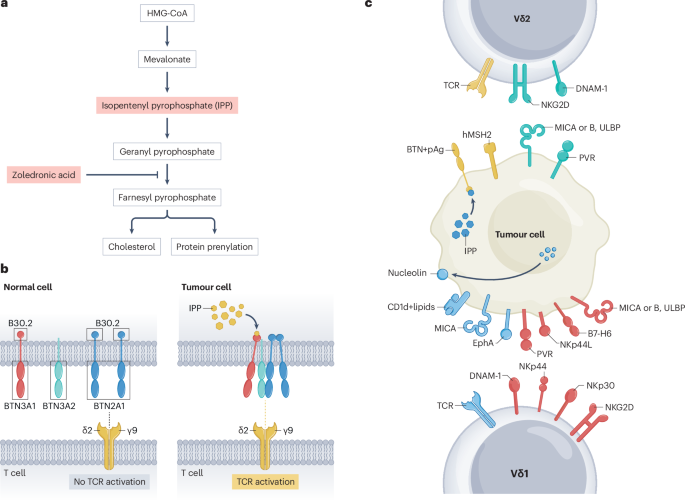
Harly, C. et al. Key implication of CD277/butyrophilin-3 (BTN3A) in cellular stress sensing by a major human γδ T-cell subset. Blood 120, 2269–2279 (2012).
Article
CAS
PubMed
PubMed Central
Google Scholar
Herrmann, T. & Karunakaran, M. M. Phosphoantigen recognition by Vγ9Vδ2 T cells. Eur. J. Immunol. 54, e2451068 (2024).
Article
PubMed
Google Scholar
Gruenbacher, G. & Thurnher, M. Mevalonate metabolism in immuno-oncology. Front. Immunol. 8, 1714 (2017).
Article
PubMed
PubMed Central
Google Scholar
Roelofs, A. J. et al. Peripheral blood monocytes are responsible for γδ T cell activation induced by zoledronic acid through accumulation of IPP/DMAPP. Br. J. Haematol. 144, 245–250 (2009).
Article
PubMed
Google Scholar
Hintz, M. et al. Identification of (E)-4-hydroxy-3-methyl-but-2-enyl pyrophosphate as a major activator for human gammadelta T cells in Escherichia coli. FEBS Lett. 509, 317–322 (2001).
Article
CAS
PubMed
Google Scholar
Sandstrom, A. et al. The intracellular B30.2 domain of butyrophilin 3A1 binds phosphoantigens to mediate activation of human Vγ9Vδ2 T cells. Immunity 40, 490–500 (2014).
Article
CAS
PubMed
PubMed Central
Google Scholar
Yuan, L. et al. Phosphoantigens glue butyrophilin 3A1 and 2A1 to activate Vγ9Vδ2 T cells. Nature 621, 840–848 (2023).
Article
CAS
PubMed
PubMed Central
Google Scholar
Gu, S. et al. Phosphoantigen-induced conformational change of butyrophilin 3A1 (BTN3A1) and its implication on Vγ9Vδ2 T cell activation. Proc. Natl Acad. Sci. USA 114, E7311–E7320 (2017).
Article
CAS
PubMed
PubMed Central
Google Scholar
Fulford, T. S. et al. Vγ9Vδ2 T cells recognize butyrophilin 2A1 and 3A1 heteromers. Nat. Immunol. 25, 1355–1366 (2024).
Article
CAS
PubMed
Google Scholar
Karunakaran, M. M. et al. A distinct topology of BTN3A IgV and B30.2 domains controlled by juxtamembrane regions favors optimal human γδ T cell phosphoantigen sensing. Nat. Commun. 14, 7617 (2023).
Article
CAS
PubMed
PubMed Central
Google Scholar
Rincon-Orozco, B. et al. Activation of Vγ9Vδ2 T cells by NKG2D. J. Immunol. 175, 2144–2151 (2005).
Article
CAS
PubMed
Google Scholar
Toutirais, O. et al. DNAX accessory molecule-1 (CD226) promotes human hepatocellular carcinoma cell lysis by Vγ9Vδ2 T cells. Eur. J. Immunol. 39, 1361–1368 (2009).
Article
CAS
PubMed
Google Scholar
Silva-Santos, B. & Strid, J. Working in “NK mode”: natural killer group 2 member D and natural cytotoxicity receptors in stress-surveillance by γδ T cells. Front. Immunol. 9, 851 (2018).
Article
PubMed
PubMed Central
Google Scholar
Cazzetta, V. et al. NKG2A expression identifies a subset of human Vδ2 T cells exerting the highest antitumor effector functions. Cell Rep. 37, 109871 (2021).
Article
CAS

Comments (0)