Hanahan, D. & Weinberg, R. A. Hallmarks of cancer: the next generation. Cell 144, 646–674 (2011).
Article
CAS
PubMed
Google Scholar
Hanahan, D. & Weinberg, R. A. The hallmarks of cancer. Cell 100, 57–70 (2000).
Article
CAS
PubMed
Google Scholar
Hanahan, D. Hallmarks of cancer: new dimensions. Cancer Discov. 12, 31–46 (2022).
Article
CAS
PubMed
Google Scholar
Lawson, A. R. J. et al. Extensive heterogeneity in somatic mutation and selection in the human bladder. Science 370, 75–82 (2020).
Article
CAS
PubMed
Google Scholar
Li, R. et al. Macroscopic somatic clonal expansion in morphologically normal human urothelium. Science 370, 82–89 (2020). This study, together with Lawson et al. (2020), showed that morphologically normal urothelium contains extensive driver mutations, notably recurrent KMT2D mutations, and large clonal expansions, establishing that epigenetic regulator loss occurs early during bladder tumour development.
Article
CAS
PubMed
Google Scholar
Martincorena, I. et al. Somatic mutant clones colonize the human esophagus with age. Science 362, 911–917 (2018).
Article
CAS
PubMed
PubMed Central
Google Scholar
Kapadia, C. D. et al. Clonal dynamics and somatic evolution of haematopoiesis in mouse. Nature 641, 681–689 (2025).
Article
CAS
PubMed
PubMed Central
Google Scholar
Lawrence, M. S. et al. Discovery and saturation analysis of cancer genes across 21 tumour types. Nature 505, 495–501 (2014).
Article
CAS
PubMed
PubMed Central
Google Scholar
Miller, T. et al. COMPASS: a complex of proteins associated with a trithorax-related SET domain protein. Proc. Natl Acad. Sci. USA 98, 12902–12907 (2001).
Article
CAS
PubMed
PubMed Central
Google Scholar
Krogan, N. J. et al. COMPASS, a histone H3 (lysine 4) methyltransferase required for telomeric silencing of gene expression. J. Biol. Chem. 277, 10753–10755 (2002).
Article
CAS
PubMed
Google Scholar
Shilatifard, A. The COMPASS family of histone H3K4 methylases: mechanisms of regulation in development and disease pathogenesis. Annu. Rev. Biochem. 81, 65–95 (2012).
Article
CAS
PubMed
PubMed Central
Google Scholar
Cenik, B. K. & Shilatifard, A. COMPASS and SWI/SNF complexes in development and disease. Nat. Rev. Genet. 22, 38–58 (2021).
Article
CAS
PubMed
Google Scholar
Wang, L. et al. Resetting the epigenetic balance of Polycomb and COMPASS function at enhancers for cancer therapy. Nat. Med. 24, 758–769 (2018). This study demonstrated that pharmacological rebalancing of Polycomb and COMPASS activities at enhancers can restore epigenetic equilibrium and suppress tumour growth.
Article
CAS
PubMed
PubMed Central
Google Scholar
Zhao, Z. et al. CARM1-mediated methylation of ASXL2 impairs tumor-suppressive function of MLL3/COMPASS. Sci. Adv. 8, eadd3339 (2022).
Article
CAS
PubMed
PubMed Central
Google Scholar
Zhang, Y. et al. ASXLs binding to the PHD2/3 fingers of MLL4 provides a mechanism for the recruitment of BAP1 to active enhancers. Nat. Commun. 15, 4883 (2024).
Article
CAS
PubMed
PubMed Central
Google Scholar
Patel, S. R., Kim, D., Levitan, I. & Dressler, G. R. The BRCT-domain containing protein PTIP links PAX2 to a histone H3, lysine 4 methyltransferase complex. Dev. Cell 13, 580–592 (2007).
Article
CAS
PubMed
PubMed Central
Google Scholar
Wang, A. H. et al. The histone chaperone Spt6 coordinates histone H3K27 demethylation and myogenesis. EMBO J. 32, 1075–1086 (2013).
Article
PubMed
PubMed Central
Google Scholar
Smith, E. R. et al. Drosophila UTX is a histone H3 Lys27 demethylase that colocalizes with the elongating form of RNA polymerase II. Mol. Cell Biol. 28, 1041–1046 (2008).
Article
CAS
PubMed
Google Scholar
Rickels, R. et al. A small UTX stabilization domain of Trr is conserved within mammalian MLL3-4/COMPASS and is sufficient to rescue loss of viability in null animals. Genes Dev. 34, 1493–1502 (2020).
Article
CAS
PubMed
PubMed Central
Google Scholar
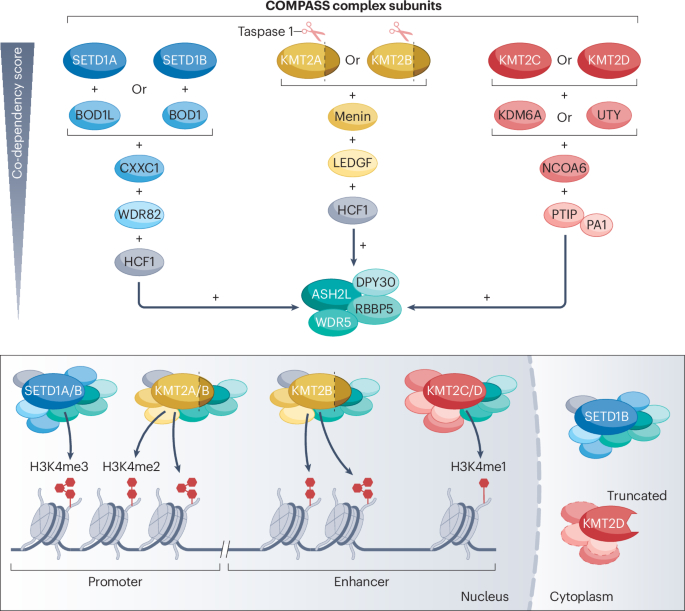
Zhao, Z. et al. Somatic mutations of MLL4/COMPASS induce cytoplasmic localization providing molecular insight into cancer prognosis and treatment. Proc. Natl Acad. Sci. USA 120, e2310063120 (2023). This study demonstrated that KMT2D truncating mutations drive aberrant cytoplasmic localization of the KMT2D protein, revealing a previously unrecognized mechanism of epigenetic dysfunction with prognostic and therapeutic implications.
Article
CAS
PubMed
PubMed Central
Google Scholar
Hoshii, T. et al. A non-catalytic function of SETD1A regulates cyclin K and the DNA damage response. Cell 172, 1007–1021.e17 (2018).
Article
CAS
PubMed
PubMed Central
Google Scholar
Callen, E. et al. 53BP1 mediates productive and mutagenic DNA repair through distinct phosphoprotein interactions. Cell 153, 1266–1280 (2013).
Article
CAS
PubMed
PubMed Central
Google Scholar
Jowsey, P. A., Doherty, A. J. & Rouse, J. Human PTIP facilitates ATM-mediated activation of p53 and promotes cellular resistance to ionizing radiation. J. Biol. Chem. 279, 55562–55569 (2004).
Article
CAS
PubMed
Google Scholar
Munoz, I. M., Jowsey, P. A., Toth, R. & Rouse, J. Phospho-epitope binding by the BRCT domains of hPTIP controls multiple aspects of the cellular response to DNA damage. Nucleic Acids Res. 35, 5312–5322 (2007).
Article
CAS
PubMed
PubMed Central
Google Scholar
Hu, D. et al. The MLL3/MLL4 branches of the COMPASS family function as major histone H3K4 monomethylases at enhancers. Mol. Cell Biol. 33, 4745–4754 (2013).
Article
CAS
PubMed
PubMed Central
Google Scholar
Herz, H. M. et al. Enhancer-associated H3K4 monomethylation by Trithorax-related, the Drosophila homolog of mammalian Mll3/Mll4. Genes. Dev. 26, 2604–2620 (2012).
Article
CAS
PubMed
PubMed Central
Google Scholar
Wang, S. P. et al. A UTX-MLL4-p300 transcriptional regulatory network coordinately shapes active enhancer landscapes for eliciting transcription. Mol. Cell 67, 308–321.e6 (2017).
Article
CAS
PubMed
PubMed Central
Google Scholar
Wang, C. et al. Enhancer priming by H3K4 methyltransferase MLL4 controls cell fate transition. Proc. Natl Acad. Sci. USA 113, 11871–11876 (2016).
Article
CAS
PubMed
PubMed Central
Google Scholar
Wang, L. & Shilatifard, A. UTX mutations in human cancer. Cancer Cell 35, 168–176 (2019).
Article
CAS
PubMed
PubMed Central


Comments (0)