Impact
As the research presented in this paper suggests, culturally responsive teaching pedagogy has had an impact on American education. One survey has been created to measure CRT’s effectiveness, named the culturally responsive teaching survey (CRTS). Rhodes (2017) was instrumental in acknowledging the CRTS as a valid and reliable way of measuring culturally responsive teaching in the classroom. The survey was designed not only to assess, but also to assist educators in creating their classroom curriculum. The CRTS remains in use but does not necessarily explain the impact of CRT on educators, students, or classroom culture. Other studies delve further into this topic, such as one examining the relationship between culturally responsive teaching, teacher cultural diversity beliefs, and self-reflection on one’s own teaching. Civitillo et al. (2019) found that those who practiced CRT and had strongly held cultural diversity beliefs tended to have more elaborate patterns of self-reflection in their teaching. While only four teachers were observed in this study, these data could point to a trend in self-reflection because of CRT. In this way, Civitillo et al. (2019)there is a substantial lack of outcome-focused research, which another study addresses. Debnam et al. (2015) observed 142 K-8 teachers at six (three elementary and three middle) schools and asked them to fill out self-reports regarding culturally proficient teaching practices. The researchers wanted to determine whether teachers who rated themselves highly on self-reported measures did what they reported to – and indeed they did. Results suggested that teachers who embrace more culturally responsive teaching strategies may be more successful in engaging their students in the classroom (Debnam et al., 2015; Vavrus, 2008). Engaging students leads to higher knowledge retention and provides positive role models.
A different qualitative study by Galloway et al. (2019) explored how 18 educators described culturally responsive pedagogy and how they engaged in CRT daily. The results were interesting, suggesting that there is an erasure of antiracist pedagogy within CRT, most likely because of discomfort around the subject matter. Participants reported using phrases like “all” or “every student’ while discussing culturally responsive pedagogy, though they noticeably omitted precise terms like “race”, “racism”, and “oppressive systems”. Thus, the authors suggested that the use of more specific terminology and race-specific practices would be helpful in addressing those inequalities. For instance, “brave spaces” should replace “safe spaces”, because the terms and conditions by which race, racism, and oppressive systems are perpetuated is through silence. Folx must be brave and address that which is uncomfortable or taboo in places where they can discuss with others, learn, and pivot their thought processes. Only through being explicit, experiencing discomfort in unfamiliar situations, and asking for help do we move forward in our progress for a more equitable education system (Galloway et al., 2019).
Even though these data indicate that CRT has a positive impact on classrooms, some people still manage to find issues with culturally responsive teaching. Landa (2011) astutely points out there are areas of contention within CRT, which impact how cultural proficiency is received in the classroom. For example, the author has noticed how some parents may not understand how CRT is beneficial for all learners, considering it to be a ‘handout’ for low-income students (notice how ‘handout’ is used with scare quotes). Others believe that CRT encourages students to prioritize people of color and their lived experiences over that of white people, thereby erasing white history. In fact, culturally responsive teaching has now been recognized as another version of critical race theory, the other CRT, which has created critical problems for the DEISJ movement in education. This is not to say the two concepts are unrelated. On the contrary, critical race theory and culturally responsive teaching inform each other in different ways. This is to say that critical race theory is being used to scare folx away from critical thinking regarding racial inequities in education. For the DEISJ movement to take root and make meaningful change, educators need to continue pushing for basic inclusive culture, like CRT, to be implemented. Although, as Ofodile (n.d.) astutely points out, critical race theory is the “crux” of this research.
In response to the contentions surrounding CRT described above, Landa (2011) and Larson et al. (2018) ask how (if at all) CRT is related to positive student behavior in the classroom. This question is especially important, as “marginalized” students are demonized in ways white, nondisabled students are not. For example, Black students are much more likely to get reprimanded and suspended than white students, and students with disabilities are suspended at higher rates than their nondisabled peers (Maynard & Weinstein, 2020). This is one of the reasons CRT was created and is being implemented – teachers carry biases as the result of their own culture and experiences which could impact the achievement gap (Gay, 2018). The use of culturally responsive teaching practices, in conjunction with proactive behavior management strategies, lead to positive student behaviors within the classroom, especially for students of color (Larson et al., 2018). Positive student behaviors may lead to more engagement in the classroom (Hammond, 2015). In fact, Hammond (2015) notes that there are three parts to promoting authentic engagement and rigor among culturally and linguistically diverse students: building awareness and knowledge, building learning partnerships, and building intellective capacity. It is necessary for educators to provide basic tools for dependent learners to move toward independent learning. This is especially salient, given that more often than not, dependent learners are not white.
Hammond (2015) mainly relies on the Ready for Rigor framework which is dependent largely on the educators doing the ‘work’ to better themselves, but also on providing the following to students: affirmation, instructional conversation, validation, and wise feedback. Wise feedback assures learners that they will not be stereotyped nor doubted as capable learners, especially as many systems undermine students of color. As Hammond (2015) says: “If we look at our society as a complex system of organizations, institutions, individuals, processes, and policies, we can see how many factors interact to create and perpetuate social, economic, and political structures that are harmful to people of color and to our society as a whole” (p. 29). Professional development is one way the harmful components of this complex system can be unlearned before entering a classroom.
Samuels (2018) agrees, positing that professional development is one way to provide preventative measures to protect students of color whom society often works against. In essence, it is easiest to think of CRT and the process to become culturally proficient as an asset – it is something to embrace and see as an opportunity for growth. Samuels (2018) found that those who used the CRT framework consider it to be advantageous, and that it is most beneficial for participants (educators) to be introduced into theory and research but also learn how to implement those practically in their classroom(s). Participants in Samuels’ 2018 study learned about CRT through six basic points: understanding how learners construct knowledge, learning about students’ lives, being socioculturally conscious, holding affirming views about diversity, using diverse instructional strategies, and advocating for all students. The study ended up not only providing answers about teaching and learning CRT but also acted as a professional development opportunity for those who participated.
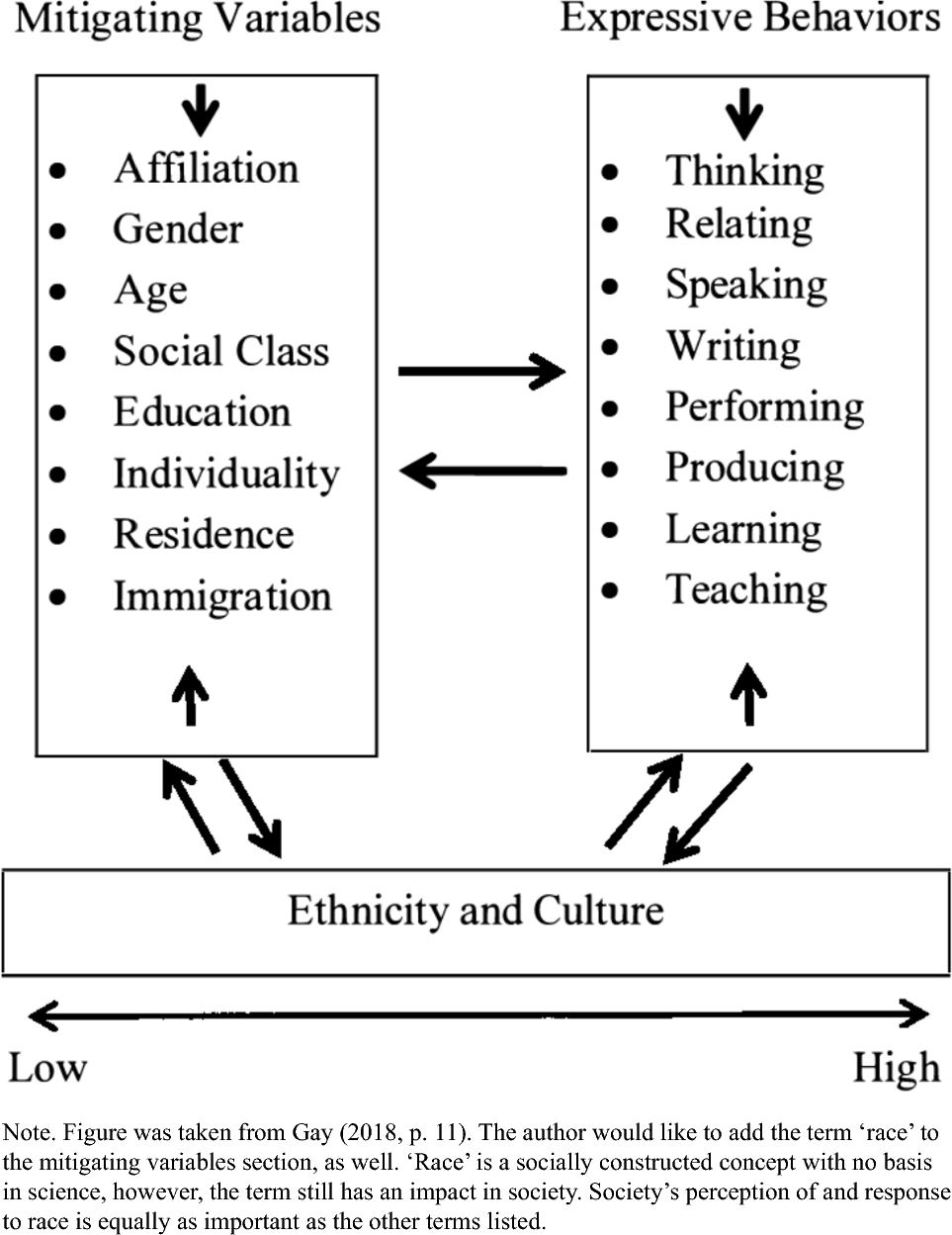
“Of all human needs, few are as powerful as the need to be seen, included, and accepted by other people, which is why shunning and banishment are among the most painful punishments to endure, a kind of social death” (Johnson, 2018, p. 49). A lack of social connection and community alienates students, making them feel as if they are alone. Sometimes, this alienation is put on students by others who do not care to understand or embrace difference. In this way, culturally responsive teaching is nuanced enough to identify and celebrate all parts of a person’s identity. Identity includes, but is not limited to: age, sex, gender, gender expression, religion, disability status, caste positionality, and race. The intersection of these identifiers creates a person’s identity, which may be considered a “marginalized” identity in society. For example, French existentialist and early feminist Simone de Beauvoir described the intersection of woman and Black as the ‘Other’, a person who is constantly considered an outcast and existing in no one space. Another example is folx long considered “unteachable” taking their power back through “entering higher education for the first time” and are “talking/writing back” (Rege, 2010, p. 89). These are only two reasons why it is necessary that those in positions of power do the ‘work’. As CRT is a framework by which to teach and learn, it is also important that educators to address disability directly by exploring meanings of disability, the history of disability, and how to act against ableism, as well as provide accessibility resources in the classroom (Baglieri & Lalvani, 2020). Accessibility can be found in the form of text-to-speech apps, ASL translators, physical printouts of online articles, subtitles on videos being shown, or even using videos instead of articles during instruction (Darrow, 2013). Exposure to the lived realities and histories of disabled people is just as advantageous to nondisabled students as it is to disabled students. Regardless of how it presents itself, inclusivity in the classroom is essential for the success of all students (Green & Stormont, 2017).
Culturally responsive teaching “demands a new way of looking at teaching that is grounded in an understanding of the role of culture and language in learning” (Villegas & Lucas, 2007, p. 2). As demonstrated by many researchers (Bennett et al., 2018; Civitillo et al., 2019; Debnam et al., 2015; Green & Stormont, 2017; Vavrus, 2008; Villegas & Lucas, 2007), CRT is valuable in the classroom. However, implementing CRT takes time and effort. Maynard and Weinstein (2020) describe that a common pushback may be a lack of time and resources, nor do teachers get paid enough, to implement CRT as it is an extensive and ongoing process. Yet, Villegas and Lucas (2007) emphasize that, even in the absence of comprehensive CRT in the classroom, teachers must get to know their students better. This relationship building process would include discovering what students think about school, learning, and subjects, as well as “family, immigration, favorite activities, concerns, and strengths” (p. 3).
In the end, “if we spent more time getting to know students and their triggers, we would spend less time dealing with behaviors” (Maynard & Weinstein, 2020, p. 174). This is especially true in early childhood education, as what is learned in those first few years of a student’s learning process is carried with them throughout their educational careers. A study done by Bennett et al. (2018) found that there are five specific areas that embody the foundation of CRT in early education: developing a culturally responsive classroom community, family engagement, critical literacy within a social justice framework, multicultural literature, and culturally responsive print rich environments. Another simple way to get to know multicultural students is by being patient and understanding with them, and being intentional in saying things like, “I see you. I acknowledge your presence in this classroom” (Howard, 2016, p. 133). By introducing culturally responsive teaching to teachers, students, and families earlier in their lives, it allows for a life filled with more diversity, equity, inclusion, and social justice.
Future Implementation
Why is CRT so important to all educators, not just Black and Indigenous People of Color (BIPOC)? Culturally responsive teaching pays homage to the cultural underpinnings of all people, not just BIPOC. This pedagogy sheds light on many psychological concepts, creating a mutual and mindful understanding between teachers and students. Bronfenbrenner’s bioecological theory reveals that many elements come together to create who a student/teacher is and how they receive information. This is specifically influential for BIPOC because the information traditionally taught in schools is not reflective of their histories nor cultures. Culturally responsive teaching is mindful of students’ cultures, learning styles, and emotionality, because “the personal is powerful” (Gay, 2010, p. 232).
For CRT to be more successful, it may be helpful to build new CRT material based on inclusive material has been used in current and past CRT-based programs. For example, Landa (2011) describes how CRT-based curriculum effects learning: “when teachers ensure that there is equal status among [students], [small, diverse] groups increase the tendency of children to develop strong and long-lasting interethnic and interracial friendships, the academic achievement of students of color, and for all students, motivation, self-esteem, and empathy” (p. 9). CRT can thereby teach cooperation, communication, leadership, and social-emotional learning (SEL). The promotion of SEL is best done through reflection and processing emotions with others, which also produces and enhances relationships between participants. Hammond (2015) suggests that providing culturally responsive feedback is one way to build a healthy learning partnership.
Culturally responsive feedback is also known as wise feedback (Hammond, 2015). There is no ‘sandwich’ format, but instead a series of steps which allow the educator to connect with and create space for the student to process the information provided. This information is processed in the reticular activating system (RAS), which regulates arousal states. The RAS plays an essential role in attention and memory retention.
Keeping this in mind, Hammond (2015) developed a teaching approach to maximize material retention, called ICCR. ICCR stands for ‘ignite, chunk, chew, and review’. ‘Ignite’ is the step where educators activate the RAS, bringing attention to the subject matter of interest. Neuroscience recognizes this step correlates to the input stage of information processing. In ‘chunk’, the material is broken down into phases, providing only the necessary information in that moment. ‘Chew’ is the step where students are asked to put the information they are learning into action, promoting active processing (also known as ‘elaboration’). In the final step, ‘review’, students must reexamine the material that has been chunked and chewed. The human brain has no more than 48 h to convert short-term memory to long-term memory, which is why complex information could be taught/learned in this way (Hammond, 2015). The more content is reviewed and applied, the quicker the neuronal connection becomes (application stage); the phrase “use it or lose it” really does apply!
Furthermore, Hammond (2015) goes so far as to say there are formal rules to follow for our brains to operate in a culturally responsive environment:
“The brain seeks to minimize social threats and maximize opportunities to connect with others in community.
Positive relationships keep our safety-threat detection system in check.
Culture guides how we process information.
Attention drives learning.
All new information must be coupled with existing funds of knowledge in order to be learned.
The brain physically grows through challenge and stretch, expanding its ability to do more complex thinking and learning” (p. 48).
If educators keep in mind the brain operates in quantifiable ways, it will be easier to implement CRT. This is especially true as learning is a partnership between the educator and those being educated. The combination of rapport and an alliance result in cognitive insight, which contributes to an understanding of thinking routines (Hammond, 2015).
In the journey to become culturally responsive and culturally proficient, one must consider how they describe themselves in relation to the ‘work’ being done. This is because true cultural proficiency involves spreading awareness, educating others, continuous education of the self, interrogation of biases and blind spots, and an effort to put yourself on the line to fight for the causes you are involved in. So, in a similar vein, we can transpose terms used to identify where you are on your cultural proficiency journey to that of advocacy work: cultural destructiveness aligns with being an ‘ally’, cultural advocacy aligns with ‘advocate’, and cultural proficiency aligns with ‘accomplice’.
According to Jackson (2019), an ally is “someone who isn’t part of a marginalized group but who supports that group actively”. In many ways, being an ally is considered performative because of how shallow the allyship is. “Without action for social justice, mere acknowledgement becomes a particularly cynical form of white privilege” (Howard, 2016, p. 85). To be an advocate means to go one step further, perhaps now educating others on what the cause is and why it is important, in addition to activities like going to speaker series on the topic(s) or wearing clothing that denotates your involvement in the cause. Being an advocate is better than being an ally, but it is still considered surface-level because of the positionality of the individual who is doing the ‘work’. Finally, Jackson (2019) describes how becoming an accomplice is the most involved stage of personal transformation: by sitting in the discomfort of stressful conversations, by being willing to lose something or be punished for something that you know is right, and by “caring more” can we stand hand-in-hand with those who are directly facing discrimination, harm, or even death. The term ‘accomplice’ is deliberately used in restorative justice because of the weight it carries and the connotation of the term itself. Many things we now enjoy came at a very high cost to those who came before us, like owning property, voting rights, or even bodily autonomy. The idea is that accomplices do not shy away from the ‘work’ and instead welcome it to explore their own connection to the harmful systems at work in our society, in addition to finding creative ways to dismantle those systems.
The ‘work’ will never be done. The ‘work’ can never be done because of the violent and oppressive systems which help the USA continue to operate and harm non-white bodies and minds. Being an ally is the bare minimum for a person with minimal awareness of the homogeneity of the USA. The author finds themselves somewhere in between that of an advocate and an accomplice, through engaging in protests, actively educating others on why support is not given to support certain people/places/things, acknowledging the stolen land being lived on, and refusing to work for and/or buy from companies who do not align with these values (because money speaks volumes in a consumer capitalistic society which exists in the USA). This is not to say there have not been mistakes made along the way, especially when the ‘work’ first began. There is an effort to right past wrongs, learn about how personal reactions to what and interrogate why, and move forward to do better. After all, we are all in this together.
Reflecting on the title of this paper, the comparison between ‘caring about’ and ‘caring for’ is a constant theme in CRT. As mentioned earlier, in this remark, Gay was commenting on how action orientation is critical for engagement and change. The term ‘about’ in this context connotates an air of generalizability. Caring about something is universal and can be said with little to no thought, like saying, “thoughts and prayers for the victims of this school shooting” and then doing nothing about gun reform. Caring about someone or something is passive and distant. The term ‘for’ in this context implies a direction and intentionality. Caring for something is specific and is said with purpose, often with action tied to it. In other words, action is imperative in the world of culturally responsive teaching. Because of this, students need to be active participants in their learning experience. Some may even need to learn how to learn! There are so many people who care deeply about DEISJ in education but do not actively engage to change the dominant culture in education. CRT is not currently being used to its fullest capacity.

Comments (0)