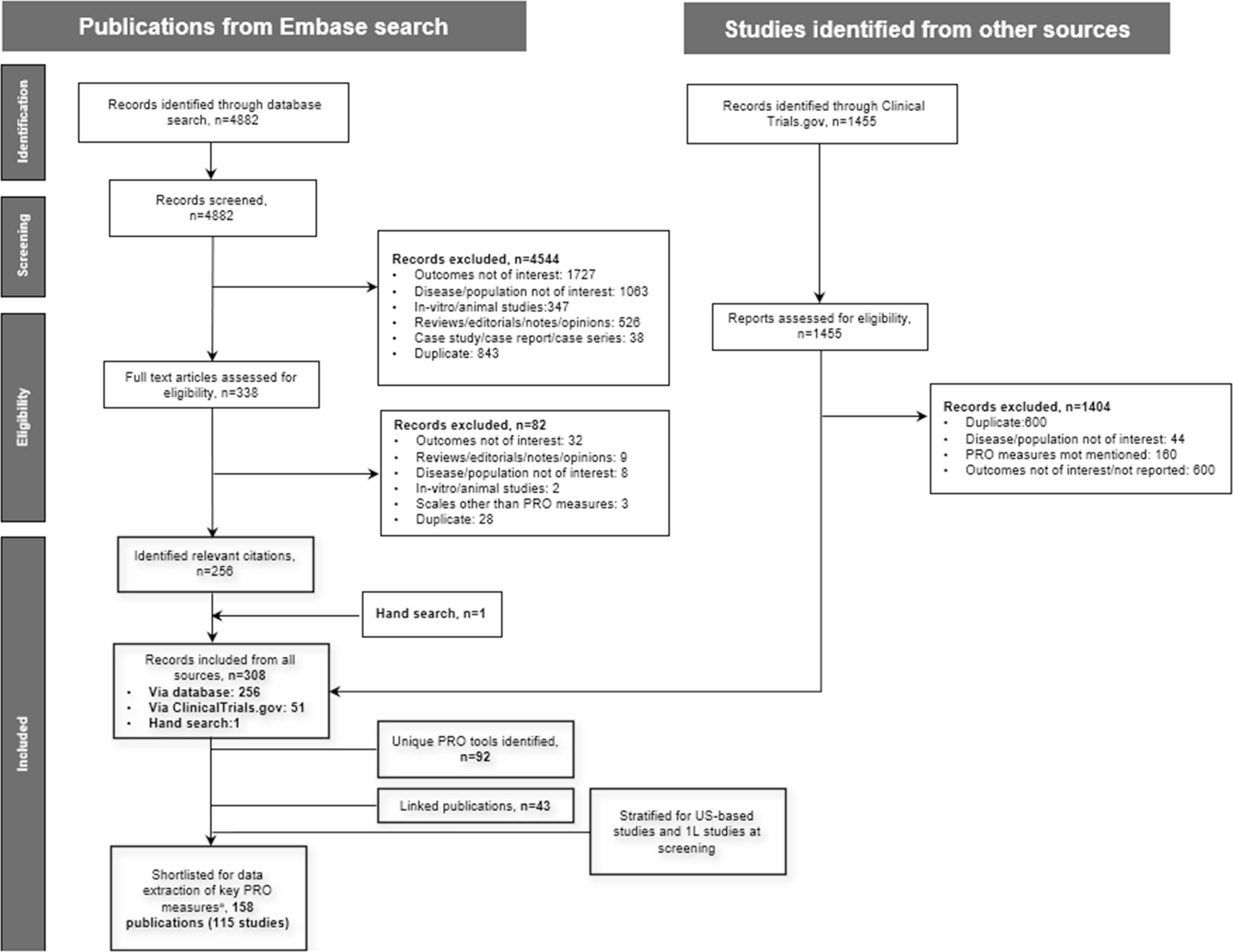
The results of our scoping literature review yielded 6337 records of CML studies that used PROMs between January 2001 and September 2023, which was refined to 208 studies, based on preset inclusion and exclusion criteria. From these studies, the most commonly reported PROMs appearing in ≥ 5% of the studies were identified and included 92 unique PROMs. Of these 92 PROMs, EORTC QLQ-C30, SF-36, EORTC QLQ-CML24, FACT-Leu, and MDASI-CML were the 5 most commonly reported PROMs in studies across all lines, and EORTC measures, SF-36, and FACT/FACIT were most frequently reported in CML studies in the frontline setting. Most of these 92 PROMs were generic (67%), while some were specific to oncology (21%) and CML/leukemia/hematology (12%). This trend was consistently seen across all 208 CML studies and across the 81 studies in the frontline setting. However, across the 54 studies with ≥ 1 US study center, most PROMs were either generic or specific to CML/leukemia/hematology, while some were oncology specific.
Overall, our results underscore a lack of consensus on PROMs used in CML studies across lines of therapy and in frontline therapy. A recent real-world systematic review by Smit et al. concluded that none the 6 identified PROMs that assessed symptoms in patients with CML (EORTC QLQ-CML24, EORTC QLQ-C30, EORTC symptom set, FACT-Leu, a generic Chinese questionnaire, HM-PRO, and MDASI-CML) were sufficient for overall content validity [20]. Additionally, 5 of these PROMs (all except the generic Chinese questionnaire) were inconsistent due to not being evaluated by professionals post development, involving few patients with CML, or missing symptoms highly relevant to CML [20]. Smit et al. concluded that while new, validated CML-specific PROMs are needed, this effort must be guided by an understanding of patient preferences to ensure the tools are practical and meaningful in real-world settings [20].
According to our scoping literature search, the most used generic PROMs (reported in ≥ 3 studies) in CML in the frontline setting were SF-36, EQ-5D, MMAS, and MMAS-8. The MMAS and its variants assess medication adherence, not health-related QOL (HRQOL); moreover, they have been retracted [21]. The EQ-5D is available in the most languages, making it globally versatile, although it is considered most useful for cost-effectiveness research rather than as a comprehensive measure of HRQOL [12, 22]. It lacks sensitivity for measurement of HRQOL, and, with its same-day recall period, symptoms that wax and wane in diseases considered mild or asymptomatic may be missed [22]. Fatigue is a common adverse effect of TKIs [23], and the FACIT-F is fatigue specific; however, it needs to be used in conjunction other PROMs that can assess other aspects of QOL [24]. A prospective, longitudinal HRQOL study in patients with CML described the SF-36 as a well-established generic HRQOL measure but noted that it may not be sensitive enough to detect QOL changes in the CML population as it is not disease specific [25]. Notably, the SF-36 does not include gastrointestinal symptoms, a common adverse effect of many TKIs [26].
Oncology-specific measures focus on symptoms that are commonly experienced because of cancer and anticancer medications. Our results showed EORTC QLQ-C30, FACT-BRM, and Functional Assessment of Cancer Therapy-General (FACT-G) to be the most used oncology-specific PROMs (reported in ≥ 3 studies) in CML in the frontline setting. Other studies have identified EORTC measures as the most extensively used PROMs in cancer clinical trials and clinical practice [27,28,29,30]. Qualitative interviews from patients with cancer (in Europe and US) confirmed that concepts included in EORTC QLQ-C30 are relevant across cancer types and disease stages and are widely understood across language versions, hence establishing good content validity of EORTC QLQ-C30 [31]. A cross-sectional study in Kenyan patients with cancer also demonstrated the reliability and cross-cultural validity of EORTC QLQ-C30 for measuring QOL [32]. A limitation in scoring of EORTC measures is that thresholds for clinical importance need to be established to help healthcare professionals correctly identify and interpret changes in scores that are meaningful for patients [33]. One unique aspect of the EORTC QLQ-C30 is an assessment of financial difficulties, which may be a common experience in this patient population but is rarely included in PROMs, which are otherwise focused on symptoms and functioning [34].
A pilot randomized trial of the first cognitive behavioral intervention for TKI-related fatigue in CML used the FACT-G due to its established reliability, validity, and sensitivity to change in patients with cancer [23]. FACT-BRM was used in a QOL study with imatinib, and although it is designed to assess QOL in patients taking BRM, it was used because of its translation into other languages, validity, and coverage of a wide range of major HRQOL areas [35]. However, authors of another QOL study with imatinib noted that FACT-G, the first part of FACT-BRM, has been translated into other languages, but the subsequent parts of the questionnaire, BRM-physical and BRM-mental, have not been translated to Urdu, in particular, which limited data collection in their study, which was conducted in Pakistan [36].
CML-specific PROMs are designed to evaluate symptoms frequently experienced in this specific patient population. The most common CML-specific measures (reported in ≥ 3 studies) in the frontline setting in our scoping literature search were EORTC QLQ-CML24, MDASI-CML, and FACT-Leu. The MDASI-CML is a CML-specific PROM that is brief, validated, and designed for patients with CML. It comprises 20 core and CML-symptom specific items that assess symptoms that are particularly relevant to patients with CML and 6 interference items that assess how symptoms impact daily life [37, 38]. After completion of a phase 2 exploratory study assessing the effect of TKI switching on the AE profile in patients with low-grade toxicities, the MDASI-CML module was validated, and headache was added as a CML-specific item [39]. Each symptom in MDASI-CML is represented by a single question, thus limiting its sensitivity. Moreover, the recall period is 24 h, which can lead to missed symptoms that vary over longer time periods. It is available in fewer languages in comparison to many of the other PROMs, limiting its practical application in some cases [40].
The more recently developed, high-quality, generic PROMs, PROMIS and PRO-CTCAE, were reported in ≤ 5 studies in our results. While both PROMIS and PRO-CTCAE are highly customizable to the study context, they have some differences [41, 42]. The PRO-CTCAE is customizable and comprehensive, with 124 items representing amount, presence/absence, frequency, severity, and interference of 78 different toxicities. It is validated in 60 languages and has a recall period of 7 days [41]. However, the PRO-CTCAE provides descriptive reports of symptomatic toxicities at their worst and does not produce composite scores that can be used for interpretation [41]. Importantly, it includes items on attention and memory and sexual health, which are not captured by the commonly used PROMs, including EORTC QLQ-C30 and SF-36 [41, 43,44,45]. PROMIS was developed using advanced qualitative and psychometric methods, with customizable measures covering 70 domains of symptoms and functioning in the areas of pain, fatigue, and physical, mental/emotional, and social health [42]. Many of the measures use a 7-day recall period, and scores are normalized to the general population to facilitate interpretation of severity [42, 46]. Both PROMIS and PRO-CTCAE have extensive item libraries that can provide a comprehensive approach for evaluating patient outcomes [41, 42]. Hence, both require careful and reasonable curation to limit patient burden. Also, the highly customizable nature can be difficult to navigate for those implementing these generic tools compared with a CML-specific measure [46]. Our results showing limited use of these PROMs in CML studies in the frontline setting likely reflect both their more recent development as well as the complexities associated with the measure/item selection required for using PROMIS and PRO-CTCAE.

Comments (0)