
Remember me
The following sections present an analysis of the themes and sub-themes derived from the interview data, along with the statistical data collected from the survey, all organized according to the study’s research questions.
Gender-Based Perception Towards STEM EducationAccording to the findings of the student survey (Table 2), 79% of the female students and 78.78% of the male students had a high inclination towards learning STEM topics, indicating a significant degree of interest in this subject matter. A neutral viewpoint was held by 3% of the male and nearly 3% of the female students, whereas only 4% of the male students expressed severe disagreement with this assertion. However, no female students indicated their disagreement on this regard. The P-value indicated that no gender-based difference has been found between male and female students. Hence, it is understandable that most students exhibit a preference for acquiring knowledge in the field of science, thereby highlighting their substantial role as stakeholders in the integration of STEM.
Table 2 Students’ interest on learning science contentsSimilarly, a majority of the teachers shared that the students are interested in learning the contents of STEM and most of the teachers did not notice any gender difference in this context. A male teacher expressed,
I did not find any gender-based difference on learning the STEM subjects. I think both male and female students like to learn the STEM contents similarly.
However, a few teachers revealed that female students are more interested in STEM than the male students in their schools. A female teacher explained,
In my class, girls are more interested in reading science, they also get better results than boys in some cases.
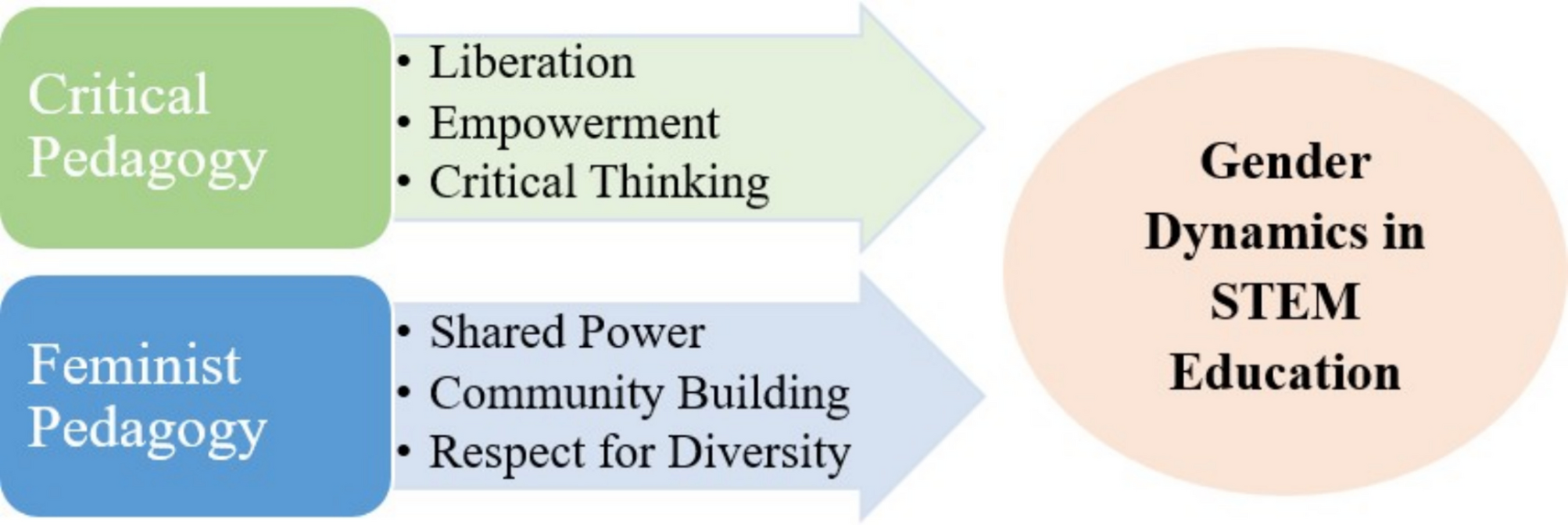
From a critical pedagogy perspective, these differing observations suggest that, while structural inequalities may not always be immediately apparent, the power dynamics and expectations within the classroom may still shape students’ engagement with STEM. Teachers who recognize the gendered differences in interest might be actively creating inclusive learning environments, allowing female students to flourish.
In line with feminist pedagogy, the teachers who perceive female students to be more engaged in STEM subjects might be seeing the positive impact of supportive, gender-sensitive teaching strategies. Feminist pedagogy emphasizes the importance of fostering a sense of belonging and confidence for all students, particularly those from marginalized groups.
Teachers’ Attitudes and Teaching Practices in Shaping Gender Dynamics in STEM EducationFrom the response of both students and teachers, several key points have been identified that reflects the teachers’ attitudes and instructional practice in shaping gender dynamics in STEM education. These are discussed below.
A majority of 84% of the male students (Table 3) expressed agreement with the idea that teachers effectively respond to questions during class. On the other hand, 91% of the female students shared their agreement on this regard. Only 3% of the male and 5% of the female students expressed a neutral viewpoint on this matter. In total, 9% of the male and nearly 3% of female students expressed dissent about this. Also, there is a difference found between the male and female students in this regard. Furthermore, 87% of the male students concurred that they had the ability to pose queries during class. In contrast, 79% of the female students agreed on this. Merely 4% of male students disagreed on this and 8% of the female students expressed dissent about this. In these cases, there is no significant difference found between the male and female students’ responses.
Table 3 Teachers’ use of pedagogyFurther, the students were requested to provide their responses regarding the extent to which teachers endeavour to elucidate complex concepts related to mathematics or ICT in a simplified manner. Out of the total number of learners, 75% of the male students expressed agreement. In addition, 82% of the female students agreed on this. In total, 18% of the male students and 11% of the female students remained neutral, while 7% of the male students and 5% of the female students disagreed. The male and female students did not differ in this response significantly.
Most of the teachers reported that the absence of relevant teacher training programs limits their ability to present science content in more engaging and inclusive ways, particularly with regard to gender dynamics. They noted that the scope for continuous professional development is restricted, which results in a heavy reliance on outdated teaching methods. This lack of training affects the overall teaching quality and also contributes to the persistence of gender biases in the classroom. Teachers expressed concern that, without modern pedagogical strategies and gender-sensitive training, it is difficult to create an environment where both male and female students feel equally encouraged and supported in STEM subjects. As a result, these traditional methods may inadvertently reinforce gender stereotypes, impacting female students’ confidence and participation in STEM education. A female teacher explained:
Teaching science subjects requires a lot of efforts and variety of techniques. But we do not have much training to understand more of the techniques and how to implement those in class. This lack of professional development makes it challenging to create engaging and inclusive learning experiences, particularly in addressing gender dynamics and ensuring equal participation from both male and female students.
In the context of critical pedagogy, this situation reflects a systemic issue where the educational structures themselves fail to equip teachers with the tools necessary to challenge and transform ingrained inequalities, including gender-based discrimination.
In the interview, many teachers mentioned that the higher number of students in the class is significantly hindering them to implement the variety of pedagogical approaches in the class. Moreover, some teachers mentioned the less participation of the girls in science related idea generation or relevant other activities. A teacher stated:
Mostly girls are less included in the creative ideas of science-based activities. We try to include all of the students, but due to the excessive number of the students we do not always address all of them.
This comment speaks to the intersection of feminist pedagogy and critical pedagogy, highlighting the ways in which structural factors such as overcrowded classrooms limit teachers’ ability to create an equitable learning environment where all students—especially girls—are encouraged to participate.
Based on the data presented in Table 4, 34% of the male students expressed agreement with the idea that there are chances to participate in conversations about new ideas or innovation in the classroom. In total, 32% of the female students also indicated their agreement on this. Furthermore, 30% of the male and 14% of the female students held a neutral position. Conversely, a significant percentage of 34% of the male students expressed their disagreement and, in this case, a higher number of female students (nearly 50%) also disagreed on this. Also, there is a significant difference found between the male and female students in this response indicating that a higher number of female students expressed disagreement than the male students. The chance of exploring new ideas is significantly restricted or nonexistent in numerous circumstances.
Table 4 Opportunity for idea generationThe student survey (Table 5) revealed that 44% of the female students cannot comprehend the science subject without any form of support and 30% of the male students also indicated the similar scenario. However, 53% of the male and 38% of the female students marked that they are able to understand the concepts without any help. On the other hand, 21% of the male students indicated that the extent of collaborative tasks in the class is limited where a large number of female students (41%) revealed the lack of collaborative tasks in class. Also, there is a difference found in gender-based distribution where female students get fewer opportunities than the male students to participate in collaborative tasks in class.
Table 5 Opportunity for group work and peer supportAll of the teachers mentioned that they do not treat students any differently based on their gender identity. They strongly pointed out that the students have gender stereotypes and that the parental expectations play a role in this concern. A teacher stated:
We are never partial to any students based on their gender. But usually, it seems that the girls are less likely participating in science subjects and related activities. There may have several reasons for that, though I think both of the boys and girls are interested in science contents.
An additional opportunity for STEM integration was noted as the opportunity to engage in discussions with instructors beyond the classroom setting. According to the study, 62% of the male students expressed their agreement with the idea of seeking guidance from teachers outside of their regular classes. In this case, 55% of the female students shared their agreement. A total of 12% of the male and 19% of the female students expressed a neutral stance on this matter. However, 25% of the male and 23% of the female students expressed disagreement, indicating that they are unable to engage in discussions with the teachers outside of the classroom (Table 6). Also, there is a difference found in male and female students’ reponses indicating that a large number of female students than male students have limited access of reaching out to the teachers outside of the class.
Table 6 Facilities of supervision and competitive taskFurthermore, comparatively, many female students (67%) concurred that there are annual scientific or math Olympiads held in schools, while 45% of the male students agreed. The statement received a neutral response from 19% of the male and 17% of the female students. In total, 34% of the male students expressed disagreement with this statement where only 14% of the female students disagreed. In addition, the P-value indicates the difference existing between the male and female students where more male students disagreed than female students exposing that the annual science or math Olympiads are not organized regularly in their schools.
The interview data reveals significant challenges regarding the coordination between teachers and students, particularly in the context of limited class time. Many teachers expressed concern that the duration of science lessons is insufficient for providing a comprehensive and holistic instruction. These time constraints hinder their ability to employ diverse teaching methods, which are crucial for offering an inclusive and effective learning experience. A teacher explained:
I learned some effective teaching approaches but the class time is too short to apply those effectively. I tried few times, but the class duration is not enough at all to provide instructions while addressing the diverse learning needs of the students.
This situation is further complicated by gender dynamics in the classroom. Some teachers noted that female students were less connected with them compared to their male counterparts. This suggests that time constraints not only impact the overall quality of teaching but may also exacerbate gender-based disparities in teacher-student interaction.
From a critical pedagogy perspective, these time limitations reflect systemic issues within the educational structure that constrain the teacher’s ability to create a truly participatory and transformative learning environment. Feminist pedagogy emphasizes the importance of creating learning environments that actively challenge traditional power dynamics, including those shaped by gender, and ensure that all students are equally encouraged, valued, and supported. When class time is constrained, teachers may inadvertently reinforce gendered power imbalances, where male students are more likely to receive attention or participate in discussions, while female students remain less visible or engaged.
According to the survey conducted among the students (Table 6), 62% of the male students expressed their agreement with the idea of seeking guidance from teachers outside of their regular classes. In this case, 55.88% of the female students shared their agreement. However, 25% of the male and 23% of the female students expressed disagreement, indicating that they are unable to engage in discussions with the teachers outside of the classroom. This clearly indicates that female students are less likely to have limited interaction with teachers outside of the class.
All of the teachers interviewed expressed that they are aware of their students’ needs and make concerted efforts to ensure their classes are as effective as possible. Many teachers emphasized that they aim to make lab classes more inclusive by organizing students into small groups to ensure equal participation in lab activities. Additionally, every teacher mentioned that they provide sufficient theoretical instruction before the practical classes to help students better relate the tasks to the theoretical concepts. A teacher stated:
We do not discriminate against any students in participating in scientific activities. And the lectures are provided before the practical work so that they can relate the task well with theoretical understanding.
In light of gender dynamics, these efforts reflect a positive intention to create an inclusive environment where all students, regardless of gender, have an opportunity to participate equally.
Critical pedagogy also emphasizes the need for a deeper analysis of power dynamics within the classroom. Even with efforts to organize small groups and provide lecture-based instruction, teachers must critically examine how power structures—such as gendered expectations and biases—might still influence participation and engagement. Critical pedagogy challenges educators to ask not only if students are being included in activities, but how they are being included.
Feminist pedagogy encourages educators to be not only aware of gender dynamics but also proactive in ensuring that both male and female students are actively included in all aspects of the learning process, including in group activities and lab work. Simply organizing students into groups may not always address underlying gender biases that influence participation.
Classroom Environment Affecting the Engagement of Male and Female Students in STEM EducationThe findings reveal key insights into gender-based experiences with various components of STEM integration, such as hands-on learning opportunity, utilization of ICT in class, participatory learning, collaborative learning, inquiry-based learning, and access to resources.
According to the survey findings presented in Table 5, 21% of the male students indicated that the extent of collaborative tasks in the class is limited where a large number of female students (41%) revealed the lack of collaborative task in class. However, 21% of the male and 2% of the female students expressed a neutral stance. Besides, 57% of the male students and 52% of the female students indicated their agreement of the scope of collaborative task in the class. This reveals that a large number of both male and female students get little scope in collaborative tasks. Also, there is a difference found in gender-based distribution where female students get little chance than the male students in collaborative tasks in class.
Some teachers in interviews expressed that they are open to the students and they encourage the students to connect with them, but they do not get much response. However, a few teachers mentioned that they do not always interact with the students outside of the class because of the class loads. This limited opportunity for out-of-class interaction could reinforce existing gender dynamics in the classroom. It may particularly affect female students, who often face additional challenges in speaking up during class or seeking support, further hindering their ability to engage and connect with their teachers. A teacher said, “I have several classes in a day, that is why I cannot always connect with the students outside of the class. However, I try to respond any of the students who reach me out”.
While this demonstrates a willingness to engage, feminist pedagogy calls for a deeper reflection on how time constraints and existing gender dynamics may still impact the equal access to support and connection for all students, particularly female students who may face societal pressures to remain more passive or less assertive in seeking help.
Hands-on learning activity or practical experience-centred learning is considered one of the most significant factors in STEM integration. According to the findings of the student survey (Table 7), nearly 50% of the male students expressed disagreement with the statement pertaining to the utilization of instructional resources by teachers in the classroom. In this scenario, 58% of the female students also disagreed. Besides, 34% of the male and 26% of the female students concurred that the teachers employ instructional materials in their classes. In total, 15% of the male and 14% of the female students had a neutral stance on this matter. Moreover, the P-value indicates that there is a strong difference between the experience of male and female students.
Table 7 Students’ response on teachers’ approaches on hands-on activitiesThe survey revealed that students recognized science projects as an excellent chance for learning. The survey includes an opinion regarding the science projects and the student’s ability to participate in them. In Table 8, 34% of the male students agreed that they can participate in projects. Also, 35% of the female students agreed on this statement. In total, 33% of the male and 17% of the female students expressed a neutral stance on this. However, 31% of the male students expressed disagreement, and 47% of the female students disagreed. Moreover, gender-based difference has been found exposing that the female students expressed more disagreement than the male students exposing that they cannot participate in science projects.
Table 8 Students’ scope on project-based learningAccording to Table 5, it was revealed that 44% of the female students cannot comprehend the science subject without any form of support and 30% of the male students also indicated the similar scenario. However, 53% of the male and 38% of the female students marked that they are able to understand the concepts without any help. This data indicates that compared with the male students, a large number of female students have a lack of self-paced learning.
In the survey of the students (Table 9), 94% of the female students believed that their teachers conduct lessons using a combination of discussion and question-and-answer technique. However, 80% of the male students agreed on this. Conversely, 10% of the male students expressed disagreement with this assertion where only 2% of the female students disagreed with this assertion. Furthermore, regarding the question of whether teachers provide adequate examples while discussing ideas, 77% of the male students concurred. On this matter, 76% of the female students expressed the agreement. A substantial proportion of students, namely 13% of the male and 11% of the female students, expressed disagreement with the notion that their lecturers employ insufficient examples when elucidating theories. Besides, the P-value indicates that there is no significant difference between male and female students in both of the statements. This finding indicated that both male and female students have similar experiences in this regard.
Table 9 Students’ response on participatory learningAccording to Table 10, a majority of 67% of the female students expressed agreement with the notion that lecturers offer instructions prior to the commencement of practical classes or activities. Regarding this matter, 57% of the male students expressed agreement. Conversely, 19% of the male students expressed a disagreement on this matter where only 8% of the female students disagreed. Also, the male and female students’ difference has been identified which revealed that a higher number of the male students expressed their disagreement than the female students in this regard. This data indicates that a considerable proportion of the students were unable to receive enough instructions prior to the commencement of the practical session, resulting in a lack of meaningful learning experience.
Table 10 Students’ response on lab class facilitiesMoreover, only 43% of the male students agreed the adequacy of practical class materials in schools. However, 70% of the female students agreed on this issue. In contrast, 30% of the male students expressed disagreement where only 11% of the female students disagreed on the statement. But there has been no difference found between the male and female students in this regard. Furthermore, it signifies difficulty in achieving significant integration of STEM. Meanwhile, 61% of the female students agreed with their equal participation in practical classes or activities. However, only 45% of the male students agreed to this perspective. Moreover, 15% of the male and 8% of the female students assumed a neutral stance. The statement received disagreement from 39% of the male and 29% of female students. Also, there is a significant difference found in the responses between male and female students in this concern (Table 10).
Furthermore, only 16% of male students concurred that they may get the greatest amount of knowledge from the practical classes. In this case, 61% of the female students agreed that they learn most from practical classes. In addition, 24% of the female and 23% of the male students had a neutral stance on this matter (Table 10). Only 14% of the female participants expressed disagreement where 31% of the male students also disagreed, indicating that they do not derive maximum benefit from the practical classes. In addition, there is a significant difference between the responses of the male and female students revealing that a higher number of female students expressed their agreement on learning from practical classes than the male students.
On the other hand, most of the teachers highlighted the inadequacy of resources as a significant barrier to providing a quality learning experience in STEM subjects. They also mentioned that the infrastructural limitations such as a small lab compared to the number of students and limited lab resources hinder providing a wholesome teaching–learning environment. A teacher expressed:
Our lab rooms are small and the number of students is large. That is why it is very difficult for us to accommodate everyone in the lab room. Also, the lab resources are limited comparing to the huge number of students.
In terms of gender dynamics, these resource constraints can exacerbate existing inequalities in the classroom. Female students may face additional challenges when the classroom environment is overcrowded or when resources are insufficient.
From the perspective of critical pedagogy, these resource constraints reflect broader structural inequities in education that impact the quality of learning experiences for all students. From the perspective of feminist pedagogy, these resource limitations also have gendered implications. Female students, particularly in STEM fields, are often underrepresented and may already face additional challenges in accessing opportunities for engagement, visibility, and support. In an overcrowded or resource-deficient classroom, female students might be further marginalized, with their participation and contributions less recognized or encouraged.
According to the findings of the student survey (Table 11), a significant number of male and female students expressed disagreement with the assertion on the utilization of technologies by teachers in the classroom. In specific, 24% of the male and 38% of the female students expressed disagreement.
Table 11 Students’ response on ICT usage in classroom settingsConversely, a considerable percentage of students have conveyed that teachers employ technological tools within the classroom setting. In total, 59% of the male students expressed agreement, while 41% of the female students strongly expressed agreement. This observation also highlights the incongruity between the students’ firsthand encounters and the teachers’ use of ICT integration. Also, the p-value indicates that there is a difference between the male and female students on the concerning statement.
Comments (0)