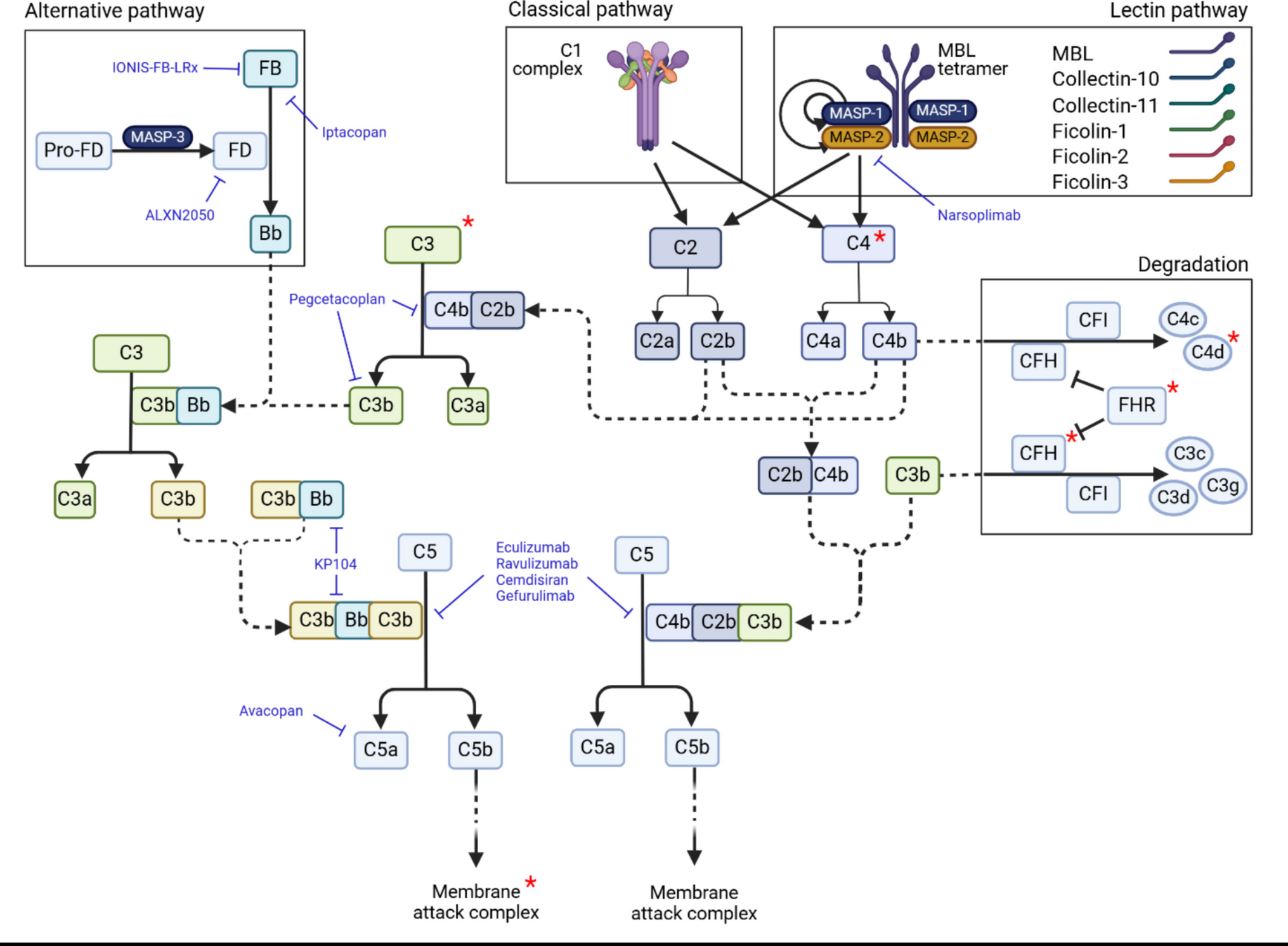
Mastellos DC, Hajishengallis G, Lambris JD (2024) A guide to complement biology, pathology and therapeutic opportunity. Nat Rev Immunol 24:118–141. https://doi.org/10.1038/s41577-023-00926-1
Article
CAS
PubMed
Google Scholar
Brocklebank V, Wood KM, Kavanagh D (2018) Thrombotic microangiopathy and the kidney. Clin J Am Soc Nephrol 13:300. https://doi.org/10.2215/CJN.00620117
Article
CAS
PubMed
Google Scholar
BioRender (n.d.) https://www.biorender.com/. Accessed 5 May 2025
Bohlson SS, Garred P, Kemper C, Tenner AJ (2019) Complement nomenclature—deconvoluted. Front Immunol 10:1308. https://doi.org/10.3389/fimmu.2019.01308
Reid KBM (2018) Complement component C1q: historical perspective of a functionally versatile, and structurally unusual, serum protein. Front Immunol 9:764. https://doi.org/10.3389/fimmu.2018.00764
Murata K, Baldwin WM (2009) Mechanisms of complement activation, C4d deposition, and their contribution to the pathogenesis of antibody mediated rejection. Transplant Rev 23:139–150. https://doi.org/10.1016/j.trre.2009.02.005
Article
Google Scholar
Dobó J, Kocsis A, Farkas B et al (2024) The lectin pathway of the complement system—activation, regulation, disease connections and interplay with other (proteolytic) systems. Int J Mol Sci 25:1566. https://doi.org/10.3390/ijms25031566
Article
CAS
PubMed
PubMed Central
Google Scholar
Vorup-Jensen T, Petersen SV, Hansen AG et al (2000) Distinct pathways of mannan-binding lectin (MBL)- and C1-complex autoactivation revealed by reconstitution of MBL with recombinant MBL-associated serine protease-21. J Immunol 165:2093–2100. https://doi.org/10.4049/jimmunol.165.4.2093
Article
CAS
PubMed
Google Scholar
Ambrus G, Gál P, Kojima M et al (2003) Natural substrates and inhibitors of mannan-binding lectin-associated serine protease-1 and -2: a study on recombinant catalytic fragments 1. J Immunol 170:1374–1382. https://doi.org/10.4049/jimmunol.170.3.1374
Article
CAS
PubMed
Google Scholar
Degn SE, Hansen AG, Steffensen R et al (2009) MAp44, a human protein associated with pattern recognition molecules of the complement system and regulating the lectin pathway of complement activation1. J Immunol 183:7371–7378. https://doi.org/10.4049/jimmunol.0902388
Article
CAS
PubMed
Google Scholar
Stover CM, Thiel S, Thelen M et al (1999) Two constituents of the initiation complex of the mannan-binding lectin activation pathway of complement are encoded by a single structural gene1 2 3. J Immunol 162:3481–3490. https://doi.org/10.4049/jimmunol.162.6.3481
Article
CAS
PubMed
Google Scholar
Dahl MR, Thiel S, Matsushita M et al (2001) MASP-3 and its association with distinct complexes of the mannan-binding lectin complement activation pathway. Immunity 15:127–135. https://doi.org/10.1016/S1074-7613(01)00161-3
Article
CAS
PubMed
Google Scholar
Roos A, Bouwman LH, van Gijlswijk-Janssen DJ et al (2001) Human IgA activates the complement system via the mannan-binding lectin pathway. J Immunol 167:2861–2868. https://doi.org/10.4049/jimmunol.167.5.2861
Article
CAS
PubMed
Google Scholar
Dobó J, Kocsis A, Gál P (2018) Be on target: strategies of targeting alternative and lectin pathway components in complement-mediated diseases. Front Immunol 9:1851. https://doi.org/10.3389/fimmu.2018.01851
Article
CAS
PubMed
PubMed Central
Google Scholar
Oroszlán G, Dani R, Szilágyi A et al (2017) Extensive basal level activation of complement mannose-binding lectin-associated serine protease-3: kinetic modeling of lectin pathway activation provides possible mechanism. Front Immunol 8:1–14. https://doi.org/10.3389/fimmu.2017.01821
Article
CAS
Google Scholar
Medjeral-Thomas N, Pickering MC (2016) The complement factor H-related proteins. Immunol Rev 274:191–201. https://doi.org/10.1111/imr.12477
Article
CAS
PubMed
Google Scholar
Merle NS, Church SE, Fremeaux-Bacchi V, Roumenina LT (2015) Complement system part I – molecular mechanisms of activation and regulation. Front Immunol 6:262. https://doi.org/10.3389/fimmu.2015.00262
Article
CAS
PubMed
PubMed Central
Google Scholar
Vivarelli M, Barratt J, Beck LH et al (2024) The role of complement in kidney disease: conclusions from a Kidney Disease: Improving Global Outcomes (KDIGO) controversies conference. Kidney Int 106:369–391. https://doi.org/10.1016/j.kint.2024.05.015
Article
CAS
PubMed
Google Scholar
Brocklebank V, Walsh PR, Smith-Jackson K et al (2023) Atypical hemolytic uremic syndrome in the era of terminal complement inhibition: an observational cohort study. Blood 142:1371. https://doi.org/10.1182/blood.2022018833
Article
CAS
PubMed
PubMed Central
Google Scholar
Kavanagh D, Goodship TH, Richards A (2013) Atypical hemolytic uremic syndrome. Semin Nephrol 33:508. https://doi.org/10.1016/j.semnephrol.2013.08.003
Article
CAS
PubMed
PubMed Central
Google Scholar
Caprioli J, Castelletti F, Bucchioni S et al (2003) Complement factor H mutations and gene polymorphisms in haemolytic uraemic syndrome: the C-257T, the A2089G and the G2881T polymorphisms are strongly associated with the disease. Hum Mol Genet 12:3385–3395. https://doi.org/10.1093/hmg/ddg363
Article
CAS
PubMed
Google Scholar
Jiang H, Fan M-N, Yang M et al (2016) Association among complement factor H autoantibodies, deletions of CFHR, and the risk of atypical hemolytic uremic syndrome. Int J Environ Res Public Health 13:1209. https://doi.org/10.3390/ijerph13121209
Article
CAS
PubMed
PubMed Central
Google Scholar
Pickering MC, de Jorge EG, Martinez-Barricarte R et al (2007) Spontaneous hemolytic uremic syndrome triggered by complement factor H lacking surface recognition domains. J Exp Med 204:1249–1256. https://doi.org/10.1084/jem.20070301
Article
CAS
PubMed
PubMed Central
Google Scholar
Smith-Jackson K, Yang Y, Denton H et al (2019) Hyperfunctional complement C3 promotes C5-dependent atypical hemolytic uremic syndrome in mice. J Clin Invest 129:1061. https://doi.org/10.1172/JCI99296
Article
PubMed
PubMed Central
Google Scholar
Legendre CM, Licht C, Muus P et al (2013) Terminal complement inhibitor eculizumab in atypical hemolytic-uremic syndrome. N Engl J Med 368:2169–2181. https://doi.org/10.1056/NEJMoa1208981
Article
CAS
PubMed
Google Scholar
National Institute for Health and Care Excellence (2021) Overview | ravulizumab for treating atypical haemolytic uraemic syndrome. https://www.nice.org.uk/guidance/ta710. Accessed 30 Mar 2025
Pickering MC, D’Agati VD, Nester CM et al (2013) C3 glomerulopathy: consensus report. Kidney Int 84:1079–1089. https://doi.org/10.1038/ki.2013.377
Article
PubMed
PubMed Central
Google Scholar
Hou J, Markowitz GS, Bomback AS et al (2014) Toward a working definition of C3 glomerulopathy by immunofluorescence. Kidney Int 85:450–456. https://doi.org/10.1038/ki.2013.340
Article
CAS
PubMed
Google Scholar
Smith RJH, Appel GB, Blom AM et al (2019) C3 glomerulopathy — understanding a rare complement-driven renal disease. Nat Rev Nephrol 15:129–143. https://doi.org/10.1038/s41581-018-0107-2
Article
PubMed
PubMed Central
Google Scholar
Bomback AS, Charu V, Fakhouri F (2025) Challenges in the diagnosis and management of immune complex-mediated membranoproliferative glomerulonephritis and complement 3 glomerulopathy. Kidney Int Rep 10:17–28. https://doi.org/10.1016/j.ekir.2024.09.017
Article
PubMed
Google Scholar
Nester CM, Bomback AS, Ariceta Iraola MG et al (2024) VALIANT: a randomized, multicenter, double-blind, placebo (PBO)-controlled, phase 3 trial of pegcetacoplan for patients with native or post-transplant recurrent glomerulopathy (C3G) or primary immune complex membranoproliferative glomerulonephritis (IC-MPGN): SA-OR92. J Am Soc Nephrol 35:10.1681/ASN.2024qdwvz5bg. https://doi.org/10.1681/ASN.2024qdwvz5bg
Nester C, Smith R, Kavanagh D et al (2025) WCN25-2041 efficacy and safety of iptacopan in patients with C3 glomerulopathy: 12-month results from the phase 3 APPEAR-C3G study. Kidney Int

Comments (0)