VV-ECMO as a bridge to lung transplantation may improve transplant candidacy for patients with end-stage lung disease. However, both VV-ECMO and sensitization are independently associated with worse post-transplant outcomes. This study investigated the early mortality risk and survival in sensitized patients bridged to lung transplant with VV-ECMO. We found that 10.0% of our patients required VV-ECMO as a bridge to lung transplantation, of which 57.5% were cPRA-positive and 42.5% were cPRA-negative. Post-transplant complication rates, one-year survival, and overall survival were comparable between cPRA-positive and -negative groups. Despite the independent risks of VV-ECMO and sensitization, these findings suggest that cPRA positivity does not confer additional risk in lung transplant recipients bridged with VV-ECMO.
Although VV-ECMO as a bridge to lung transplantation has clear benefits for critically ill patients on the waiting list, it carries known risks. Some of the most frequent complications with perioperative ECMO use are the increased incidence of bleeding and thromboembolic events, which are associated with worse survival [25, 26]. However, in our cohort, we found no significant difference in intraoperative blood transfusions, post-transplant DVT, and post-transplant PE between cPRA-positive and -negative patients. These findings suggest that while sensitization itself may predispose to immune-mediated complications, it does not necessarily potentiate the bleeding and thromboembolic risks of VV-ECMO. Furthermore, our anticoagulation and ECMO protocols may have mitigated potential added risks in sensitized patients [20].
Renal injury is another common early complication following lung transplantation. ECMO has been linked to higher rates of AKI and increased need for renal replacement therapy, both of which are associated with greater hospital mortality [27, 28]. Sensitized patients often require more intensive immunosuppression, which can contribute to nephrotoxicity [29]. Additionally, increased intraoperative transfusions from both VV-ECMO and sensitization may exacerbate the risk of renal injury through volume overload [30]. In our study, rates of AKI (69.6% cPRA-positive vs. 76.5% cPRA-negative, p = 0.73) and dialysis requirement (34.8% vs. 41.2%, p = 0.75) were substantial but not significantly different between groups. These findings suggest that sensitization does not confer additional risk for renal injury in patients bridged to lung transplantation with VV-ECMO, despite the baseline risks associated with VV-ECMO and sensitization. Although VV-ECMO may delay early post-transplant recovery [31], we found that cPRA positivity did not further prolong post-transplant ventilator use, ICU stay, or hospital length of stay. This may be because cPRA-positive patients did not experience significantly higher rates of post-transplant complications such as AKI, DVT, or PE which can hinder recovery.
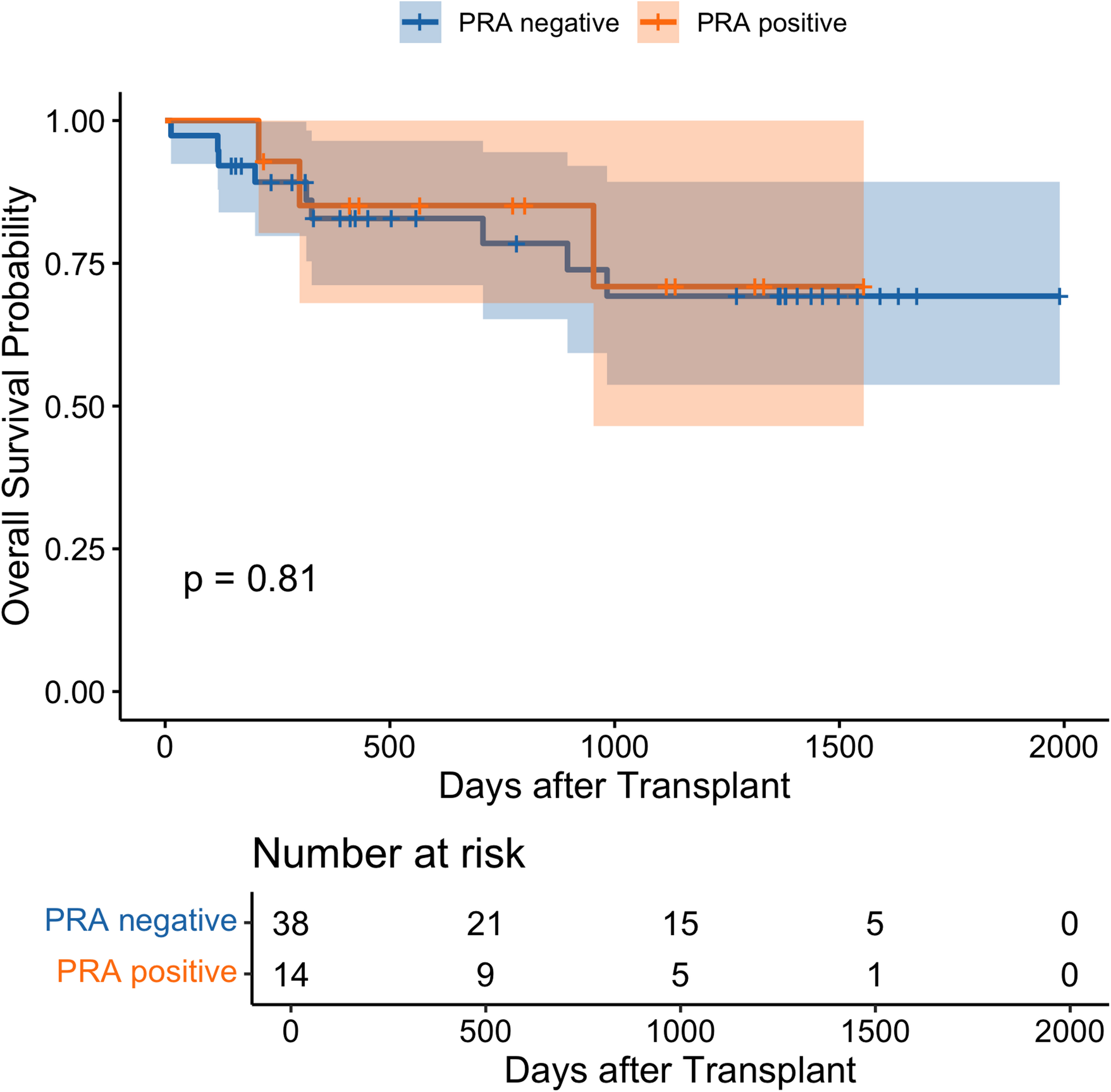
Sensitization, particularly the development of anti-HLA antibodies, poses a significant risk for graft rejection and poor outcomes in lung transplant recipients [32, 33]. Both sensitization and VV-ECMO have been associated with increased risk for primary graft dysfunction (PGD), a major predictor of early morbidity and mortality after lung transplantation [34, 35]. We found that rates of PGD in any grade (69.6% cPRA-positive vs. 64.7% cPRA-negative, p > 0.99) and PGD grade 3 (39.1% vs. 41.2%, p > 0.99) were high in both groups, reflecting inherent risks in VV-ECMO and lung transplantation. However, rates of PGD development were not greater the cPRA-positive group, suggesting that the additive impact of sensitization may be minimal or insignificant in the context of VV-ECMO bridging, where baseline PGD risk is already elevated [35]. Finally, we found that 1-year survival rates and overall survival were similar between cPRA-positive and -negative groups. cPRA positivity was not a significant predictor of either PGD grade 3 or overall survival. It is possible that our aggressive perioperative immunosuppressive regimen of plasmapheresis, eculizumab, and ATG employed in cPRA-positive patients may have helped attenuate the immunologic risks associated with sensitization, contributing to similar PGD development rates and survival outcomes. Moreover, recent studies have shown that one-year and overall survival after lung transplantation do not differ between VV-ECMO-bridged and non-bridged patients, suggesting that with appropriate perioperative desensitization and immunosuppression, even sensitized patients bridged on VV-ECMO may achieve outcomes comparable to non-VV-ECMO recipients [36, 37] evertheless, further investigation is needed to clarify the role and efficacy of perioperative immunosuppression strategies in this high-risk population.
This study has several limitations. First, it is a single-center retrospective analysis, which may limit the generalizability of the findings and the power of the study. Given the modest sample size, non-significant p-values may reflect insufficient power rather than true equivalence. Observed trends—such as numerically lower PE incidence in cPRA-positive patients—may warrant investigation in larger, multicenter cohorts. Although cPRA-positive and -negative groups did not differ significantly in pre-transplant traits, laboratory values, or donor characteristics, the cPRA-negative cohort was on average three years older, had nearly threefold greater smoking prevalence, and received lungs from donors two years older—imbalances that, despite non-significance in univariate Cox models, may contribute to residual confounding. Although we did not have the power to perform propensity score matching, cPRA-positive and -negative groups did not have significant differences in pre-transplant traits, lab values, or donor characteristics. Additionally, while we adjusted for multiple variables in the multivariate analysis, residual confounding factors may still influence the results. Therefore, studies using matched analyses to control for these confounding variables may be necessary. Third, there is no data available about cPRA before VV-ECMO support. Finally, while cPRA-positive patients had comparable one-year survival outcomes to their cPRA-negative counterparts, the long-term impact of sensitization in VV-ECMO bridged patients beyond one-year post-transplant remains unclear. Our cohort includes only patients who survived to receive lung transplantation; we lack data on VV-ECMO–bridged candidates who died or were weaned prior to transplant. Thus, our findings may underestimate the accurate risk profile of VV-ECMO in sensitized wait-listed patients. Future prospective studies should capture the full spectrum of outcomes—including pre-transplant mortality and weaning—in order to mitigate selection bias. Also, our registry lacks detailed VV-ECMO management metrics—such as support duration, circuit exchange frequency, documented thromboses, and ECMO-related infections—which likely modulate both immunologic sensitization and transfusion exposure. Prospective data collection with standardized ECMO event logging will be necessary to delineate these contributions. We only captured pre-transplant pRBC transfusion within the 4-week and 1-week windows; FFP and platelet exposures over the whole duration of VV-ECMO support were not available. Given that the majority of our cohort had prolonged VV-ECMO runs for ARDS, unmeasured cumulative transfusions may have influenced cPRA levels. Future prospective studies will comprehensively record all blood product exposures during ECMO to better delineate their role in allo-sensitization. Notably, our institution’s protocol includes aggressive perioperative desensitization—plasmapheresis with eculizumab ± ATG/IVIG for cPRA ≥ 30% [38]—and a low-intensity anticoagulation strategy during VV-ECMO (subcutaneous heparin only unless otherwise indicated) [20]. These measures may have attenuated both immunologic and thrombotic complications in our sensitized cohort and therefore may not fully reflect outcomes in centers using different desensitization or anticoagulation regimens. We acknowledge that our modest sample size—particularly in the cPRA-positive VV-ECMO subgroup—limits statistical power. Non-significant differences may represent type II error, and trends warrant evaluation in a larger population. To enhance generalizability, future validation through multicenter prospective registries—such as the Extracorporeal Life Support Organization (ELSO) database or the ISHLT Lung Transplant Registry—is essential. Such collaborative efforts can capture diverse ECMO management practices and larger patient numbers to confirm our findings.
In conclusion, this study demonstrates that sensitized lung transplant recipients bridged with VV-ECMO experience similar intraoperative and post-transplant outcomes—including amounts of blood transfusions, rates of PGD and AKI, and hospital length of stay—compared to their non-sensitized counterparts. Although transplant teams should still carefully evaluate the independent risks associated with VV-ECMO and sensitization, the comparable 1-year and overall survival outcomes indicate that VV-ECMO remains a viable bridge-to-transplant strategy, even in highly sensitized patients.

Comments (0)