
Remember me

In the contemporary discourse on cognitive warfare, as explored by Deppe and Schaal (2024), Reczkowski and Lis (2022). and others, there is a growing focus on information warfare, particularly observed in the strategies employed by countries such as Russia or China to achieve politico-military objectives. This literature highlights the importance of various factors that mitigate cognitive barriers and disruptions in the social domain. At this point, it is important to mention the knowledge about human beings and their cognitive faculties that we have obtained thanks to Catholic moral theology. The primary goal of those engaged in cognitive warfare is to influence the interrelated beliefs, values (both social and religious), and cultural elements of individuals, groups, and/or populations through the manipulation of the information environment. In essence, the goal is to shape the perceptions and reasoning of a social entity (be it an individual, group, or population) in accordance with the preferences of the potential aggressor. A broader definition characterizes cognitive warfare as “a psychological strategy aimed at gradually shaping the beliefs of the targeted public” (Yu, 2023, p. 87) or as “an unconventional form of warfare that uses cyber tools to modify the enemy’s cognitive processes, exploit mental biases or reflexive thinking, and induce thought distortions to influence decision-making and impede actions, resulting in adverse effects at both the individual and collective levels” (Claverie & du Cluzel, 2022). From another perspective, cognitive security is understood as protection against malicious influences, provoked by both external factors and AI, which can disrupt the cognitive approach to reality (Huang et al., 2023). This includes the provision of an adequate framework for cognitive access to the object of study. It refers to a state of safety with respect to cognitive processes and involves ensuring the well-being and reliability of mental functions, particularly those related to perception, reasoning, memory, and decision-making (Roszak et al., 2024).
As has been demonstrated, practicing moral virtues appears to raise the level of cognitive safety. Some virtues increase the intellect’s ability to recognize truth and improve its understanding of the laws operating in the surrounding reality. Conversely, virtues that strengthen the will are useful for combating manipulative cognitive warfare techniques that exploit human reasoning weaknesses, particularly those designed to influence decisions, emotions, and autonomy. Developing virtues of the will increases a person’s resistance to adversity, fatigue, and uncontrolled indulgence in sensual pleasures. This enables them to consistently pursue the good they have learned and to obey the law. This can protect citizens from the deliberate exploitation of their cognitive and volitional weaknesses by their enemies. It also strengthens their freedom, which is understood as the ability to correctly recognize and choose the good.
As Miller (2023) notes, the challenges posed by the advent of cognitive warfare are considerable, not least for liberal democracies committed to ethical or moral (we use these terms interchangeably) values and principles such as freedom of communication, democratic processes, the rule of law, evidence-based truth-telling, and so on. Thus, while there is a need to curb disinformation, there is also a need to do so without undermining freedom of communication. Again, there is a need to combat states that engage in cognitive warfare, but it is problematic for a liberal democratic state to do so by spreading its own self-serving disinformation or by attempting to manipulate citizens of authoritarian states. Another issue is that of responsibility. Given the nature of cognitive warfare, there is a need for a variety of institutions other than just governments and security agencies to take responsibility for combating cognitive warfare, such as by building resilience to disinformation, ideology, and the use of manipulative techniques. What exactly are these responsibilities, and to which institutions should they be assigned? In general, we propose a collective responsibility (understood as shared responsibility) on the part of several institutions (or at least their members), including governments, security agencies, media organizations, and educational institutions such as schools and universities (Miller, 2023).
In the authors’ opinion, cognitive activities are and will be of special interest to revisionist countries such as Russia and China, which use these activities as an element of rivalry with the West. In the years 2000–2007, these countries developed concepts of cognitive operations together with an effective model for their implementation, having many years of experience in the field of information, deception, and psychological operations. The organization of the system of cognitive operations in these countries, which includes all elements of the state command and control system along with the coordinating and managing role of the highest state bodies, should be emphasized.
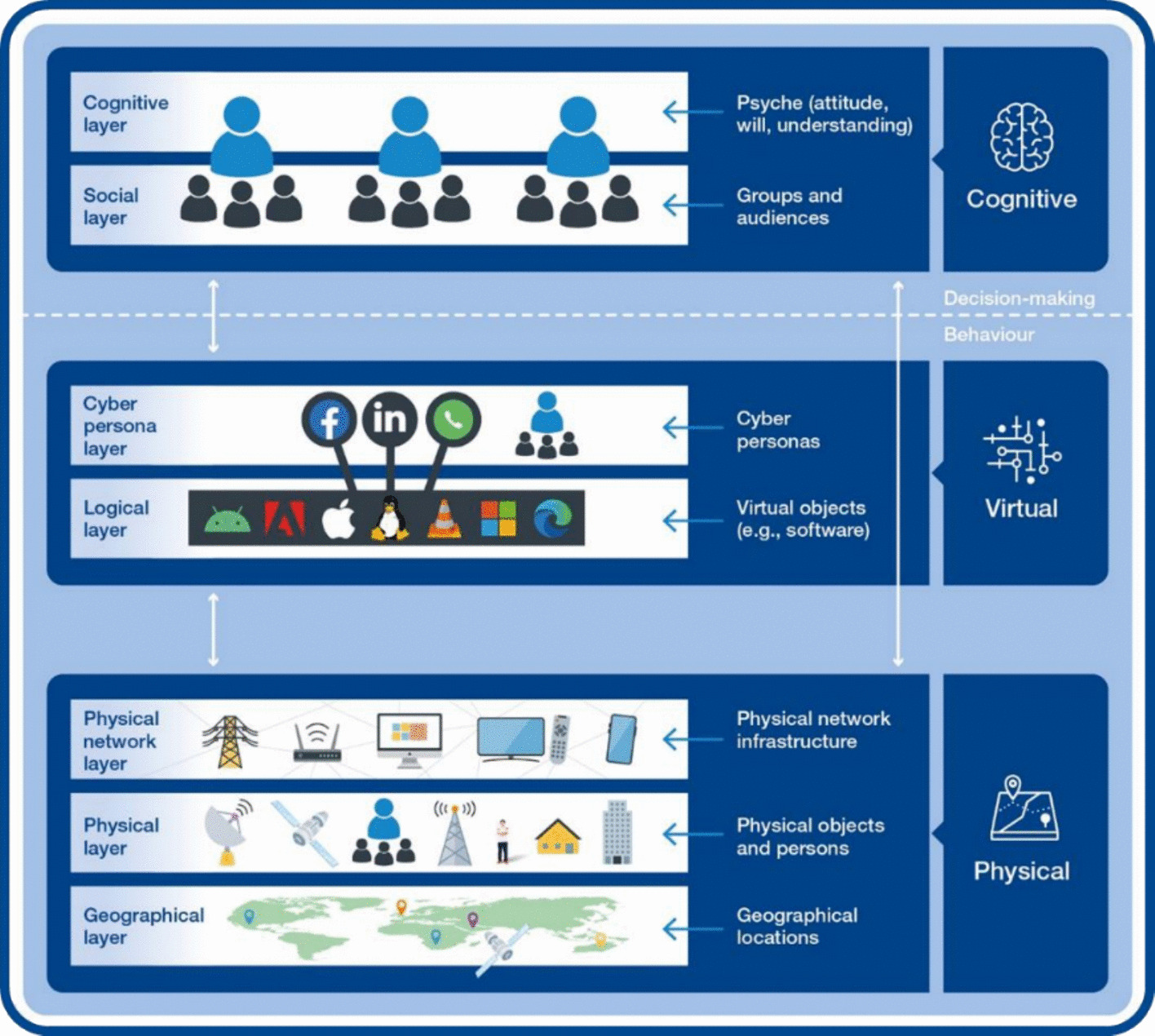
In this regard, Russia, for example, has developed and implemented a multidimensional model of mental warfare, the strategic goal of which is to destroy the will and ability to defend the state by changing individual and mass social consciousness (Greidina, 2022; Ilnicky, 2022; Wojnowski, 2024). The main targets of mental warfare are the political elite, the leadership of the state, the leadership of the armed forces, and society in general. Russia is particularly interested in interfering with the decision-making processes of these targets by disrupting their perceptions (see Fig. 3). The final goal is achieved through indirect actions that lead to the breakdown of social ties, the separation of the leadership elite from society, the destruction of trust, and the creation of a suitable line of divisions and conflicts that destroy the national and social community.
Fig. 3
The Observe, Orient, Decide, Act (OODA) Loop, a Decision-Making Model Developed by John Boyd (1995), Versus Cognitive Warfare Goals
As Wojnowski (2024) notes, Russia achieves its goals of mental warfare through long-term measures aimed at destroying moral, spiritual, and cultural values and traditions, defragmenting national identity, and demoralizing society and the military. As a result, it also destroys the freedom of individuals by weakening their cognitive abilities and influencing their decision-making processes. These measures are implemented on a strategic level with a long-term perspective. Mental warfare is conducted using all available tools and means that affect the cognitive abilities of the opposing side (Wojnowski, 2024). However, it is important to note that Russia uses all existing tools and means to achieve its goals in the field of mental and cognitive warfare, which leads to the disruption of the cognitive abilities of the human mind in the fields of information, psychological, cognitive, neuroscience, neurophysiology, biotechnology, and emerging and disruptive technologies, including AI.
Therefore, in the authors’ opinion, the biggest challenge for all Western countries in the field of cognitive activities is aggressive Russian actions, which are ongoing regardless of the state of the country’s defense readiness. In addition, Russia, like China, has developed capabilities to carry out the entire spectrum of cognitive activities and operations carried out by civilian and military entities within the state’s command and control system. These capabilities are reinforced by its own research and development facilities and education and training centers. Since the beginning of the twenty-first century, Russia and China have had special structures dedicated to conducting cognitive warfare activities and have implemented new concepts in this area.
Literature analysis and the authors’ own research indicate that in the case of Russia, the units responsible for cognitive activities and operations in the broad sense are located throughout the chain of the state’s command and control system at the strategic level. In the case of nonmilitary elements of the Russian security system, the task of directing cognitive activities and operations is carried out by the administration of the president of the Russian Federation together with specialized organizational units that supervise and coordinate all projects in this area in the country (the Russian Security Council and the Council of Ministers of the Russian Federation through the Ministry of Foreign Affairs of the Russian Federation). In the case of the military components of the Russian security system, these tasks are performed by individual levels of the command and control system, such as the National Center for Defense Control and its specialized organizational units, which supervises and coordinates all projects in this area in the Ministry of Defense and the Armed Forces; the General Staff of the Armed Forces of the Russian Federation, including the Military Intelligence Service; and command structures of military districts with specialized units.
In the case of the Republic of Belarus, the military elements of the security system of the Russian Federation engaged in cognitive activities in the broadest sense include the Ministry of Defense of the Republic of Belarus and its specialized organizational units, including intelligence and ideological units; the Military Intelligence Service of the Republic of Belarus and its specialized organizational units; and operational command structures and their specialized units. In China, on the other hand, the Central Military Commission and the Chinese People’s Liberation Army, together with the specially designated Information Support Force, including specialized cyberspace operations structures, are responsible for cognitive activities and operations in the command and control system.
Importantly, in the authors’ opinion, the actions of the Russian Federation, Belarus, or China (especially those against Western countries) will, by their nature, tend to fall below the threshold of Article 5 of the Washington Treaty, or below the level of force necessary to persuade the United Nations Security Council to adopt a resolution (unless new “red lines” are drawn for these countries, which, if crossed, would lead to open armed conflict). This means that in our modern era—an era of strategic rivalry between countries—cognitive activities, among other things, will be constantly used by these countries (and others) to achieve their own goals. Therefore, we should expect a number of challenges and threats, the main sources of which for Western countries as a whole will probably be Russia and China.
However, this threat does not go unchallenged. Research suggests that resilience can be strengthened through education on cognitive biases, AI-based misinformation detection, and regulatory frameworks for emerging technologies (Bernal et al., 2020; Cullen et al., 2021). NATO’s cognitive warfare concept, under development since 2023, aims to integrate these defenses into military and civilian strategies (Deppe & Schaal, 2024). However, current technological progress is outpacing current efforts, requiring urgent action. To counter these threats and challenges, one of the key actions should be to achieve a cognitive advantage over a potential adversary, including through the detection of hostile actions (preferably with the support of emerging and disruptive technologies). In the authors’ view, it will also be important to take proactive measures to shape the cognitive dimension by more closely integrating instruments of power, military instruments of power, and society. The religious practices of a given society are also significant in this regard. The values and skills they impart increase cognitive security and reduce the risk of manipulation. This will not only build the right cognitive resilience but will also build and enhance operational capabilities to counter evolving cognitive threats.
As Hansen (2017) and Waltzman (2017) rightly point out, the ongoing “weaponization of information” and thus the “weaponization of the human cognitive dimension” not only draw our attention to the problems and challenges associated with this domain but also make us aware of the new possibilities offered by modern information technology. While the main part of the operation takes place in the cognitive domain, the digital domain is the stage for the transmission of information from the sender to the target. In other words, new information technology is a force multiplier that allows the sender to both reach the recipients of the information immediately and influence the way they think and act. Furthermore, it is important to remember that not all information flows constitute the use of information as a weapon; to perceive them as such would be highly destructive to regular communication between entities. Nevertheless, further work is needed to help users distinguish between information flows that are entirely regular and just part of everyday communication and those that are deliberately designed to exert a cognitive influence on the target. The label of weaponization is currently analytically opaque and used too indiscriminately (Hansen, 2017; Waltzman, 2017).
In conclusion, cognitive warfare represents a critical shift in modern conflict in which the human mind becomes both target and weapon. Its mechanisms—information overload, narrative manipulation, and neurological disruption—exploit cognitive vulnerabilities with precision and are amplified by AI, data analytics, and neurotechnology. The implications are stark; individuals are losing autonomy, societies are fragmenting, and global stability is buckling under the weight of invisible assaults. The authors and many experts advocate an interdisciplinary and holistic approach—combining psychology, neuroscience, ethics, and Christian theology—to secure the cognitive dimension. Without proactive measures, cognitive warfare threatens to reshape societies in ways that undermine the principles of freedom and stability. The mind, once a sanctuary, is now a battlefield. Protecting it is therefore the challenge of our time, for which we can draw on the experience and wisdom from previous times, as we have illustrated using the example of Thomas Aquinas’s teaching.
Comments (0)