
Remember me

Insulin crystals have been grown in microgravity and have, in some cases, been found to be superior in size and overall order [4, 13]. Additionally, Redwire has grown insulin crystals in the microgravity environment of the ISS in two types of Pharmaceutical In-space Laboratory – Biocrystal Optimization eXperiments (PIL-BOXes), the PIL-BOX Fluidics Cassette (FC) and the PIL-BOX Dynamic Microscopy (DM). The crystals that were formed in microgravity in the PIL-BOX FC were larger and had no visible imperfections compared to those formed on the ground. In comparison, the crystals that formed in the reaction chambers of the PIL-BOX DM in microgravity were, unexpectedly, smaller than the crystals formed in the reaction chambers for the ground study (0.40 mm). However, none of the observed crystals in the reaction chambers formed in microgravity had cracks or defects compared to the ground crystals which did. All of the crystals formed in microgravity had clear faces, sharp edges and were without obvious inclusions or imperfections.
The focus of space enabled protein crystal growing has changed in recent years. The shift is towards crystal growth of commercially significant products, not for structure determination and improved academic understanding but for form and ultimately formulation. This change in direction can be traced back to a study performed by Merck Sharp & Dome Corp [14]. In this study the Merck product, Pembrolizumab (Keytruda), was crystalized on orbit to improve the homogeneity of the size distribution of this monoclonal antibody product. The resulting crystalline suspensions were found to be less viscous and sedimented more uniformly upon returning to earth than the comparable ground-based crystalline suspensions. This was presumed to be the result of improved control of nucleation through the key variables: temperature gradients and sedimentation. The team applied the outcomes from the space-based study to the production of crystalline suspensions in subsequent Earth-based development studies, using rotational mixers to reduce sedimentation and temperature gradients, to induce and control crystallization. It has been presumed that this space-based effort led to the next generation version of this product which, due to an improved formulation, is being evaluated for new routes of administration in the hope that this will lead to improved adherence, patient experience, efficacy and perhaps lower costs [15].
The Pembrolizumab study, which was directed at crystal growth for form, focused on a monoclonal antibody and represents a new approach to protein crystallization in microgravity. Not only is it a new class of compound for study, but this program also represents a new rationale for executing the work. The focus is not on structure determination but for purity and form. Other monoclonal antibodies (representing significant commercial value) could also benefit from the development of improved crystal structure, new forms and improved uniformity. The new focus has led Redwire (and others) to change tactics in their approach as well. It is not just that new protein targets are being selected based on commercial value, new types of targets are being examined like small molecules for example. To study these new molecule types the design for hardware is also an area for consideration.
Generally, in the past, the protein crystal growing programs were developed by groups with experience in terrestrial protein crystal growth. Hardware that was optimized in their labs, would be used for microgravity work and, if necessary, modified for the task. For this next wave of commercial work, there are two new approaches seen.
The first method is that described by the Merck team. In this approach, simple hardware systems that reflect the tools from the lab are used as a foundation for work done in space. These systems are simple, cost effective and easy to operate. They also, as suggested in the Merck paper [14], lend themselves toward in space production of the setups using a plastic 3D-printer. These systems require astronaut assistance but with a little training this is not a problem and with live “eyes on” operations allow for dynamic trouble shooting and limited qualitative observational evaluation.
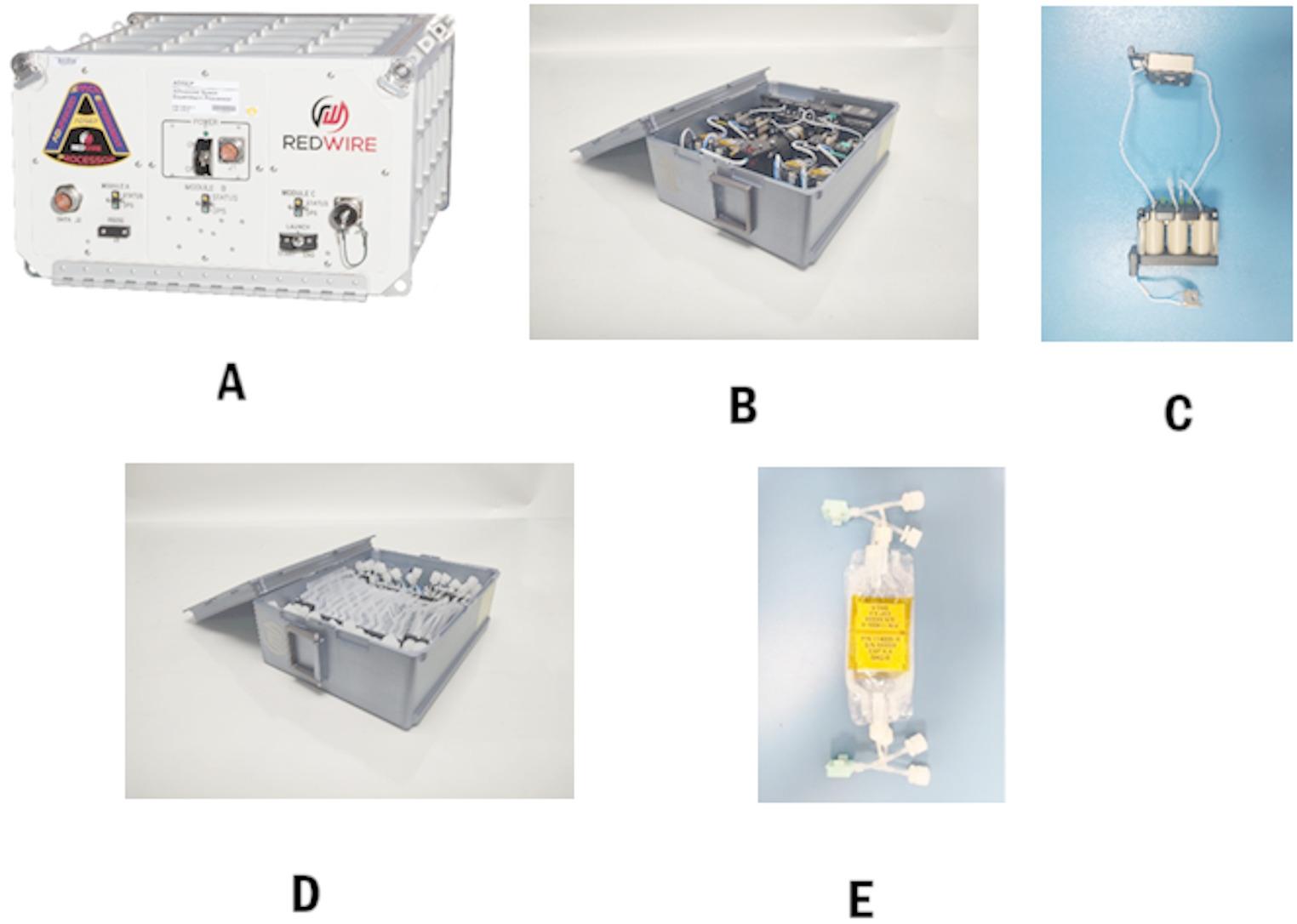
The second approach employes an automated and more sophisticated method for crystal growing. The Redwire team has developed a suite of different cassette-based systems called the PIL-BOX systems (Figs. 1 and 2) [16]. The PIL-BOX FC can perform up to twenty unique crystallization experiments but does not include observational capabilities. The second system, the PIL-BOX DM, can perform up to four unique experiments while recording video or taking still images of the crystallization process for peptides/proteins and small molecule effort requiring organic solvents. The PIL suite of hardware is operated using the ADvanced Space Experiment Processor (ADSEP) mid-deck locker equivalent which resides on the ISS. The set-ups (hardware and experiments) are built into the PIL-BOXes that are flown to station and installed into the ADSEP facility for power and data connections. The PIL-BOX fluid loop components provide precise fluid transfer handling that allows for solvent / anti-solvent fluid handling and mixing. These systems are expensive and relatively complex but enable autonomous operation and, with new analytical tools, remote viewing with microscopic cameras and soon spectroscopic evaluations. This leads us closer to the capabilities we expect in a modern-day laboratory and in addition to expanding capabilities on the ISS, enables this work on future free flying systems without astronaut support and toward the next generation of Space Stations and exploration missions.
Reichert, et al. [14] also mention a drawback common to past crystal growth efforts. Studies have in the past been run as “black box” experiments with little or no detailed observational ability of the transformation occurring during operations. As a result, little is understood about what happened on orbit other than what an astronaut may be able to see. Even in examples where professional protein crystallographers have flown as astronauts [17], the ability to understand what happened is still best understood once the samples have been returned and evaluated terrestrially. This leads to a variety of potential issues to understand what is happening in microgravity. There is a chance that what is found in the final ground-based evaluation, was not what was produced in the microgravity environment of the orbiting platform. The forces that the material is exposed to upon reentry may change the result or as we have seen, some molecules may undergo transition [16] either related to the change of gravitational force or due to a process unrelated to gravity. Based only on what you get in the lab on the ground weeks after the space-based study samples are returned, you may not have a full picture of the outcome or have missed important transition information provided in microgravity during the formation of stable crystallization structures.
Fig. 1
Redwire hardware used for on orbit crystal growth operations including Images of the ADSEP Facility (A), a PIL-BOX DM (B), a PIL-BOX DM fluid loop (C), a PIL-BOX FC (D), and a PIL-BOX FC fluid loop (E)
Fig. 2
The basic schematics of the PIL-BOX DM fluid loop (Left) and the PIL-BOX FC fluid loop (Right)
The second benefit to having on orbit analytical capabilities is that you can “watch” things happen to better understand the processes and factors that are influencing the outcomes. As an example of the capabilities of the more sophisticated system with on orbit observational capabilities we will consider one result from recent efforts. Lysozyme, in addition to possessing strong antibacterial and anti-inflammatory properties with uses in medicine, cosmetics, and food preservation, has been utilized as a control example for testing and understanding the capability of a protein crystal growing apparatus. Crystals of Lysozyme are generally simple to produce, consistent in size and shape and easily recognized. We grew crystals of Lysozyme in the PIL-BOX hardware on the ground and generated crystals of the expected size and shape. We then performed the same study in the same hardware set up in the Microgravity Environment of the ISS (Fig. 3). During the space-based operations, we were again able to record images during the growth period.
The images of the crystals growing in orbit show that the crystals retain the same overall gross shape characteristics (habit) but there are some significant differences. The crystals grown on the ground at first glance look clean and sharp, but a close inspection shows them to have rough faces and edges that ridged and imperfect. The crystals of Lysozyme grown in microgravity possess sharp edges and flat surfaces that look almost polished, see Fig. 3. Also, the crystals grown on earth were a variety of shapes and sizes, whereas the crystals grown in orbit are consistently sized cuboid prisms in overall shape, see also Fig. 3.
Fig. 3
Comparison of Lysozyme crystals grown Terrestrially (A) to those grown in the same system under the same conditions on the ISS (B). Image (C) shows the imperfections seen on the solution-oriented face of a Lysozyme crystal growing Terrestrial study
Images recorded during the crystal growing effort on station during operations were also evaluated and provide explanation (at least in part) for the improved results. In Fig. 4, there is no change in perspective or magnification. These images show the effects of time passing and the crystal growing over a span of six hours. Notice that over this period the crystal does not rotate or fall. This is indicative of the quiescent nature of the microgravity environment on station and supports the reasoning for the improved quality of crystals grown in orbit.
Fig. 4
Lysozyme crystals time sequence of growth over six hours in the microgravity environment of the International Space Station
One of the challenges for growing large protein crystals is that molecular defects are amplified as the crystal grows. These defects, be they cracks, twins, or impurities, will magnify as the crystal grows which can either slow/stop the crystal growth on some faces, and create excessive nucleation on other faces [18]. Once these defects reach a critical point, the crystal will “break” under the stresses of this uneven growth (Fig. 5A). In microgravity, defects on the growing face of the crystals are reduced, allowing crystals to grow larger than their Earth-grown counterparts (Fig. 5B).
Fig. 5
Insulin grown on the ground (A) and on the ISS under the same conditions (B)
Comments (0)