Gornitzky A, Diab M. Coping skills in children: current concept review. JPOSNA. 2021;3(1). https://doi.org/10.55275/JPOSNA-2021-211. Website is: https://www.jposna.org/index.php/jposna/article/view/211. Accessed 10 Sept 2025
Helmerhorst GT, Teunis T, Janssen SJ, Ring D. An epidemic of the use, misuse and overdose of opioids and deaths due to overdose, in the United States and Canada: is Europe next? Bone Joint J. 2017;99-B:856–64.
Article
CAS
PubMed
Google Scholar
Lindenhovius ALC, Helmerhorst GTT, Schnellen AC, Vrahas M, Ring D, Kloen P. Differences in prescription of narcotic pain medication after operative treatment of hip and ankle fractures in the United States and The Netherlands. J Trauma. 2009;67:160–4.
PubMed
Google Scholar
Nasir M, Scott EJ, Westermann RC. Pain catastrophizing, kinesiophobia, stress, depression, and poor resiliency are associated with pain and dysfunction in the hip preservation population. Iowa Orthop J. 2023;43:125–32.
PubMed
PubMed Central
Google Scholar
Podeszwa DA, Richard HM, Nguyen DC, De La Rocha A, Shapiro EL. Preoperative psychological findings in adolescents undergoing hip preservation surgery. J Pediatr Orthop. 2015;35:253–7.
Article
PubMed
Google Scholar
Sieberg CB, Klajn J, Wong C, Bowen G, Simons LE, Millis MB. Predictors and trajectories of chronic postoperative pain following hip preservation surgery. J Hip Preserv Surg. 2017;4:45–53.
Article
PubMed
PubMed Central
Google Scholar
Wagener N, Löchel J, Hipfl C, Perka C, Hardt S, Leopold VJ. Psychological status affects postoperative quality of life, function, and pain after periacetabular osteotomy. Bone Jt Open. 2023;4:758–65.
Article
PubMed
PubMed Central
Google Scholar
Richey AE, Segovia N, Hastings K, Klemt C, Pun SY. Self-reported preoperative anxiety and depression associated with worse patient-reported outcomes for periacetabular osteotomy and hip arthroscopy surgery. J Hip Preserv Surg. 2024;11:251–6.
Article
PubMed
PubMed Central
Google Scholar
Vranceanu A-M, Bachoura A, Weening A, Vrahas M, Smith RM, Ring D. Psychological factors predict disability and pain intensity after skeletal trauma. J Bone Joint Surg Am. 2014;96:e20.
Article
PubMed
Google Scholar
Vranceanu A-M, Barsky A, Ring D. Psychosocial aspects of disabling musculoskeletal pain. J Bone Joint Surg Am. 2009;91:2014–8.
Article
PubMed
Google Scholar
Rabbitts JA, Palermo TM, Zhou C, Meyyappan A, Chen L. Psychosocial predictors of acute and chronic pain in adolescents undergoing major musculoskeletal surgery. J Pain. 2020;21:1236–46.
Article
PubMed
PubMed Central
Google Scholar
Rabbitts JA, Palermo TM, Lang EA. A conceptual model of biopsychosocial mechanisms of transition from acute to chronic postsurgical pain in children and adolescents. J Pain Res. 2020;13:3071–80.
Article
CAS
PubMed
PubMed Central
Google Scholar
Gatchel RJ, Peng YB, Peters ML, Fuchs PN, Turk DC. The biopsychosocial approach to chronic pain: scientific advances and future directions. Psychol Bull. 2007;133:581–624.
Article
PubMed
Google Scholar
Young ND, Brimeyer CT. Postop spinal fusion pain and the continued neglect of biopsychosocial lens in pediatric orthopaedics. JPOSNA [Internet]. 2022 [cited 2025 Mar 2];4. Available from: https://jposna.org/index.php/jposna/article/view/583. Accessed 14 Sept 2025
Millis MB. Hipology 2023: science, philosophy, and craft. HSS J. 2023;19:467–72.
Article
PubMed
PubMed Central
Google Scholar
Richard HM, Cerza SP, De La Rocha A, Podeszwa DA. Preoperative mental health status is a significant predictor of postoperative outcomes in adolescents treated with hip preservation surgery. J Child Orthop. 2020;14:259–65.
Article
PubMed
PubMed Central
Google Scholar
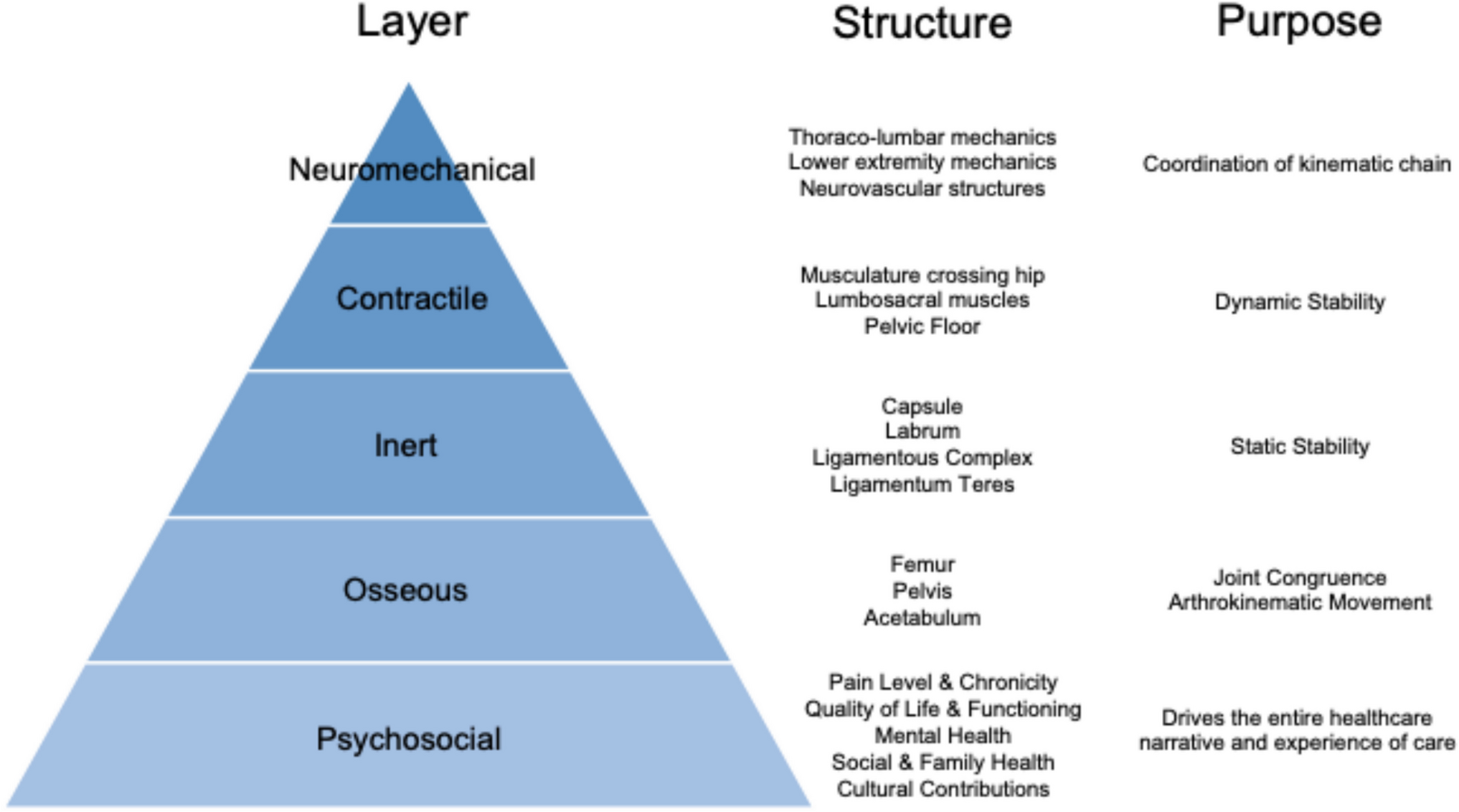
Draovitch P, Edelstein J, Kelly BT. The layer concept: utilization in determining the pain generators, pathology and how structure determines treatment. Curr Rev Musculoskelet Med. 2012;5:1–8.
Article
PubMed
PubMed Central
Google Scholar
Wegener ST, Carroll EA, Gary JL, McKinley TO, O’Toole RV, Sietsema DL, et al. Trauma collaborative care intervention: effect on surgeon confidence in managing psychosocial complications after orthopaedic trauma. J Orthop Trauma. 2017;31:427–33.
Article
PubMed
Google Scholar
Major Extremity Trauma Rehabilitation Consortium (METRC). Early effects of the trauma collaborative care intervention: results from a prospective multicenter cluster clinical trial. J Orthop Trauma. 2019;33:538–46.
Article
Google Scholar
Gatchel RJ, Okifuji A. Evidence-based scientific data documenting the treatment and cost-effectiveness of comprehensive pain programs for chronic nonmalignant pain. J Pain. 2006;7:779–93.
Article
PubMed
Google Scholar
Gornitzky A, O’Donnell J, Diab M. More than just medication: Exploring the potential of a perioperative psychosocial intervention following major pediatric orthopaedic surgery: quality, safety and value (QSVI). JPOSNA [Internet]. 2023 [cited 2025 Mar 2];5. Available from: https://www.jposna.org/index.php/jposna/article/view/592
Rabbitts JA, Aaron RV, Fisher E, Lang EA, Bridgwater C, Tai GG, et al. Long-term pain and recovery after major pediatric surgery: a qualitative study with teens, parents, and perioperative care providers. J Pain. 2017;18:778–86.
Article
PubMed
PubMed Central
Google Scholar
Richard HM, Nguyen DC, Podeszwa DA, De La Rocha A, Sucato DJ. Perioperative interdisciplinary intervention contributes to improved outcomes of adolescents treated with hip preservation surgery. J Pediatr Orthop. 2018;38:254–9.
Article
PubMed
Google Scholar


Comments (0)