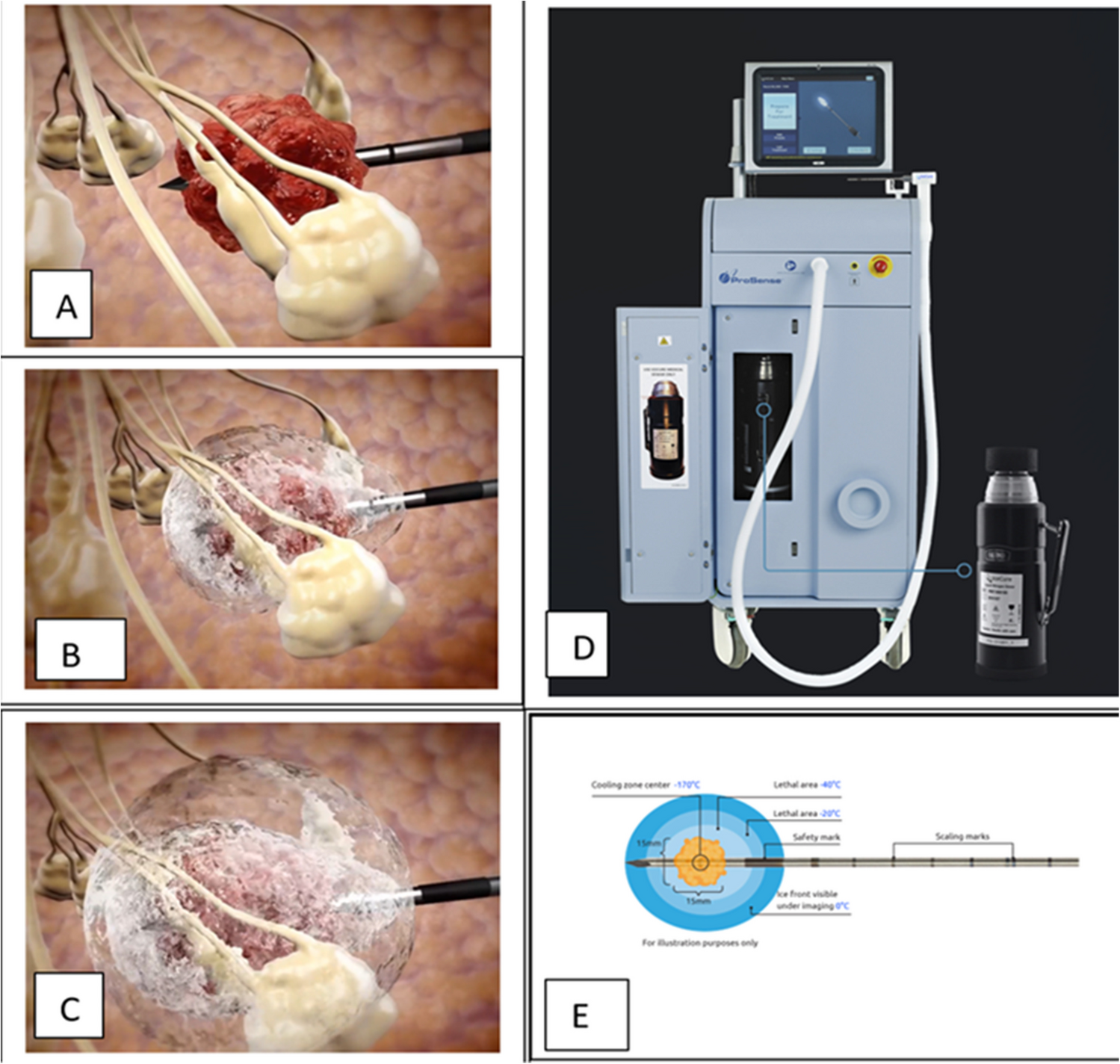
Cryoablation for breast cancer has been studied since 1994. In contrast to the other ablation techniques, cryoablation utilizes extreme cold to damage cells. The tissue is cooled to −40 C for the ablation zone. Ice crystals develop within the cells resulting in direct injury and necrosis. The process involves a freeze–thaw-freeze cycle; during the thaw cycle, the reperfusion leads a release of free radicals and vascular injury resulting in additional ischemia and tissue necrosis. The cold has its own anesthetic effect making the procedure very tolerable in the outpatient setting requiring only the use of local anesthetic for placement of the probe. As with the other ablative techniques, a recommended distance of 5 mm or more between the zone of ablation and dermis or chest wall muscle helps decrease the complication of skin or muscle necrosis. An ablation margin of 5–10 mm around the tumor has been utilized in most studies [10, 17, 18]. The average time for the procedure is dependent on the size of the ice ball required. The duration of the procedure when documented for lesions < 2 cm ranged from 15–40 min with a median of 26 min. The cases with tumors larger than 2 cm or use of multiple probes for multifocal/bilateral disease could be over 60 min. [10].
In the van de Voort meta-analysis [5]evaluating 8 studies evaluating cryoablation, the pooled complete ablation rate was 80.3%, but ranged from 18–99%. Multifocal disease was a consistent reason for incomplete ablation. Complications occurred in ~ 5.0% of patients, and mostly consisted of ecchymosis, seroma, thickening around the treatment site. The reaction to the ice ball can last for several months.
Multiple prospective trials have evaluated the success of cryoablation. The Phase 2 Alliance Z1072 was a nonrandomized single arm trial that included cryoablation of 87 breast cancers < 2 cm followed by surgical resection. The authors set a threshold of 90% complete ablation to establish efficacy of this method. The overall ablation rate was 75.9%. However, the authors noted that if multifocal disease > 2 cm from the cryoablation zone was excluded, the complete ablation rate increased to 92%. Furthermore, a subset analysis in this study showed tumors < 1 cm had 100% ablation. [3].
The THERMAC trial, a randomized Phase 2 trial, compared the RFA, MWA and cryoablation techniques tumors < 2 cm in postmenopausal women. Surgery was completed after the 3 months post ablation MRI. The preliminary results were presented at the European Society of Breast Imaging in October 2024 with results on 37 patients. Cryoablation in 16 patients achieved 94% complete ablation with no adverse events [6].
Cryoablation without resection has been performed in several studies since 2016. Habrawi et al. [9] completed a prospective longitudinal study of 12 patients with early-stage breast cancer aged 50 or older with unifocal ER + PR + Her2- invasive ductal carcinoma less than 1.5cm, with < 25% EIC. The cryoablated area included a 1 cm margin of normal tissue around the imaged tumor. There was complete ablation by imaging with no local recurrences after median follow-up of 28.5 months [9].
Additionally, a prospective longitudinal single institution study was performed in 32 patients with luminal A breast cancers < 2 cm (as defined by genomic testing) treated with cryoablation alone. Patients received cryoablation per the Z1072 protocol. With a follow-up of 2–3 years (62% and 37.5% respectively), there were no in-breast tumor recurrences. The only recurrence occurred in the axilla of a patient who did not take endocrine therapy. That patient had an axillary dissection and had no additional disease in over 5 years at the time of the publication. No complications were reported. [19].
The ICE3 trial [2] is the largest prospective multicentered study evaluating the efficacy for cryoablation without resection. It included 194 patients > 60 years of age with an US visible IDC 1.5 cm or smaller, Grade 1–2, ER + Her2-. Patients underwent cryoablation followed by adjuvant therapy per the decision of the care providers. The mean age was 74.9 years, with mean follow up 54.16 months. The 5-year IBTR was 4.3% for all patients. The subset taking endocrine therapy had 3.7% IBTR recurrence [2]. This recurrence rate is similar to the 4% recurrence rate found in the CALGB 9343 trial of lumpectomy with endocrine therapy only vs endocrine therapy and radiation therapy [20].
Sonia Khan and colleagues [21]performed a cost analysis comparing cryoablation to surgery. Direct and indirect costs of care for each procedure were computed from actual cost of disposables and maintenance incurred by the system (not the reimbursement rates or charges). The median cost for cryoablation was $2221.70, significantly lower than that of resection, $16,896.50 [p < 0.0001] [21].

Comments (0)