
Remember me

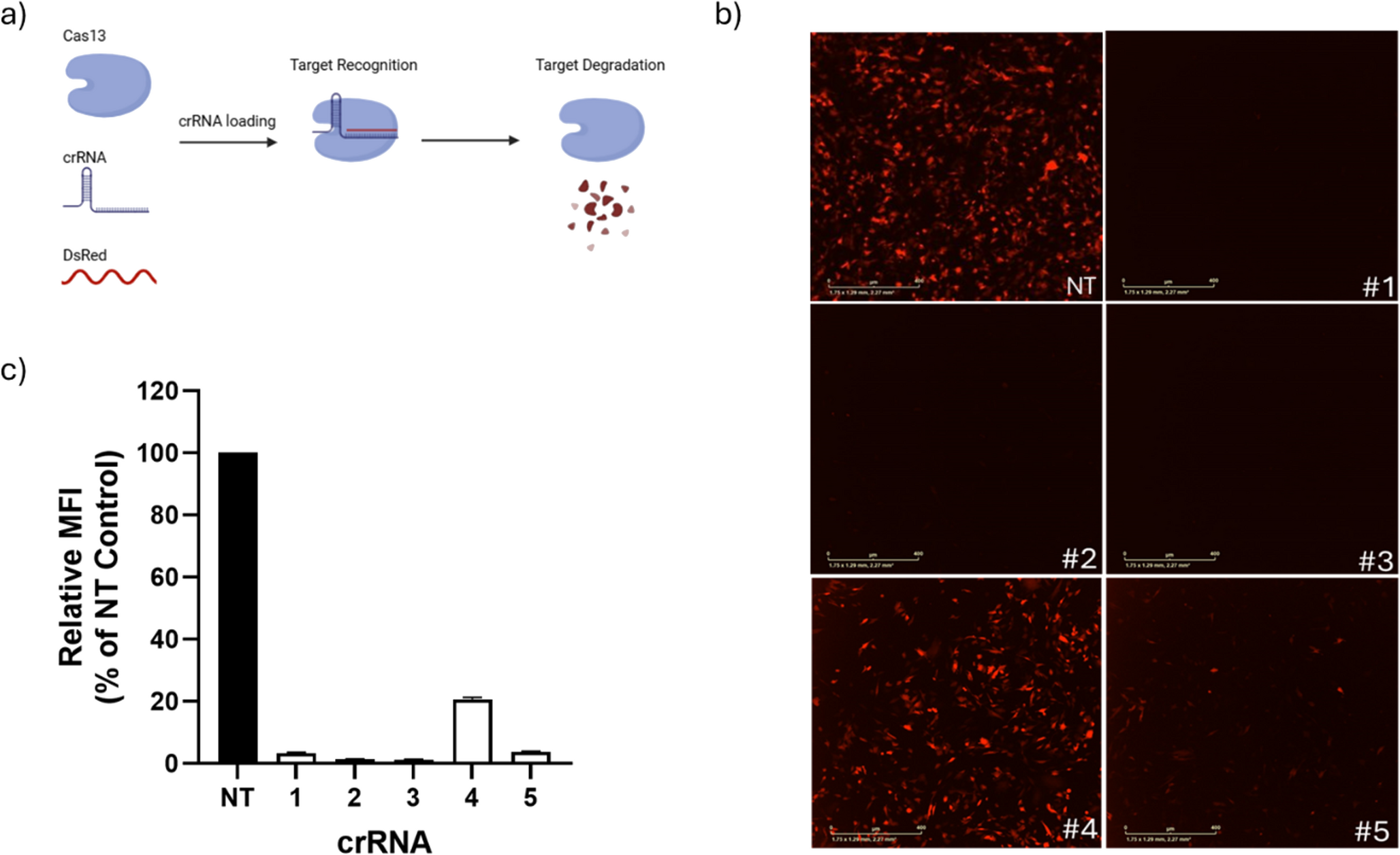
To establish RfxCas13d-mediated transcript knockdown (Fig. 1a), we first generated a chicken fibroblast DF1 cell line (DF1-RfxCas13d) by stably integrating the RfxCas13d-Puro transgene into the chicken genome using the Tol2 transposon system (Fig. S1 & S2). We selected the DsRed fluorescent reporter gene as our target and designed five different 28-spacer crRNAs (crDsRed#1–crDsRed#5) of 28-nt in length, each fully basepairing with unique regions of DsRed mRNA. The designed crRNAs sequences were then each cloned into a crRNA expression vector and expressed under the control of a U6 promoter (Fig. S1). To examine RfxCas13d-mediated DsRed knockdown, DF1-RfxCas13d cells were co-transfected with pCMV-DsRed vector and DsRed-crRNA vectors. Cells transfected with a non-targeting (NT) crRNA sequence (crNT) were used as a negative control. Following co-transfection, the knockdown of DsRed expression was examined by fluorescence microscopy and flow cytometry analysis 24 h post-transfection. Fluorescence microscopy analysis revealed that four out of the five DsRed-targeting crRNAs induced potent knockdown, in which DsRed fluorescence was almost undetectable. In contrast, cells transfected with the NT-crRNA vector did not show any DsRed fluorescence knockdown, confirming that RfxCas13d mediates DsRed knockdown in a spacer-dependent manner (Fig. 1b). Flow cytometry analysis revealed that DF1-RfxCas13d cells transfected with crDsRed#1, crDsRed#2, crDsRed#3, and crDsRed#5 exhibited strong and specific transcript suppression, in which DsRed knockdown by these four crRNAs reached 97% − 99% (Fig. 1c). However, crDsRed#4 did not show strong DsRed knockdown, suggesting that not all designed crRNAs are capable of inducing mRNA knockdown and that RNA secondary structures, the spatial accessibility of specific mRNA regions, or nucleotide composition of the spacer sequence may influence the knockdown efficiency.
Fig. 1
RfxCas13d-mediated knockdown of DsRed in chicken fibroblast DF1 cells. a Schematic of RfxCas13d-mediated targeted recognition and degradation of DsRed mRNA (b) Representative fluorescence microscopy images of RfxCas13d targeting of DsRed using five different crRNA in stable RfxCas13d-expressing DF1 cell line. c DsRed fluorescence knockdown determined by flow cytometry. Data points in the graph are averages of the normalised mean fluorescence intensity from technical triplicates. Error bars show SD
RfxCas13d-mediated knockdown is independent of PFS contextTo test whether RfxCas13d-mediated mRNA knockdown is dependent on PFS, we compared the knockdown efficiency of a previously validated crRNA (crDsRed#2), which contains a U PFS, with three newly designed crRNAs targeting adjacent regions of the DsRed transcript. These newly designed crRNAs possess A, C, and G PFS. respectively and are in spatial proximity to the crDsRed#2 target site (Fig. 2a, top panel). Fluorescence microscopy analysis revealed that crRNAs with C, G, or U PFSs exhibited a clear reduction in DsRed fluorescence. However, crRNAs possessing an A PFS did not result in comparable DsRed fluorescence knockdown (Fig. 2b).
Fig. 2
RfxCas13d mediates mRNA targeting in a PFS-independent manner. a Schematic of the DsRed mRNA and crRNAs with A, G, U and C PFS that were designed in proximity. b Representative fluorescence microscopy images of four A PFS and C, U and G nucleic acid crRNAs determined by FACS flow cytometry. c DsRed fluorescence knockdown by crRNAs with different PFS determined by flow cytometry. Data points in the graph are averages of the normalised mean fluorescence intensity from technical triplicates
To determine whether the failure to induce a robust DsRed knockdown by crRNAs with A PFS was due to PFS dependency or a positional effect, we performed a follow-up study by designing three additional crRNAs with an A PFS (Fig. 2a, bottom panel). The three new crRNAs with A PFSs were designed to bind spatially close to the previously validated target site (crDsRed#2). To examine the knockdown efficiency achieved by crRNAs with different PFS variants, we performed a comparative transfection experiment using all seven crRNAs: four with A PFS and three previously validated crRNAs with C, G, and U PFS, respectively. Flow cytometry on transfected cells revealed that three newly designed A PFS crRNAs (A#2, A#3, and A#4) exhibited robust knockdown of DsRed fluorescence, in which targeting efficiencies were ranged between ~ 92–95%. The knockdown levels achieved by these newly designed A PFS crRNAs are comparable to those observed with C (~ 96%), G (~ 96%), and U (~ 95%) PFS crRNAs, indicating that Cas13d-mediated knockdown does not rely on a strict PFS requirement for crRNAs (Fig. 2c).
Cas13d mediates knockdown in a CrRNA length-dependent mannerRfxCas13d-mediated mRNA targeting typically uses crRNAs with a canonical spacer length of 28-nt. This spacer length has been shown to induce high targeting efficiency in various intracellular and biochemical knockdown studies. However, designing a 28-nt crRNA that enables coverage of multiple subtypes of rapidly evolving RNA viruses can be often challenging. One approach to circumvent these issues is by designing shorter spacers that can mediate similar levels of knockdown as the canonical spacer length of 28 nt. To test this, we systematically shortened the spacer region of the validated 28-nt crRNA (DsRed-crRNA#2) to generate a set of six truncated crRNAs (24–16 nt) (Fig. 3a). This rational spacer truncation was carried out at the 3’ end of the crRNA rather than at the 5’ end (where the PFS is present) to avoid affecting the Cas13d knockdown efficiency by the PFS. Following the co-transfection of chicken DF1-Cas13d cells with individual truncated crRNAs and the DsRed expression plasmid, the knockdown efficiency was evaluated by fluorescence microscopy and flow cytometry at 24 h post-transfection. Fluorescence microscopy examination of transfected cells indicated that truncated crRNAs of 24-nt, 23-nt, 22-nt, and 21-nt exhibited pronounced knockdown, in which the DsRed fluorescence knockdown was comparable to those observed with the full-length 28-nt crRNA (positive control). In contrast, cells transfected with the shorter 20-nt or 16-nt crRNAs displayed only modest reductions in DsRed signal relative to NT control cells (Fig. 3b).
Fig. 3
RfxCas13d-mediated mRNA targeting is crRNA length dependent. a Schematic of crRNA truncations performed for investigating minimal length required for Cas13d mediated mRNA cleavage. b Representative fluorescence microscopy images show the knockdown DsRed by different truncated spacers. c and (d) DsRed fluorescence knockdown by different spacers was determined by flow cytometry. (e) DsRed fluorescence knockdown of ineffective crRNAs (i.e., 20-nt and 16-nt) by increasing the plasmid concentration. Values shown as the mean ± Sd. Data points in the graph are averages of the normalised values from technical triplicates
For accurate quantification of knockdown efficiency, transfected cells were analysed by flow cytometry to determine: (i) the percentage of DsRed knockdown cells (Fig. 3c), and (ii) the DsRed fluorescence based on mean fluorescence intensity (MFI) (Fig. 3d). Flow cytometry analysis revealed that cells transfected with 28-nt and 24-nt crRNAs exhibited 80% knockdown of DsRed-expressing cells compared to NT transfected. The truncated 24-nt to 21-nt crRNAs showed a trend of decreasing targeting efficiency, with a 2–3% loss observed for every nucleotide truncation. However, DsRed knockdown using a 20-nt crRNA was greatly affected, with only ~ 60% reduction achieved. DsRed targeting was greatly diminished using 16-nt crRNA, suggesting a strong link between the knockdown efficiency and crRNA length (Fig. 3c). Similarly, quantitative analysis of DsRed MFI revealed that cells transfected with different lengths of DsRed crRNAs (28-nt to 21-nt) displayed up to ~ 90% DsRed knockdown, while cells transfected with 20-nt crRNAs exhibited ~ 85% knockdown efficiency (Fig. 3d). In contrast, DsRed knockdown efficiency was substantially affected in cells transfected with the 16-nt crRNA, with fluorescence levels reduced by only ~ 50%, indicating a profound loss of Cas13d targeting activity when using shorter crRNAs.
To assess whether increasing the plasmid concentration enhances the knockdown efficiency of 20-nt and 16-nt crRNAs, we performed additional transfection by increasing crRNA vector concentration by four-fold (2000 ng) relative to the standard (500 ng) during transfection. DF1-RfxCas13d cells transfected with 2000 ng of the 20-nt crRNA showed markedly improved knockdown efficiency by achieving up to 92% reduction in DsRed fluorescence. In contrast, even a four-fold increase of plasmid concentration did not yield any noticeable increase of knockdown efficiency using the 16-nt crRNA, suggesting that RfxCas13d activity is spacer length-dependent (Fig. 3e).
Mismatches in the CrRNA spacer influence Cas13d mediated knockdownEffective targeting of Cas13d requires the use of a crRNA that maintains near-perfect complementarity at the spacer-target interface. This requirement poses challenges when designing spacers against rapidly mutating RNA viruses, in which emerging mutations may reduce the binding affinity of crRNAs and subsequent cleavage activity. Therefore, a detailed understanding of Cas13d’s sensitivity to mismatches is essential for the development of robust and broadly effective RNA-targeting strategies.
To systematically evaluate the effect of mismatches on knockdown activity, we generated a panel of 18 crRNAs with unique mismatches into the spacer of the previous 24-nt DsRed-targeting crRNA. Specifically, 1-nt, 2-nt, 3-nt, 4-nt, 8-nt, and 12-nt mismatches were introduced into the 5′ end, central region, or 3′ end of the spacer (Fig. 4a). To test the knockdown efficiency, DF1-Cas13d cells were co-transfected with DsRed and crRNAs with different mismatches. The knockdown efficiency of mismatched spacers was compared to the 24-nt crRNA (positive control). Fluorescence microscopy images revealed that cells transfected with crRNAs with 1-nt mismatch were tolerated, but not with crRNAs containing four or more mismatches (Fig. S3 - S5). For accurate quantification of knockdown efficiency, transfected cells were analysed by flow cytometry to assess how different types of mismatches affected Cas13d knockdown activity. It was found that crRNAs with 1-nt mismatches at the 3’-end, middle and 5’-end were well tolerated with knockdown efficiency achieving ~ 96–99% knockdown, which was comparable to that of crRNA 24-nt (on-target) (Fig. 4b). However, the knockdown efficiencies varied for mismatches that are 2-nt or more, depending on the position at which they were introduced. For mismatches introduced at the 5′ end of crRNAs, a 2-nt mismatch resulted in approximately ~ 80% knockdown, while a 3-nt mismatch reduced knockdown efficiency to ~ 50%. Mismatches of 4-nt, 8-nt, or 12-nt completely abolished knockdown activity, indicating a tolerance threshold in this region. For the central region of crRNAs, mismatches of 2-nt significantly impaired knockdown with only ~ 60% knockdown activity. Introduction of 3-nt or more mismatches at this position completely abolished knockdown activity, suggesting the central region is highly sensitive to mismatches. In contrast, 3′ end mismatches were better tolerated in which knockdown efficiency remained largely unaffected up to 4-nt mismatches, indicating relative flexibility in this region. However, 8-nt and 12-nt mismatches at the 3′ end resulted in a complete loss of activity, reflecting an upper limit of toleration is maximum 4-nt at this position (Fig. 4b). Given that the 5’-end of the crRNAs is highly sensitive to mismatches, we conducted an additional study by designing four additional crRNAs with a single-nucleotide mismatch at the 1 st, 2nd, 3rd and 4th position (Fig. 4c). Flow cytometry analysis revealed a gradual recovery of knockdown activity similar to that of on-target as the mismatch is positioned distal to the 5’-end (Fig. 4d). Collectively, these data demonstrate that mismatch position critically influences Cas13d activity, with middle and 5′ end mismatches being more disruptive than those at the 3′ end.
Fig. 4
RfxCas13d-mediated mRNA targeting is sensitive to mismatches in the crRNA (a) List of designed spacers with introduced mismatches (1-nt, 2-nt, 3-nt, 4-nt, 8-nt or 12-nt) at 5’ end, middle and 3’end into the 24-nt function DsRed targeting spacer. The nucleotides highlighted in red are introduced mismatches The DsRed knockdown efficiency was compared between the various crDsRed with mismatches, on-target spacer (positive control) and crNT (non-targeting, negative control) (b) The percentage DsRed fluorescence knockdown by crRNAs with various introduced mismatches at 5’-end, central and 3’-end using flow cytometry. c Single-nt mismatches introduced at the 1 st, 2nd, 3rd and 4th bases from the 5’ end (near the PFS) of the spacer. The percentage DsRed fluorescence knockdown by flow cytometry. Values shown as the mean ± Sd. Data points in the graph are averages of the normalised mean fluorescence intensity from technical triplicates
RfxCas13d and HfCas13d induces collateral activity in chicken cellsAlthough RfxCas13d has showed robust mRNA knockdown in our study and in several published reports (Konermann et al. 2018; Kushawah et al. 2020; Zhang et al. 2021), there is substantial evidence in the literature on the collateral activity of Cas13d proteins (Li et al. 2023; Shi et al. 2023). To mitigate this undesired property of RfxCas13d, Tong et al. (2023) developed HfCas13d that reportedly has a reduced collateral activity whilst possessing high on-target cleavage activity. To directly compare the on-target and collateral effects of these two effectors, we established DF1 cell lines stably expressing either RfxCas13d or HfCas13d using Tol2 transposon system (Fig. S1). To assess knockdown activity, RfxCas13d and HfCas13d cells were co-transfected individually with five validated 28-nt DsRed-targeting crRNAs and a DsRed expression vector. Flow cytometry analysis revealed that RfxCas13d consistently showed high levels of DsRed knockdown, in which DsRed crRNAs #1, #2, #3, and #5 exhibiting up to ~ 99% fluorescence knockdown. In contrast, the same crRNAs induced a modest knockdown (~ 50–60%) when targeting DsRed in HfCas13d-expressing cells. Interestingly, crRNA#4, which resulted in ~ 80% DsRed knockdown using RfxCas13d, further diminished its activity in HfCas13d cells, resulting in only ~ 20% knockdown efficiency (Fig. 5a). Given the transgenic DF1 cell lines expressing RfxCas13d and HfCas13d may produce variable expression levels of respective transgenes, we conducted an additional experiment to alleviate any potential variability during characterisation. For this experiment, all three components (Cas13d, corresponding crRNA-DsRed and pCMV-DsRed) were transfected at equal DNA concentration into WT chicken DF1 cells. Fluorescence microscopy analysis of these transfection experiments also revealed that the RfxCas13d cells consistently outperformed knockdown activity across all five DsRed crRNAs (Fig. S6), suggesting that the HfCas13d exhibits reduced targeting efficacy even in cells transfected with equivalent DNA concentration of both variants. The results obtained with five DsRed targeting crRNA transient transfection experiments thus agree with those data obtained in our stable Cas13d-expressing cell lines.
Fig. 5
Comparison of on-target and collateral effects of RfxCas13d and HfCas13d in chicken cells. a DF1-RfxCas13d and DF1-HfCas13d were each co-transfected with vectors encoding DsRed and five different crRNA (targeting DsRed mRNA) or NT crRNA (negative control). DsRed fluorescence knockdown by different crRNAs was determined by flow cytometry. b DF1-RfxCas13d and DF1-HfCas13d were each co-transfected with vectors encoding GFP and individual crRNA (targeting GFP mRNA) or NT crRNAs (negative). The percentage GFP fluorescence knockdown by different crRNAs was determined by flow cytometry. c Assessment of collateral activity of RfxCas13d and HfCas13d in chicken cells. The corresponding cell lines were transfected with crRNA targeting DsRed, along with expression vectors for DsRed (on-target) and GFP (serves as collateral reporter). Representative microscopy images of both DsRed and GFP fluorescence degradation in DF1-RfxCas13d cells (top panel) compared with DF1-HfCas13d cells (bottom panel). d The percentage DsRed (on-target activity) and GFP (collateral activity) fluorescence knockdown measured by flow cytometry. Values shown as the mean ± Sd. Data points in the graph are averages of the normalised mean fluorescence intensity from technical triplicates
To further verify whether RfCas13d and HfCas13d exhibit variable RNA-targeting efficiency, we selected GFP as an additional target and designed three new 28-nt crRNAs targeting GFP transcripts. Consistent with our observations for DsRed, RfxCas13d consistently outperformed HfCas13d, achieving GFP knockdown levels up to ~ 98–99% across all three crRNAs tested. In contrast, the HfCas13d variant yielded more variable knockdown efficiencies, ranging from 75% to 90% (Fig. 5b & Fig. S7). These data revealed that although HfCas13d mediates RNA targeting, its knockdown efficiency was reduced relative to that of RfxCas13d.
To directly compare the collateral activity of Cas13d effectors, we established a dual-fluorescence reporter assay in which DsRed served as the on-target and GFP as the collateral activity reporter. In this system, successful cleavage (cis) of DsRed mRNA is expected to induce indiscriminate degradation of non-target RNAs (trans), including GFP mRNA. To test this, stable DF1 cells expressing RfxCas13d and HfCas13d were co-transfected with vectors encoding crDsRed#2, or crNT, along with pCMV-DsRed and pCAG-GFP. Fluorescence microscopy analysis revealed that both Cas13d effectors induce on-target and collateral activity, albeit at varied levels (Fig. 5c). In RfxCas13d-expressing cells, sequence-specific targeting of DsRed mRNA led to a substantial reduction (up to ~ 99%) in both DsRed and GFP fluorescence, indicating robust on-target cleavage accompanied by collateral degradation of GFP transcripts. In contrast, HfCas13d-expressing cells displayed only 50% of DsRed fluorescence compared to that was observed in RfxCas13d cells (~ 99%). Furthermore, GFP fluorescence knockdown resulting from collateral activity was largely unaffected with only 10% reduction, suggesting that the collateral activity in HfCas13d cells was significantly attenuated (Fig. 5d, S8). These findings suggest that HfCas13d induces minimal collateral activity, albeit with the trade-off of reduced on-target cleavage activity compared to RfxCas13d.
To examine the downstream effects of Cas13d’s collateral cleavage on endogenous genes, we performed RNA-seq analysis on cells transfected cells with either crDsRed#2, or crNT and both pCMV-DsRed and pCAG-GFP. Compared to the crNT control, catalytically active RfxCas13d perturbed the expression of 49 endogenous genes significantly (FDR < 0.05), whilst HfCas13d disrupted the regulation of 199 genes (Fig. 6a). Despite the presence of these differentially expressed genes (DEGs), only 3 DEGs in RfxCas13d DF1 cells were considered to have had a substantial change in expression (> 1.25 fold-change), compared to the 36 observed in HfCas13d (Fig. 6b). Gene ontology and biological process analysis found that the DEGs belonged in four distinct areas: cholesterol biosynthetic process, respiratory chain complex I, translation and the cytosolic large ribosomal subunit (Fig. 6c). Despite the presence of these DEGs, and their connection to key biological processes, the expression changes of individual genes in these pathways were determined to be quite minor and have limited effect on cell viability.
Fig. 6
Transcriptome-wide collateral activity of RfxCas13d and HfCas13d in chicken cell lines. a Venn diagram of overlapping differentially expressed genes (DEGs) upregulated or downregulated. b Volcano plot of the RNA-seq analysis comparing RfxCas13d (left) or HFCas13d (right) DF1 transgenic cells transfected with DsRed and GFP, and either DsRed-crRNA or NT-crRNA. Lines denote a > 1.25-fold change (FC). c Gene ontology (GO) and biological process (BP) term analysis for the DEGs in (b)
RfxCas13d mediated knockdown of NP gene of H5N1 2.3.4.4bTo investigate whether RfxCas13d can be repurposed to target synthetic sequences of viral RNA, we selected the nucleoprotein (NP) gene of H5N1 clade 2.3.4.4b influenza A strain, A/turkey/Indiana/3703-003/2022. To quantitatively measure the viral RNA knockdown, a luciferase reporter construct was generated by fusing firefly luciferase in-frame with the 200-bp NP target region. Five crRNAs (crNP#1–crNP#5; Supplementary Table 1) were designed across the NP sequence. The luc-NP and crRNA encoding plasmids were then co-transfected into RfxCas13d expressing cell lines. Luciferase assay revealed that crNP#1 and crNP#2 achieved knockdown efficiencies of approximately 86% and 87%, respectively, whereas crNP#3 mediated a ~ 79% knockdown. In contrast, crNP#4 and crNP#5 showed reduced knockdown efficiencies of ~ 61% and ~ 56%, respectively (Fig. 7).
Fig. 7
RfxCas13d mediated knockdown of nucleoprotein mRNA of avian influenza virus. Five spacers targeting distinct regions within the NP gene segment of A/Turkey/Indiana/22–003707-003/2022/H5N1 (Clade: 2.3.4.4b). Knockdown of H5N1 NP gene by transfection of individual crRNAs and siCHECK-2 + NP into RfxCas13d cells. Firefly luciferase activity measured and represented as percentage of inhibition relative to NT crRNA
Comments (0)