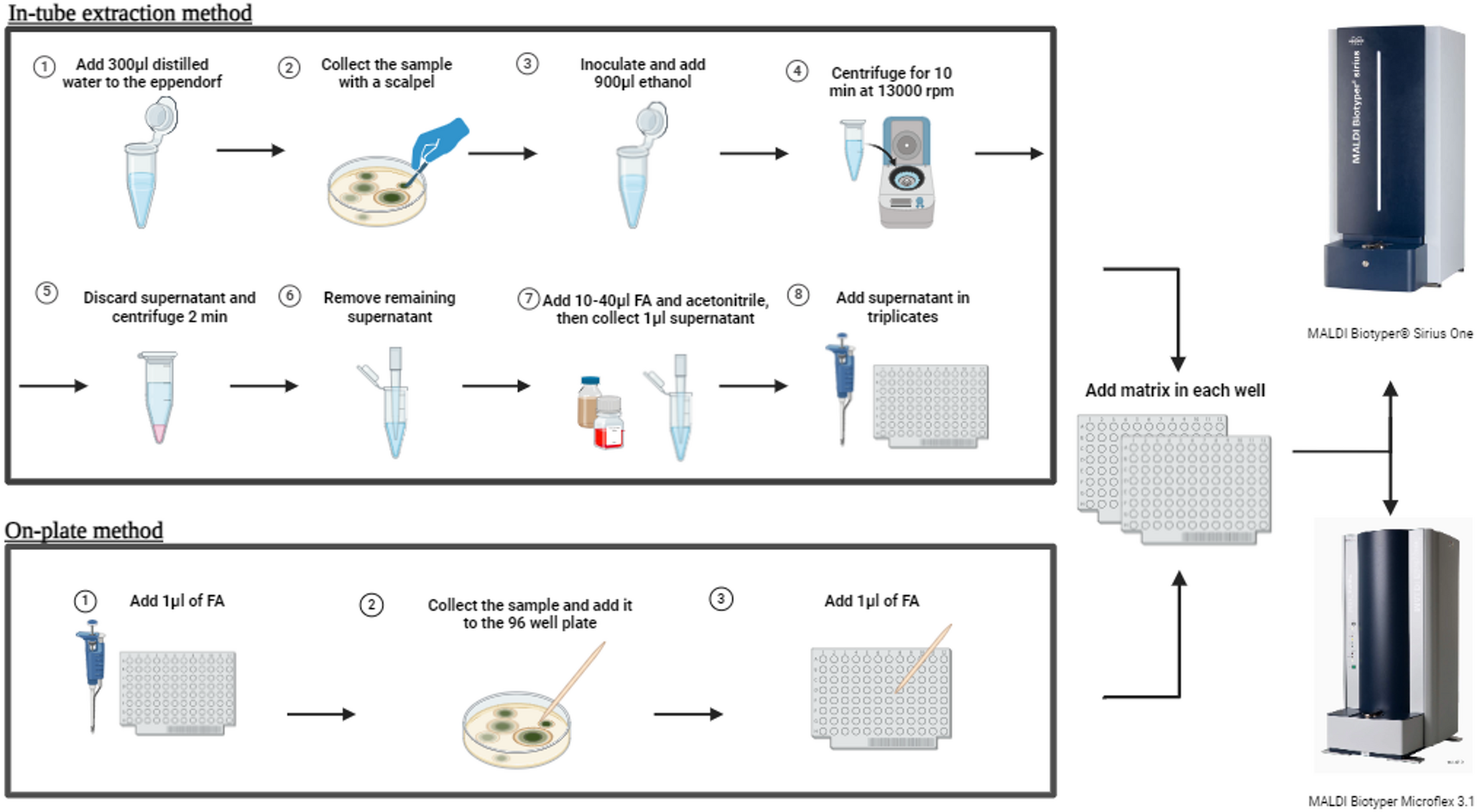
MALDI-TOF MS is a highly useful tool for rapid and accurate identification of microorganisms in clinical settings. Studies have demonstrated its effectiveness in identifying common fungal species. However, challenges remain, such as the need for effective protein extraction methods and expanded databases [14, 15]. This study investigates the performance of the Sirius One and Microflex 3.1 Bruker MALDI-TOF MS systems, comparing in-tube and on-plate extraction methods for mold identification. It also evaluates the efficiency of the manufacturer’s library alongside the MSI-2 database, focusing on optimizing speed and accuracy for routine clinical applications.
This study included 68 distinct mold strains, featuring both clinical and quality control isolates and covering a wide spectrum of common filamentous fungi species identified in clinical samples. In our study, the Sirius One system significantly outperformed the Microflex 3.1, achieving 92.6% correct identification compared to 70.6% for Microflex (p < 0.01) for identification of filamentous fungi (Table 2). The MALDI Biotyper® Sirius One System delivers quicker target exchange times compared to earlier models with a high-capacity vacuum pump. The advanced electronics also enable more rapid x/y-stage movements, significantly reducing time-to-result. To improve the detection time, Bruker also recommends on-plate extraction method for filamentous fungi identification combined with its MBT HT Filamentous Fungi Module for MALDI Biotyper Sirius One System.
Our study found that the on-plate extraction method performed equally well, and in some cases even outperformed, the conventional in-tube extraction method when tested with the Sirius One and Microflex Biotyper systems. There were no significant differences in analytical performance between the two approaches. (Table 2). However, in terms of speed, the on-plate method required only 10 min per sample compared to approximately 45 min for the in-tube method, highlighting a clear time advantage for routine clinical microbiology laboratory workflow. Choi et al. [10]. also compared the performance of the Bruker Biotyper, ASTA MicroIDSys, and VITEK MS systems in identifying 84 filamentous fungal isolates and they found that the in-tube extraction method provided the highest sensitivity, with the Bruker Biotyper achieving the best performance at a 71.43% correct identification rate. However, similar to our study, the researchers found no significant difference between the on-plate and in-tube extraction methods. We observed that, when using the in-tube extraction method, correct identification was more frequently achieved in all three replicates compared to the on-plate method. Although no formal reproducibility study was conducted, this observation suggests that performing tests in triplicate may increase the likelihood of obtaining at least one correct identification, particularly when using the on-plate extraction method. Therefore, incorporating triplicates may be beneficial for ensuring reliable results in routine laboratory practice.
A limitation of this study, is that the same plate which was first analyzed on the Sirius One was analyzed directly afterwards on the Microflex 3.1 system. Due to differences in system setups in number of shots fired at the plate when performing spectral analysis, the signal quality and strength in the Microflex 3.1 system was likely lowered. Therefore this could have led to a lower level of identification on the Microflex 3.1 system. In addition, while this study included several different species and genera from cryptic and non-cryptic species of fungi, our collection size was relatively small. Another limitation of this study is the potential geographical bias, as all isolates were collected from a single country, which may not fully represent the global diversity of filamentous fungi and caution should be taken when generalizing the findings to rare or region-specific species.
Another important aspect to consider when choosing a workflow, is the volume of single-use plastics involved. Single-use tips, tubes and scalpels are used to prevent cross contamination. However, in the modern hospital environment, action must be taken to reduce the use of unnecessary and non-biodegradable plastics. By adopting a primary workflow involving direct on-plate extraction before moving on to in-tube extraction, we can reduce our environmental footprint.
Among the two MALDI-TOF systems evaluated, the Sirius One demonstrated superior performance compared to the Microflex when using the MBT HT Filamentous Fungi IVD Module library, achieving higher identification rates. However, the improved library still could only identify approximately half of the isolates in this study. This highlights the need for enhanced solutions in filamentous fungi identification. To address these limitations, researchers have utilized in-house libraries or third-party databases, such as MSI-2, to enhance analytical performance. Normand et al. [6] evaluated the performance of the newly developed MSI-2 database in comparison to MSI-1 and the Bruker Filamentous Fungi Database for identifying molds. The study demonstrated that the MSI-2 database significantly outperformed both MSI-1 and Bruker in species-level identification, achieving an accuracy of 83.25%, compared to 63.19% for MSI-1 and 38.07% (1.7 threshold) for Bruker. The distinct advantage of using the MSI-2 database for the identification of filamentous fungi has also been demonstrated in various studies [16,17,18,19]. Notably, using the MSI-2 database enabled more accurate identifications in triplicate analyses, emphasizing its potential as a valuable tool in fungal diagnostics. Although the MSI system outperformed Bruker’s manufacturer library in species-level identification, it resulted in a higher number of misidentifications. Additionally, it should be recognized that the MSI-2 database is a non-IVDR certified reference library. Misidentifications missed by laboratory staff, for example, when a clinically relevant Rhizopus spp. is identified as e.g. Penicillium spp., this could result in delayed treatment, which could have devastating results on patient outcome. Therefore, results from the MSI-2 database should not be taken at face value but must be considered in conjunction with other microbiological data, such as microscopy, ideal temperature and macroscopic appearance. When all these findings are considered together, we propose a rapid, reliable, and environmentally friendly workflow for routine laboratories by utilizing the new MALDI-TOF Sirius One system combined with the on-plate extraction method.
Advancements in MALDI-TOF MS technology, such as the improved Sirius One system, have significantly enhanced diagnostic accuracy for filamentous fungi identification. The on-plate extraction method, with its efficiency and speed, demonstrates potential for incorporation into an algorithmic diagnostic workflow, especially in routine laboratory settings. However, the study highlights the importance of refining reference libraries to improve identification outcomes further. Incorporating third-party databases, like MSI-2, offers notable benefits and could provide a pathway to achieving even more reliable and comprehensive fungal diagnostics.


Comments (0)