Despite its importance in guiding requesting clinicians in clinical management of the patient, the interpretation of laboratory results in the context of the patient’s clinical history is often underrepresented in EQAs for laboratory testing of LB. This study aimed to assess the level of agreement among MMLs in the Netherlands regarding the interpretation of LB laboratory diagnostics in relation to a patient’s clinical history using a web-based questionnaire with case descriptions.
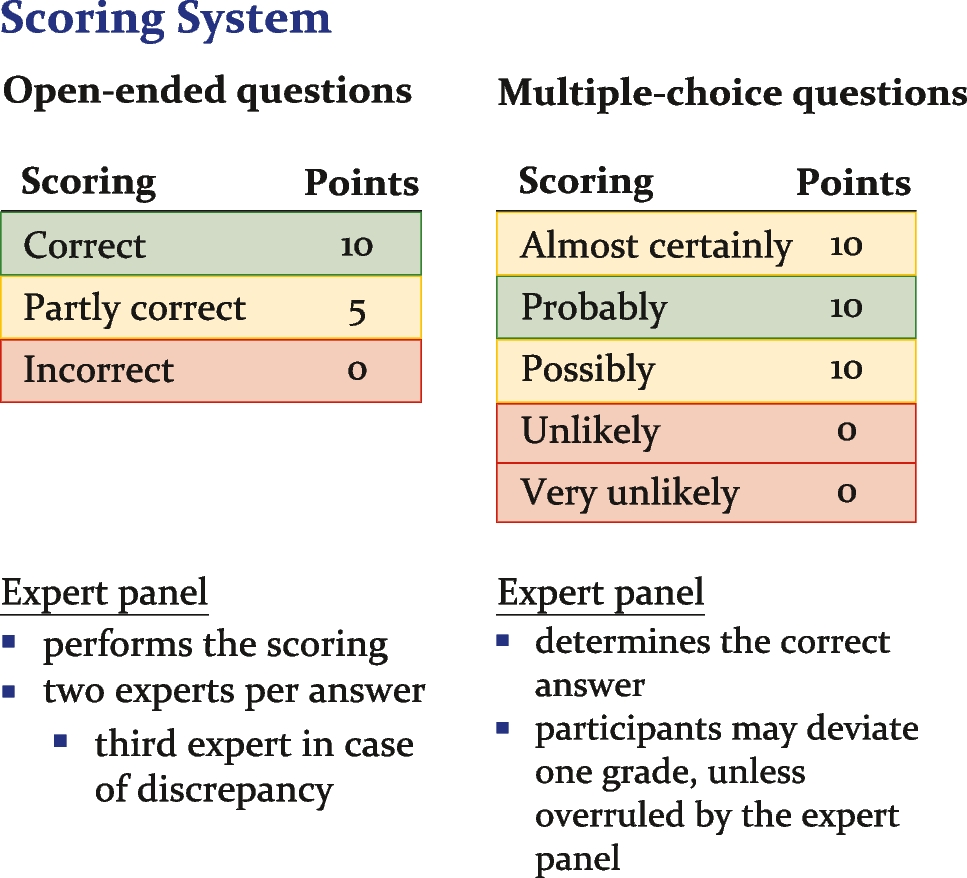
The overall participant scores ranged from 7.2 to 9.8 on a scale of ten, and participants performed especially excellent (8.4 to 10) in determining active LB that requires treatment (the multiple-choice questions). The interpretation score of the cases ranged from 5.6 to 9.8, leaving room for improvement. For those laboratories scoring below average, a re-evaluation of the MML’s interpretation routines is highly recommended. The multiple-choice questions yielded higher scores than the open-ended questions, in line with previous studies [15, 16]. Multiple-choice questions offer a choice of pre-defined answers that may steer the thoughts of the participants, while open-ended questions demand more critical thinking and correct formulation of the answer and give room for interpretation bias.
The perceived complexity of the cases was evaluated to identify manifestations or specific cases that require attention for future training or clarification of the guidelines. Overall, a negative linear correlation was observed between the score and the discrepancy rate of the case. For cases with follow-up questions, scores were positively correlated with the progression of the case. In clinical practice, however, treatment decisions must often be made without all information available (yet). In such situations, assessment of clinical symptoms and risk exposure, and the expertise of the medical microbiologist and physician play a critical role. However, due to the low incidence of disseminated LB manifestations, most physicians rarely encounter these patients, if ever.
Limited exposure to low-incidence manifestations such as Lyme carditis [5] could be an argument to centralize LB diagnostics. However, this brings forth various concerns. While potentially addressing knowledge gaps, centralization risks distancing clinical patient information and specialists’ involvement. Furthermore, centralization could adversely affect turn-around times, and even cost-effectiveness of centralized diagnostics is being debated [17]. Lastly, outsourcing laboratory diagnostics could erode research and educational activities at the primary hospital location [18]. Considering the response rate of this EQA and participants’ eagerness to learn, additional education could be an effective alternative towards harmonized interpretation of LB diagnostics. Accessibility to expert consultation for challenging laboratory findings might aid optimal patient management. This is facilitated by the National Reference Laboratory for Lyme Borreliosis, as well as the Dutch Lyme Disease Expertise Center (i.e., the Lyme disease outpatient clinic at Radboud University Medical Center (UMC) and the Amsterdam UMC Multidisciplinary Lyme Borreliosis Center). This approach ensures high-quality expertise at the point of care while fostering continuous professional development of physicians.
To our knowledge, this is the first published report of an EQA aiming to assess the level of harmonization of LB diagnostics interpretation by combining disease history and laboratory results. Participating medical microbiologists have become more aware of several pitfalls in LB diagnostics, which is considered a strength. Moreover, the high response rate and attendance at the symposium, where the results were discussed with the participants, indicate a willingness to learn and improve. Apparently, many medical microbiologists are aware that the interpretation of LB diagnostics can be challenging. Therefore, this EQA might be exemplary for future harmonization efforts on a European level, and might be facilitated via the ESCMID Study Group for Lyme borreliosis (ESGBOR).
While some may argue that EQAs require pre-existing standardized protocols, it is common practice in EQA schemes, including those of the Dutch SKML, for reference laboratories or expert panels to define consensus results when gold standards are lacking or when significant heterogeneity exists [19]. This approach is especially relevant for LB in Europe, where the diversity of Borrelia species results in a broader spectrum of clinical presentations than in other regions. The role of the medical microbiologist in the Netherlands further adds a layer of clinical integration that may not be present in other healthcare systems. As such, using expert consensus to assess inter-laboratory variation is both appropriate and necessary in this context. Our findings underline the importance guidelines tailored to the European setting, and of adapting EQA schemes to reflect both the biological and organizational diversity inherent in LB diagnostics.
The length of the questionnaire may be considered a limitation of this study. Requiring a considerable investment of their time could have caused participants to allocate insufficient time to carefully consider their answers, and could thus have impacted their score. This time investment (approximately 45 min) was anticipated, and therefore the option to pause and resume the questionnaire at a later time was addressed in the invitation.
The harmonization of LB diagnostics interpretation could benefit from a certification program tailored for medical microbiologists as well as (primary care) physicians. Modern learning methods, such as e-learning, could enhance recognition of the diverse LB manifestations. In 2017 and 2022, the Dutch College of General Practitioners (NHG) offered such e-learning for primary care physicians (in training), of which an adjusted version entitled “Lyme en werk” has been made freely available for company and insurance physicians at https://www.e-learning.beroepsziekten.nl/ (login required). A similar approach for medical microbiologists and specialists could include e-learning tools featuring case descriptions and predefined scoring, emphasizing key components for accurate interpretation. Despite limited use in current training programs, e-learning shows great potential, as evidenced by high satisfaction rates, highlighting its adaptability and accessibility in medical education [20]. Additionally, establishing an (inter)national case register could further solidify knowledge and interpretation skills.
Artificial intelligence (AI) and decision-making algorithms are promising tools for assisting medical microbiologists and physicians [21]. Although machine learning-based clinical decision support (CDS) systems have primarily focused on risk analysis and image recognition, a prototype CDS platform integrating multiple LB guidelines was introduced in 2014 to support diagnosis and treatment recommendations [22]. Unfortunately, evaluations of this prototype remain unpublished. With the increasing integration of AI in clinical decision-making, future studies should prioritize the development of a CDS system for LB diagnostics, ideally based on all European LB guidelines and a case register, that also includes suggested reporting language [23].
In conclusion, this study underscores the importance of harmonizing the interpretation of laboratory results in conjunction with the clinical history of the patient across different MMLs to ensure consistent clinical management of LB. While concordance was high for common LB presentations, rare or complex cases led to greater variability in interpretation. Ongoing education and training, particularly focused on low-incidence manifestations, are essential The integration of innovative tools, such as e-learning and AI-based CDS systems may further improve diagnostic accuracy and patient care.

Comments (0)