World Health Organization. World Malaria Report: Addressing Inequity in the Global Malaria Response (WHO, 2024).
Cowman, A. F., Healer, J., Marapana, D. & Marsh, K. Malaria: biology and disease. Cell 167, 610–624 (2016).
Article
PubMed
Google Scholar
Duffy, P. E., Gorres, J. P., Healy, S. A. & Fried, M. Malaria vaccines: a new era of prevention and control. Nat. Rev. Microbiol. 22, 756–772 (2024).
Article
PubMed
Google Scholar
Koch, M. & Baum, J. The mechanics of malaria parasite invasion of the human erythrocyte — towards a reassessment of the host cell contribution. Cell Microbiol. 18, 319–329 (2016).
Article
PubMed
PubMed Central
Google Scholar
Moreau, A. et al. Physical mechanisms of red blood cell splenic filtration. Proc. Natl Acad. Sci. USA 120, e2300095120 (2023).
Article
PubMed
PubMed Central
Google Scholar
Martinez, M. et al. Rhoptry secretion system structure and priming in Plasmodium falciparum revealed using in situ cryo-electron tomography. Nat. Microbiol. 7, 1230–1238 (2022).
Article
PubMed
PubMed Central
Google Scholar
Kadekoppala, M. & Holder, A. A. Merozoite surface proteins of the malaria parasite: the MSP1 complex and the MSP7 family. Int. J. Parasitol. 40, 1155–1161 (2010).
Article
PubMed
Google Scholar
Zuccala, E. S. et al. Subcompartmentalisation of proteins in the rhoptries correlates with ordered events of erythrocyte invasion by the blood stage malaria parasite. PLoS ONE 7, e46160 (2012).
Article
PubMed
PubMed Central
Google Scholar
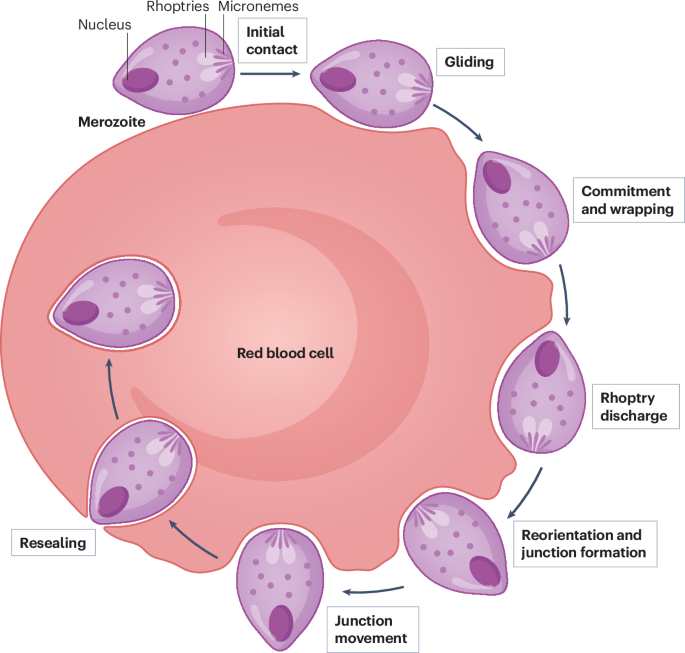
Riglar, D. T. et al. Super-resolution dissection of coordinated events during malaria parasite invasion of the human erythrocyte. Cell Host Microbe 9, 9–20 (2011). This paper provides a powerful demonstration through super-resolution microscopy of the stages of invasion.
Article
PubMed
Google Scholar
Bannister, L. H. & Mitchell, G. H. The fine structure of secretion by Plasmodium knowlesi merozoites during red cell invasion. J. Protozool. 36, 362–367 (1989).
Article
PubMed
Google Scholar
Frenal, K., Dubremetz, J. F., Lebrun, M. & Soldati-Favre, D. Gliding motility powers invasion and egress in apicomplexa. Nat. Rev. Microbiol. 15, 645–660 (2017).
Article
PubMed
Google Scholar
Yahata, K. et al. Gliding motility of Plasmodium merozoites. Proc. Natl Acad. Sci. USA 118, e2114442118 (2021). This article demonstrates that merozoites glide.
Article
PubMed
PubMed Central
Google Scholar
Hart, M. N. et al. Sequential roles for red blood cell binding proteins enable phased commitment to invasion for malaria parasites. Nat. Commun. 14, 4619 (2023).
Article
PubMed
PubMed Central
Google Scholar
Scally, S. W. et al. PCRCR complex is essential for invasion of human erythrocytes by Plasmodium falciparum. Nat. Microbiol. 7, 2039–2053 (2022).
Article
PubMed
PubMed Central
Google Scholar
Weiss, G. E. et al. Revealing the sequence and resulting cellular morphology of receptor-ligand interactions during Plasmodium falciparum invasion of erythrocytes. PLoS Pathog. 11, e1004670 (2015).
Article
PubMed
PubMed Central
Google Scholar
Ben Chaabene, R., Lentini, G. & Soldati-Favre, D. Biogenesis and discharge of the rhoptries: key organelles for entry and hijack of host cells by the apicomplexa. Mol. Microbiol. 115, 453–465 (2021).
Article
PubMed
Google Scholar
Cova, M. M., Lamarque, M. H. & Lebrun, M. How apicomplexa parasites secrete and build their invasion machinery. Annu. Rev. Microbiol. 76, 619–640 (2022).
Article
PubMed
Google Scholar
Besteiro, S., Dubremetz, J. F. & Lebrun, M. The moving junction of apicomplexan parasites: a key structure for invasion. Cell Microbiol. 13, 797–805 (2011).
Article
PubMed
Google Scholar
Harris, P. K. et al. Molecular identification of a malaria merozoite surface sheddase. PLoS Pathog. 1, 241–251 (2005).
Article
PubMed
Google Scholar
Pavlou, G. et al. Toxoplasma parasite twisting motion mechanically induces host cell membrane fission to complete invasion within a protective vacuole. Cell Host Microbe 24, 81–96.e5 (2018).
Article
PubMed
Google Scholar
Bisio, H. & Soldati-Favre, D. Signaling cascades governing entry into and exit from host cells by Toxoplasma gondii. Annu. Rev. Microbiol. 73, 579–599 (2019).
Article
PubMed
Google Scholar
Singh, S., Alam, M. M., Pal-Bhowmick, I., Brzostowski, J. A. & Chitnis, C. E. Distinct external signals trigger sequential release of apical organelles during erythrocyte invasion by malaria parasites. PLoS Pathog. 6, e1000746 (2010).
Article
PubMed
PubMed Central
Google Scholar
Tham, W. H., Healer, J. & Cowman, A. F. Erythrocyte and reticulocyte binding-like proteins of Plasmodium falciparum. Trends Parasitol. 28, 23–30 (2012).
Article
PubMed
Google Scholar
Iyer, J., Gruner, A. C., Renia, L., Snounou, G. & Preiser, P. R. Invasion of host cells by malaria parasites: a tale of two protein families. Mol. Microbiol. 65, 231–249 (2007).
Article
PubMed
Google Scholar
Sim, B. K., Chitnis, C. E., Wasniowska, K., Hadley, T. J. & Miller, L. H. Receptor and ligand domains for invasion of erythrocytes by Plasmodium falciparum. Science 264, 1941–1944 (1994).
Article
PubMed
Google Scholar
Orlandi, P. A., Klotz, F. W. & Haynes, J. D. A malaria invasion receptor, the 175-kilodalton erythrocyte binding antigen of Plasmodium falciparum recognizes the terminal Neu5Ac(alpha 2-3)Gal- sequences of glycophorin A. J. Cell Biol. 116, 901–909 (1992).
Article
PubMed
Google Scholar
Tolia, N. H., Enemark, E. J., Sim, B. K. & Joshua-Tor, L. Structural basis for the EBA-175 erythrocyte invasion pathway of the malaria parasite Plasmodium falciparum. Cell 122, 183–193 (2005).
Article
PubMed
Google Scholar
Tham, W. H. et al. Complement receptor 1 is the host erythrocyte receptor for Plasmodium falciparum PfRh4 invasion ligand. Proc. Natl Acad. Sci. USA 107, 17327–17332 (2010).
Article
PubMed
PubMed Central
Google Scholar
Duraisingh, M. T., Maier, A. G., Triglia, T. & Cowman, A. F. Erythrocyte-binding antigen 175 mediates invasion in Plasmodium falciparum utilizing sialic acid-dependent and -independent pathways. Proc. Natl Acad. Sci. USA 100, 4796–4801 (2003).
Article
PubMed
PubMed Central
Google Scholar
Stubbs, J. et al. Molecular mechanism for switching of P. falciparum invasion pathways into human erythrocytes. Science 309, 1384–1387 (2005). This paper shows that merozoites can switch between different invasion pathways that use different EBL and RBL proteins.
Article
PubMed
Google Scholar
Gruszczyk, J. et al. Cryo-EM structure of an essential Plasmodium vivax invasion complex. Nature 559, 135–139 (2018).
Article
PubMed
Google Scholar
Gruszczyk, J. et al. Transferrin receptor 1 is a reticulocyte-specific receptor for Plasmodium vivax. Science 359, 48–55 (2018).
Article
PubMed
PubMed Central
Google Scholar
Moon, R. W. et al. Normocyte-binding protein required for human erythrocyte invasion by the zoonotic malaria parasite Plasmodium knowlesi. Proc. Natl Acad. Sci. USA 113, 7231–7236 (2016).
Article
PubMed
PubMed Central
Google Scholar
Tham, W. H. et al. Plasmodium falciparum adhesins play an essential role in signalling and activation of invasion into human erythrocytes. PLoS Pathog. 11, e1005343 (2015).
Article
PubMed
PubMed Central
Google Scholar
Volz, J. C. et al. Essential role of the PfRh5/PfRipr/CyRPA complex during Plasmodium falciparum invasion of erythrocytes. Cell Host Microbe 20, 60–71 (2016).
Article





Comments (0)