
Remember me
Current ADA/EASD guidelines emphasize a patient-centered approach for T2DM management, prioritizing organ protection alongside glycemic control. For patients with atherosclerotic cardiovascular disease (ASCVD), guidelines specifically recommend GLP-1 RAs as first-line treatment or sodium-glucose co-transporter 2 (SGLT2) inhibitors. If glycemic targets are not met, both drug classes can be combined. New generation BI analogs serve as important alternatives, particularly where rapid glycemic control is required or when GLP-1 RAs are contraindicated/not tolerated or inaccessible in the country. If heart failure (HF) and/or chronic kidney disease (CKD), SGLT2 inhibitors are the preferred option, while GLP-1 RAs serve as an alternative. The guidelines stress the importance of individualized treatment selection based on patient characteristics and local resource availability, particularly in settings like Iraq where obesity prevalence and access to newer therapies may impact treatment decisions. The guidelines also emphasize personalized weight management strategies, recommending medications like weekly GLP-1 RA when lifestyle modifications alone prove insufficient. This tailored approach aims to optimize both glycemic outcomes and long-term organ protection while considering practical implementation challenges [7, 9].
Consensus Report by ADA and EASD—2022: Management of Hyperglycemia in T2DMFor patients with severe hyperglycemia (hemoglobin A1c (HbA1c) > 10% or fasting plasma glucose (FPG) > 300 mg/dL) or inadequate response to oral agents, insulin initiation is advised. For patients already on GLP-1 RA therapy who require further glucose-lowering interventions, the addition of BI is preferred, starting at 10 units/day or 0.1–0.2 units/kg/day, with careful titration to avoid hypoglycemia. Fixed-ratio combinations (FRCs) of BI and GLP-1 RAs are encouraged before advancing to intensified insulin regimens (basal bolus or premixed insulin), as they simplify therapy while maintaining efficacy and reducing side effects [7].
ADA 2024: Intensification Strategies for Patients Requiring Insulin TherapyThe ADA Standards of Care 2024 guidelines provide a structured approach for intensifying therapy in patients not meeting glycemic targets on GLP-1 RAs alone. Second-generation BI analogs are recommended over older generation of BIs due to their improved safety profile and low risk of hypoglycemia. If HbA1c remains elevated, combining BI with GLP-1 RAs (as separate agents or FRCs) is preferred before progressing to basal-bolus or premixed insulin. This approach optimizes glycemic control while minimizing hypoglycemia and weight gain [10].
Guideline Recommendations on Combination Therapy for T2DMBoth ADA Standards of Care 2024 and American Association of Clinical Endocrinology (AACE) 2023 guidelines highlight the benefits of early combination therapy, particularly for patients with HbA1c ≥ 1.5–2.0% above target. Combining agents with complementary mechanisms addresses multiple pathophysiological defects, improves long-term outcomes, and reduces therapeutic inertia. This strategy is especially important for younger patients (< 40 years) to prevent complications from prolonged hyperglycemia [10].
Local Management of T2DM in Iraq: Challenges and NeedsThe management of T2DM in Iraq faces challenges due to disparities between public and private healthcare sectors, limited access to advanced therapies, and cultural and socioeconomic barriers. According to the Iraqi Experts Consensus 2020, metformin and sulfonylureas remain the primary treatments in public healthcare due to cost constraints, while newer agents, including GLP-1 RA and new generation insulin analogs, are mostly restricted to private settings. Public-sector facilities often lack resources for early diagnosis and structured diabetes care, including lifestyle modification programs and dietician support.
Access to recently introduced antidiabetic therapies is also restricted; for example, SGLT2 inhibitors, GLP-1 RAs, second-generation insulin analogues like Glargine U300 and Degludec 100 and FRCs of BI and GLP-1 RAs are typically unavailable in public hospitals, where earlier generations of BI options such as Neutral Protamine Hagedorn (NPH) insulin are still widely used.
Cultural and socioeconomic factors further hinder management. Patients often resist injectable therapies due to fear of injection (29%), dependence on administration assistance (38%), stigma (13%) or misconceptions about insulin (11.5%). Low health literacy exacerbates this issue, though familial exposure to insulin improves acceptance. Physicians also contribute to delays, citing concerns such as hypoglycemia risk (14%) and poor adherence. Additional clinician-related barriers include time constraints and perceived regimen complexity, which contribute to delays in treatment intensification. Lifestyle changes, including sedentary behavior and unhealthy diets, particularly among women with limited access to fitness resources, further drive diabetes prevalence [11, 12].
Despite awareness of international guidelines, therapeutic inertia remains high, highlighting the need for simplified protocols. 80% of experts reported that insulin initiation is often delayed by six to nine years after oral therapy, worsening outcomes. Local evidence supports earlier insulin use in severe hyperglycemia to preserve β-cell function. These delays reflect persistent therapeutic inertia rooted in patient reluctance, provider hesitation, and systemic limitations. Improving access to advanced therapies, including GLP-1 RAs and latest-generation insulins, alongside enhanced patient education, is critical. While metformin remains foundational, policy reforms are urgently needed to ensure equitable care [1, 13].
To overcome these multidimensional barriers, coordinated solutions are needed: [1] clinician training to streamline and support timely intensification strategies; [2] patient-centered education that addresses specific fears and misconceptions surrounding injection-based treatment options, including insulin-based therapies and GLP-1 RA; and [3] health system reforms that enhance access to simplified, safe, and effective regimens. Together, these efforts can help bridge the gap between evidence-based recommendations and real-world clinical practice [14,15,16,17,18,19].
Implications of Various Insulin Regimens in IraqThe Role and Advancements of BI in T2DM Management.
In Iraq, several insulin regimens are used for the management of T2DM, including intermediate-acting insulin, premixed insulin formulations, and basal insulin. This section focuses primarily on BI given its role as the preferred initial insulin therapy in both international guidelines and local clinical practice. BI serves as the foundational latest insulin therapy for T2DM, with modern formulations offering progressively improved profiles. Current options range from intermediate-acting NPH insulin (peaking at 4–6 h, lasting 12–16 h, typically requiring twice-daily dosing) to longer-acting analogs like Glargine U100 and Detemir (providing more stable 24-h coverage, though Detemir may need twice-daily administration in some patients) [20, 21]. The newest second-generation analogs—Glargine U300 and Degludec 100 represent significant advancements with their ultra-long (> 24 h), peakless action profiles that minimize glycemic variability and hypoglycemia risk, making them particularly suitable for vulnerable populations (elderly, CKD, or patients with hepatic impairment) [22,23,24,25,26,27,28,29,30] and those with lifestyle challenges like irregular schedules [31] or Ramadan fasting [32]. Clinical evidence highlights the advantages of BI over premixed insulins, such as simpler initiation, improved stability, and lower risks of hypoglycemia and weight gain, suggesting that some patient fears around insulin-based treatment options may stem from outdated experiences with premix regimens, especially in the context of limited access to modern BI [22,23,24, 33,34,35,36,37]. Real-world data from Iraq shows 20% of poorly controlled patients with T2DM achieved HbA1c < 7% within six months using Glargine U100 [38]. These attributes, combined with ADA recommendations positioning BI as first-line preferred initial insulin therapy when combined with metformin and organ-protective agents, underscore its critical role in optimizing long-term outcomes across diverse patient populations [39]. 70% of experts considered BI as the most preferred type of insulin for initiating therapy after oral antidiabetic drugs (OADs) in patients with T2DM, followed by second generation premixed insulin as the preference of 30%.
Therapy IntensificationWhen HbA1c remains elevated despite optimized BI dosing (0.5 units/kg/day), treatment augmentation is required to avoid overbasalization. For cases where BI titration leads to hypoglycemia without glycemic improvement, transitioning to more intensive regimens should be considered to address both fasting and postprandial targets.
The Place in Therapy of BI Analogues in IraqClinical Practice BI use90% of Iraqi experts preferentially recommend initiate insulin-based treatment with second-generation BI analogues vs older generations, while 10% use all types equally.
Second generation analogues such as GLA-300 and Degludec 100 are accessible only in private sector through out-of-pocket payment.
Second-generation analogues have lower risk of hypoglycemia compared to first generation insulins, prolonged action (> 24 h), peakless action with minimal glycemic variability and flexible dosing window which make them suitable for vulnerable populations with high risk of hypoglycemia such as elderly and CKD patients.
While new generation analogues show improved safety profiles with reduced hypoglycemia, they should complement (not replace) therapies with proven cardiorenal benefits.
The ORIGIN trial findings (2012) demonstrated that insulin glargine 100 use in prediabetes/early T2DM showed neutral effects on cardiovascular outcomes and mortality but significantly reduced microvascular complications by 28% (nephropathy/retinopathy). This reinforces that while new generation basal analogs like GLA-300 and Degludec 100 improve safety, they should be combined with cardiorenal-protective agents (GLP-1 RAs/SGLT2i) for comprehensive management, particularly in Iraq where advanced therapies are limited.
Patients that would benefit from Insulin Based Treatment Options as 1st Injectable in IraqAmong patients with HbA1c < 2% above target especially when fasting hyperglycemia predominates, BI introduction followed by titration is recommended for those with BMI ≤ 30.
Individuals with unpredictable schedules needing flexible regimens
Vulnerable populations with high risk of hypoglycemia (elderly, patients with CKD) due to lower risk of hypoglycemia and decreased glycemic variability compared to older generation BIs [24, 40]
Addressing Titration Inertia with Second Generation BILatest analogues such as Gla-300 and Degludec 100 help overcome titration barriers through: stable glucose control, reduced variability, lower hypoglycemia risk.
A formal cost-effectiveness analysis comparing these second generation BIs (Gla-300 and Degludec 100) is needed in Iraq, as both demonstrate generally comparable safety profiles post-titration. Notably, each insulin has its own recommended titration schedule that clinicians should follow carefully to optimize outcomes.
Titration typically continues until 0.5 units/kg/day is reached. At this point, adding a GLP-1 RA or prandial insulin (and modifying mealtimes) is considered to further manage glycemic control, aiming to control FPG and postprandial glucose (PPG).
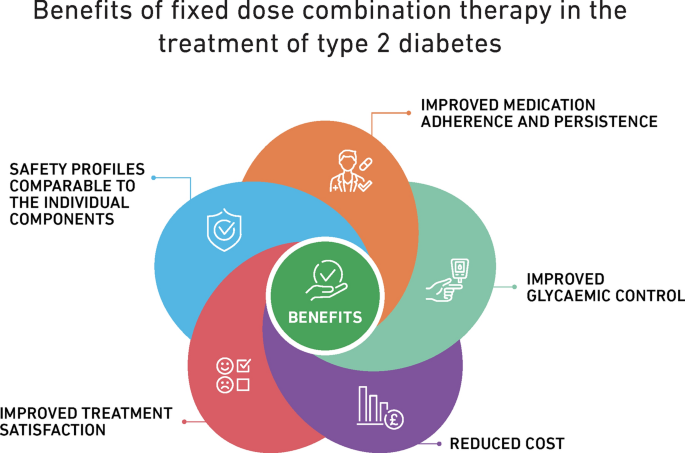
The Place in Therapy of BI and GLP-1 RA FRC in IraqThe Role of FRCs of BI and GLP-1 RA therapy in T2DM treatment paradigmCurrent insulin regimens present distinct limitations: BI fixes fasting first but often inadequately controls PPG, premixed insulins require regular meal timing and cause hypoglycemia and weight gain while basal-prandial therapy (basal plus or basal bolus) increases hypoglycemia risk, weight gain and increased injection burden / complexity of treatment. Latest insulin therapies of BI with GLP-1 RAs FRC such as iGlarLixi (currently the only available FRC in Iraq), address these challenges by reducing hypoglycemia risk and maintaining weight neutrality compared to intensive insulin regimens [30, 41, 42]. Global guidelines consistently recommend combining BI with GLP-1 RAs (as separate injections or FRCs) due to improved glycemic control with particular benefits for both fasting and postprandial glucose control [43,44,45,46,47] and their safety profile while minimizing gastrointestinal side effects as compared to GLP1-RAs alone due to gradual titration [48, 49]. These attributes make FRCs valuable for optimizing outcomes in T2DM management [50, 51] while simplifying regimens and maintaining better adherence rates than free-dose combinations [52] and multiple daily injection regimens due to once-daily dosing.
Patients that would benefit most from FRCs of BI plus GLP-1 RA in IraqCombinations of BI plus GLP-1 RA (separately or FRC) are preferred treatment for patients uncontrolled on oral agents with HbA1c ≥ 2% above target needing both PPG + FPG control. GLP-1 RA choice in the combination is guided by patient-specific factors such as desired weight benefits (prefer GLP-1 RAs with weight loss effect in obesity), established cardiovascular disease (CVD), CKD, access and cost. Alternative options such as premixed insulins and basal-prandial regimens (basal prandial or basal bolus) were minimally preferred by the experts in this situation
FRCs of BI plus GLP-1 RA can be considered for patients initiating insulin with HbA1c < 2% less than the target with BMI > 30 as an alternative option due to their weight neutral effect if GLP1-RA is inaccessible or not well tolerated due to GI intolerance
FRCs are preferred due to their simplicity and safety profile (lower hypoglycemia risk and weight neutrality) in patients with T2DM uncontrolled on oral agents + BI who need intensification with simplified regimen, instead of choosing other intensified regimens
The Place in Therapy of Basal-Prandial Regimens (Basal Plus and Basal-Bolus) in IraqThe Role of Basal-Prandial Regimens (Basal Plus and Basal-Bolus) in T2DM treatment paradigmCurrent guidelines outline evidence-based approaches for intensifying latest insulin therapies when glycemic targets remain unmet. The 2024 ADA standards of care prioritize adding GLP-1 RA therapy (either separately or as FRC) before considering prandial insulin, given their favorable efficacy and safety profiles. For patients requiring further intensification, options include stepwise addition of prandial insulin starting with the largest meal, or transitioning directly to basal-bolus regimens for comprehensive control. Alternative approaches include twice-daily NPH for those already on bedtime NPH, or premixed insulin for patients with regular meal schedules. The guidelines emphasize regular 3–6 month reassessments to adjust therapy based on individual response and needs [30].
Patients That Would Benefit Most from Basal-Prandial Regimens vs. Premix in IraqBasal-prandial regimens are optimal for:
oPatients with irregular meal schedules needing flexible dosing
oThose requiring individualized dose adjustments
Premix insulin may be preferable for:
oPatients uncontrolled on oral agents with HbA1c ≥ 2% above target needing PPG + FPG control.
oPatients with structured meal routines
oSettings where simplicity and accessibility are prioritized (human premix insulins are widely used in government settings and primary care).
Key challenges:
oBasal-bolus regimens often face low adherence due to complexity of multiple daily injections
oPremix insulin lacks dosing flexibility as it requires a regular eating schedule to prevent hypoglycemia
oTitration may be difficult with premix insulin
oPremix insulin sometimes requires twice-daily administration, and a switch to a bolus regimen after six months
oFrequent glucose monitoring (e.g., Continuous Glucose Monitor (CGM)) may be impractical and costly in community settings
Transition considerations:
oPatients failing basal bolus may switch to premix with careful monitoring
oInterest exists in transitioning insulin users to FRCs of BI and GLP-1 RA
Based on the discussion, the characteristics of patients with T2DM who might benefit from different insulin regimens are summarized in Table 1.
Table 1 Patient Characteristics and Individualized Approach to Insulin TherapiesIntegrating New Therapies in Local Practice in IraqTreatment Algorithm for Initiating and Intensifying Injectable Insulin Therapy in IraqFollowing expert discussions on patient characteristics best suited for each class of insulin therapy, experts emphasized the importance of a clear and individualized approach for patients with T2DM who require treatment advancement in Iraq. A structured framework was developed to guide Iraqi healthcare providers in initiating and intensifying injectable therapy, considering patient-specific needs, glycemic targets, body weight levels, and access limitations.
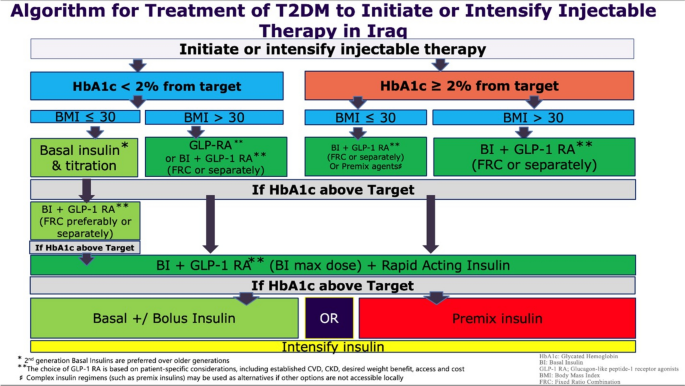
For patients whose HbA1c is less than 2% above target, therapy selection is guided by BMI. Those with a BMI of 30 or lower should initiate treatment with BI and titration, while those with a BMI above 30 are advised to start with a GLP-1 RA, or a combination of BI and GLP-1 RA, preferably as a FRC or free combination. If glycemic targets are not achieved in this group, combination therapy with BI and GLP-1 RA should be implemented. For patients with an HbA1c that is 2% or more above target, the recommended initial treatment is a combination of BI and GLP-1 RA for potent glucose-lowering effect, again either as an FRC or administered separately. When HbA1c remains above target, despite optimization of BI and GLP-1 RA, therapy should be intensified by adding rapid-acting insulin. If glycemic control is still not achieved, further intensification should include either a basal-bolus regimen or premixed insulin, depending on patient-specific factors, preferences, and access. This structured algorithm balances global best practices with the realities of clinical practice in Iraq, including considerations of medication availability and cost, while prioritizing treatment efficacy, patient safety, and ease of implementation (Fig. 1) (53).
Fig. 1 The alternative text for this image may have been generated using AI.
Iraq-Specific Injectable Therapy Pathway: Place in Therapy of Injectable Options Based on Clinical Needs and Local Market Realities in T2DM
Study LimitationsThis review has several limitations. While it identifies barriers like therapeutic inertia and cost, it lacks detailed regional analysis across Iraq's diverse healthcare settings. The psychological aspects of insulin initiation (e.g., injection anxiety) require deeper investigation. Reliance on expert opinions and real-world insights may not fully reflect actual local clinical practice. Future research should develop targeted interventions addressing these gaps, including provider education on individualized approaches and patient-centered strategies to improve acceptance of advanced insulin therapies.
Comments (0)