Descriptions of Selected MBMIs
Brief descriptions of modalities included in this study’s definition of MBMIs are first provided, recognizing that this is not an exhaustive list, and that these modalities may be combined with other therapies. MBMIs are often delivered in a group setting, adding opportunities for social engagement and support, but may also include one-on-one sessions with a trained therapist.
Qigong, Tai Chi, and Ai Chi
Qigong, tai chi, and ai chi can be considered forms of traditional Chinese exercises (TCEs). Qigong dates back over 5,000 years and is based on the philosophical principles of classical Chinese medicine, focusing on balancing the flow of energy (or “qi”) in the body. There are thousands of styles of qigong, which typically combine physical movements, mindfulness, and breathwork, and can also include visualization, vocalization, and self-massage [15]. Bodily movements are commonly performed while standing or sitting and can include stretching, shaking, and/or synchronizing arms and legs in rhythmic formation. Tai chi was initially developed as a martial art and considered a subtype of qigong [15]. Postures and movements are generally upright and involve long, choreographed “forms” that often include walking. Over the last 50 years, tai chi has gained popularity as a wellness exercise, with forms adapted for elderly populations and those with limited mobility (e.g., “Tai chi for arthritis and fall prevention” program [16]). Ai chi is a modern, aquatic adaptation of tai chi, and can be considered a form of aquatic exercise or hydrotherapy. Participants are shoulder-depth in warm water, conducting slow movements of the arms, legs, and torso, with emphasis placed on abdominal breathing synchronized to movement [17]. All TCEs emphasize body awareness combined with a relaxed mind and body.
Dance
Dance is defined as movement synchronized to rhythm or music [18]. Dance incorporates physical and motor skills, including stretching, balance, coordination, and aerobic exercise, with cognitive processes, including memory and perception [19]. It is commonly delivered in a culturally relevant context, with social, emotional, spiritual, and artistic aspects that make it enjoyable, thus promoting adherence [18]. In addition to more recreational or exercise-based dance, dance movement therapy is a type of psychotherapy administered by a trained therapist to specifically address psychological and/or medical conditions [20]. Dance movement therapy often incorporates aspects of mindfulness and somatic awareness [21, 22].
Pilates
Pilates is a mind-body exercise founded in the 1920 s by Joseph Pilates, a physical trainer and inventor. Emphasis is placed on building strength, flexibility, and core stability, particularly in the torso, low back, and pelvic regions, through proper muscle control, posture, and breathing [23]. Because much of the focus is on core stabilization, Pilates is often prescribed for lower back pain and injury [24]. Movements are performed either standing, sitting, or lying on a mat or spring-resistant reformer. Unlike the TCEs and yoga, which have philosophical and spiritual aspects stemming from ancient contemplative practices, Pilates can be considered more of a physical exercise. However, it does incorporate awareness of bodily sensations, postural control, and breathwork.
Yoga
Yoga originated in ancient India 2500–3000 years ago as a contemplative practice to achieve spiritual enlightenment [25]. Modern yoga is practiced primarily to promote physical and mental health, emphasizing postures (asanas) and breathing techniques (pranayama), but may also include meditation and chanting [26]. Different styles of yoga include traditional (e.g., hatha and ashtanga), which incorporate more meditation, chanting, and breathwork; exercise-based (e.g., vinyasa, power), focused more on physical movements; and therapeutic (e.g., restorative, gentle) [26]. Yoga is commonly performed on a mat, combining standing, seated, and reclined postures, but can be modified (i.e., chair yoga) for those with limited mobility.
Protocol Registration
To assess the evidence on MBMIs for MS, we followed the recommended conduct guidelines for umbrella reviews from the Cochrane Handbook of Systematic Reviews [27] and reporting guidelines for umbrella reviews from the Preferred Reporting Items for Overviews of Reviews (PRIOR) framework [28]. We also developed an a priori protocol, which was prospectively registered in the International Prospective Register of Systematic Reviews (PROSPERO) on March 25, 2025, at https://www.crd.york.ac.uk/PROSPERO/view/CRD420251019568.
Eligibility Criteria
Our review focused on peer-reviewed systematic reviews and meta-analyses. Unpublished grey literature (e.g., theses, dissertations) was also eligible if it met the inclusion criteria. A “systematic review” was defined a priori as a study that reported a clearly stated research question, conducted a systematic search of at least two databases, and employed a structured data synthesis to compare populations, interventions, and outcomes. Studies identifying themselves as scoping reviews were also included if they met the above criteria. Our population consisted of adults diagnosed with MS, regardless of subtype, disease severity, or duration.
We included reviews with at least one primary MBMI study (either stand-alone or combined with other therapies), including the following: qigong/tai chi/ai chi (or TCEs), dance therapy, Pilates, and yoga. Data from control or comparator groups were included when available. Reviews must have reported on at least one of the following domains: mood (e.g., depression), pain, cognition, balance, fatigue, physical function (e.g., walking ability, gait, muscle strength), and quality of life.
To reduce redundancy, only reviews published between 2015 and 2025 were included. We excluded narrative reviews that did not meet our criteria for a systematic review. Other umbrella reviews were excluded but were used for backward citation searching, consistent with the TARCiS statement [29]. We anticipated many reviews would have a mix of eligible and ineligible studies (e.g., both aerobic exercise and yoga).
Information Sources
We conducted database searches in PubMed/MEDLINE, EMBASE, Web of Science, Scopus, Academic Search Elite, AMED, Alt Health Watch, CINAHL Plus with Full Text, Health Source, Epistemonikos, PsycINFO, and the China Knowledge Resource Integrated Database. Additional sources included PROSPERO and the Cochrane Database of Systematic Reviews. We searched the grey literature using ProQuest (theses, dissertations) and the first 300 results from Google Scholar using a WebCrawler strategy [30]. Authors of potentially eligible but unpublished reviews were contacted to confirm publication status. No language restrictions were applied; articles in languages other than English were translated using DeepL Translate® and confirmed by native speakers when feasible. We investigated any discrepancies or uncertainties in a review by returning to the original primary study to verify data accuracy and context. A medical librarian peer-reviewed the PubMed search strategy using PRESS criteria [31]. A PubMed search filter for systematic reviews and meta-analyses was obtained from the University of Pittsburgh Health Sciences Library System [32]. The search strategy for each database, including terms, filters, limits, and search date, is available in Supplemental Table 1. The last search was conducted on April 22, 2025.
Selection Process
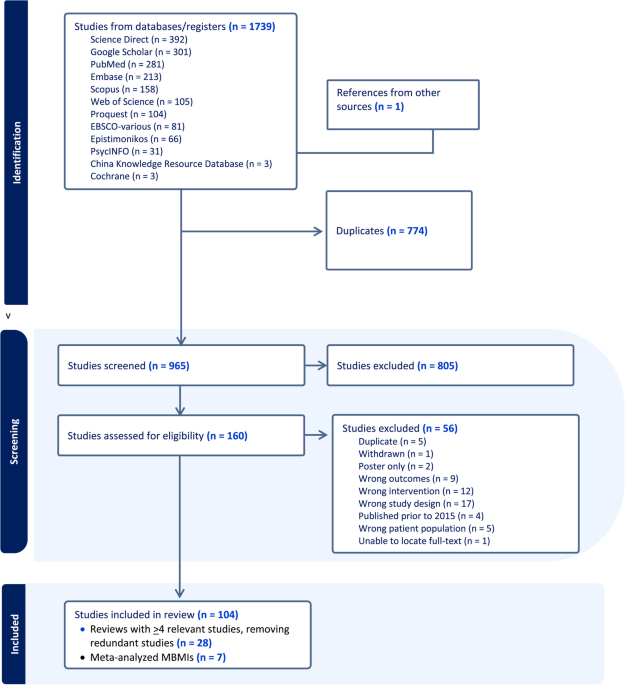
All citations were imported into Covidence software [33], and screened independently and in duplicate by two reviewers (LB, AB). Screening occurred in two stages: title/abstract and full text. Discrepancies were resolved through consensus. Reasons for exclusion at the full-text stage were recorded and presented in a flow diagram.
To address potential overlap of primary studies, we created a citation matrix of all relevant primary studies in each review. We removed reviews that included all primary studies found in other reviews and were rated “low” or “critically low” methodological quality (based on A MeaSurement Tool to Assess systematic Reviews-2 (AMSTAR-2) scores) to avoid double-counting outcomes. We retained all reviews that (1) included a meta-analysis of relevant MBMI studies, (2), were rated “high” quality on AMSTAR-2, or (3) contained relevant primary studies not found in any other review to prevent data loss.
Data Collection Process
A standardized data extraction form was developed in Covidence and pilot tested by two authors (LB, AB). Data extraction was conducted independently and in duplicate with paired reviewers (AB, LB, OG, TM, RW), with discrepancies resolved through consensus. Extracted data included review-level characteristics (authors, publication year, list of included primary studies, and date of last search). We also collected population characteristics (age, sex, disease subtype), interventions (type, dose, frequency), comparators, outcomes, and follow-up duration if data specific to MBMIs were presented in the text. Methodological characteristics such as review design, synthesis methods, and heterogeneity metrics (e.g., I²) were also recorded. Discrepancies in data across reviews were noted.
Primary outcomes included MS-related (1) symptoms (fatigue, depression, pain); (2) functional status (cognition, walking, balance, muscle strength, endurance, activities of daily living); and (3) health-related quality of life. These domains align with core outcome recommendations by Motl et al. (2017) and Daniels et al. (2023) [14, 34]. Secondary outcomes included other related measures within these domains. Outcome definitions were grouped based on similarity, and author-reported subgroup definitions were used when available.
Risk of Bias Assessment
Methodological quality of reviews was assessed using the AMSTAR-2 tool [35]. Ratings were completed independently and in duplicate, and checked for consensus among reviewer pairs (AB, LB, OG, TM, RW) in Covidence, with discrepancies resolved through discussion. Reviews were then given an overall score of “high,” “moderate,” “low,” or “critically low” credibility based on the number of “Yes,” “Partial Yes,” or “No” answers, with more consideration given to critical domains identified by Shea et al. (2017) as Items 2, 4, 7, 9, 11, 13, and 15 [35]. Per published guidance, reviews were rated “high” if they had 0–1 non-critical weakness and no critical weaknesses; “low” if they had one critical weakness; and “critically low” if they had ≥ 1 critical weakness [35].
To assess the risk of bias (RoB) of primary studies, we documented the RoB ratings reported in each review, noting discrepancies between different reviews. We modified the assessment guidelines to calculate an overall “low” or “high” score for each study using the following process. For reviews using the Cochrane Risk of Bias tool (CRoB), we followed Cochrane’s 2019 guidance [36] and rated a study as “low risk of bias” if all domains scored “low” or included one “unclear.” A study was given an overall rating of “high risk of bias” if one domain was “high” or two or more were “unclear.” Blinding in exercise studies is challenging, as the type of exercise may be evident to both participants and facilitators. However, this issue can be addressed by including an active comparator group (e.g., aerobic exercise). Because the CRoB tool deducts points for unblinded participants, we re-rated any primary study with an active comparator group by not marking down for participant blinding. For reviews using the Physiotherapy Evidence Database (PEDro) tool, we used the same criteria for blinding participants. Studies were rated “low” RoB if the total score was ≥ 6 (out of 10), and “high” if the score was ≤ 5, per published guidance. For the Joanna Briggs Institute Meta-Analysis of Statistics Assessment and Review Instrument tool (JBI-MASTARI) guidelines, ≥ 7 points was “low” RoB, and < 6 points was “high,” also per standard published guidance.
Synthesis Methods
A qualitative synthesis was conducted for meta-analyzed data from reviews that separately analyzed MBMIs. We did not re-analyze pooled data, but instead reported results as presented. Data from network meta-analyses comparing MBMIs to other treatments were also extracted. Measures of statistical heterogeneity (e.g., I²) were extracted where reported. Umbrella-level heterogeneity was also considered, including variations in MS subtype, intervention characteristics, and review methodologies. Assessments of reporting bias (e.g., funnel plots, publication bias analyses) were extracted as reported in the included reviews.
Certainty Assessment
To assess the certainty of the evidence, we used the Grading of Recommendations Assessment, Development and Evaluation (GRADE) framework for meta-analyses [37]. If a review conducted its own GRADE assessment, we used what was reported [37]. When GRADE was not provided or lacked sufficient detail, our team conducted GRADE independently and in duplicate. For network meta-analyses, we used the GRADE Working Group’s framework for assessing the certainty of evidence in network meta-analyses [38]. To assess RoB for the GRADE framework, we used the RoB assessments described above. If ≥ 50% of studies within a review were rated as high RoB, the outcome was rated as having a “serious risk of bias” on the GRADE table and rated down one level of certainty.
Deviations from Original Protocol
Initially, we planned to assess all reviews that included MBMI studies. However, we discovered that many exercise reviews included a small number of MBMI studies, which were often analyzed together with conventional exercises or other interventions. To avoid redundancy and focus on reviews with the broadest coverage, we limited data extraction to reviews with ≥ 4 (or ≥ 50%) eligible studies. Furthermore, we discovered that synthesized outcome data for MBMIs were often not readily available because the data were combined. Therefore, we analyzed outcomes only for reviews that provided meta-analytic data for MBMIs.

Comments (0)