
Remember me
Pathogenic fungi are major sources of infections every year, and, while there are antifungal treatments available, drug resistance manifests rapidly. This is often related to the organism’s ability to quickly respond to changes in the host environment, including host defenses. In some cases, these changes follow classical genetic approaches resulting in microevolution of the strains within a host (Chen et al. 2017). However, epigenetic regulation offers another pathway for rapid adaptation. In the search for novel treatment options, it is important to understand how fungal pathogens may regulate virulence processes by epigenetic means.
Histone modification is one major pathway that fungi utilize for rapid adaptation, mainly involving methylation and/or acetylation of chromatin. This allows the fungus to adapt to its surroundings without changing its DNA by dramatically altering gene expression in response to environmental conditions in a heritable manner. Eukaryotic DNA is packaged into highly condensed complexes known as chromatin. The subunits of chromatin, nucleosomes, exist as 146 base pairs of DNA wrapped around a histone complex consisting of two copies each of H2A, H2B, H3, and H4. Modifications most often occur on the N-terminal tails of these histones. Histone acetylation, deacetylation, methylation, and demethylation alter chromatin accessibility, adding an extra layer of gene expression regulation.
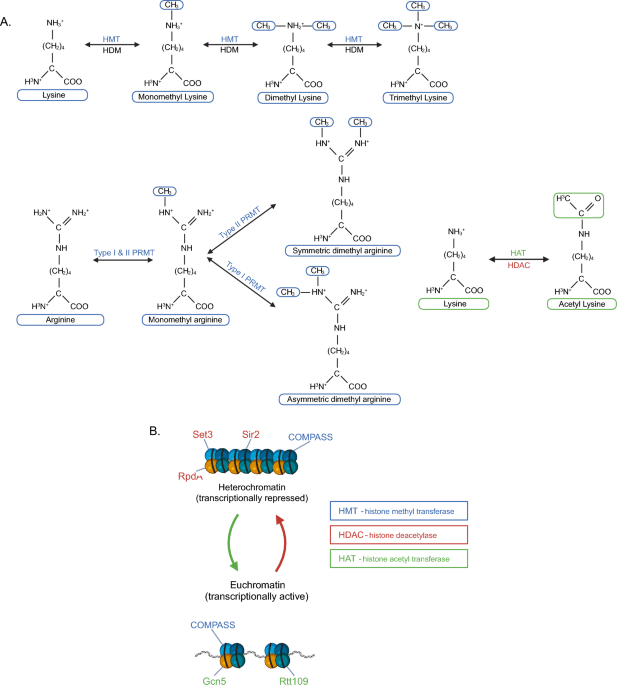
Generally, chromatin that is open or accessible is termed euchromatin and allows for gene transcription, and closed chromatin is known as heterochromatin and does not allow for gene transcription (Fig. 1). In this way, histone modifications allow for the organism to quickly modify its gene expression and respond to its environment. The best understood of these enzymes are histone methyltransferases (HMT), histone demethylases (HDM), histone acetyltransferases (HAT), and histone deacetylases (HDAC). As many of these enzymes were first studied in model yeasts and fungi (Fig. 1), we will discuss their functions during saprophytic growth and development as well.
Fig. 1 The alternative text for this image may have been generated using AI.
Histone modifications important in fungal pathogenesis. A. Enzymatic modifications of amino acids. Methylation and demethylation of lysine using HMTs and HDMs are exemplified. Acetylation and deacetylation of lysine is also shown via HATs and HDACs. Lastly, methylation of arginine is demonstrated using PRMTs. (Figure adapted from Husmann et al. 2019, Shahin et al. 2020, Khandelwal et al. 2023) B. Overview of Histone Modifications. Histone modifications regulate chromatin accessibility in fungi, enabling rapid adaptation to environmental changes (Lai et al. 2022). Histone acetyl transferases activate gene expression (green arrow and font). HDACs repress gene expression (red arrow and font). HMTs are less regimented as a group and have members that can perform either function (activation or repression; blue font) depending on the context. Created in BioRender. Price, M. (2025) https://BioRender.com/klb9gvx
MethylationLysine methylationHistone lysine methylation is a major mechanism of histone modification in fungi, occurring though the action of HMT. In most cases, HMT transfer a methyl group to specific lysine residues on either H3 or H4. At each site, mono-, di-, and trimethylation can occur based on the HMT (Fig. 1). Depending on the site or combination of sites, gene repression or activation can result (Lai et al. 2022).
HMT genes are currently classified into six HMT classes (KMT1-6); however, characterization of KMT5 class genes have been restricted to model and plant pathogen to date (Bachleitner et al. 2021, Wang and Jia. 2009, Zhang et al. 2022a). The KMT1 group specifically methylates H3K9, which is the largest group of HMTs, and is often associated with gene repression (Gessaman and Selker. 2017). This group includes DIM-5 and ClrD. The KMT2 group is made up most notably by SET1, encoding a key component of the COMPASS (Complex Proteins Associated with Set1) complex. This enzyme methylates H3K4 (Govindaraghavan et al. 2014). Methylation at this lysine residue is associated exclusively with gene activation (Rai and Rai. 2024). This was first described in S. cerevisiae but is found in many eukaryotes (Miller et al. 2001). H3K36 methylation occurs through Set2 which is part of the KMT3 group (Lai et al. 2022). Within the KMT4 group of methyltransferases, the S. cerevisiae protein Dot1p methylates histone H3K79, a part of the globular domain of the histone, instead of the tail as seen with other methyltransferases (van Welsem et al. 2008). Lastly, the PRC2 (Polycomb Repressive Complex 2) complex is the main component of the KMT6 group which methylates H3K27 (Lai et al. 2022). Numerous proteins are associated in this complex including two methyltransferases: Ezh1 and Ezh2 (Aramayo and Selker. 2013). Like KMT1 group methyltransferases, this complex is associated with gene silencing, particularly regarding secondary metabolite (SM) gene clusters (Zhang et al. 2022a). PRC2 is not found in S. cerevisiae as it does not harbor SM genes. Interestingly, this complex is also not found in Aspergillus or Penicillium species (Zhang et al. 2022a).
Histone methylation is known to play a role in stress response and virulence. In Candida albicans, Set1 is vital for virulence as a pathogenic fungus, although it leads to the expression of relatively few genes. Specifically, Set1 mediates response to reactive oxygen species (ROS) made by the host cells in response to infection via expression of oxidative stress response genes and mitochondrial genes (Kim et al. 2021). Additionally, Set1 is necessary along with other COMPASS components for growth at high temperatures and melanin production, both of which are key virulence factors in the critical priority fungal pathogen Cryptococcus neoformans. However, titan cell formation was not affected in COMPASS deletion strains, therefore it appears that proteins in the COMPASS complex do not take part in this process (Liu et al. 2023).
This histone modification is also necessary for normal growth and reproduction. In the model fungus Neurospora crassa, the HMT DIM-5, part of the KMT1 group, is necessary normal growth and fertility of the fungus (Tamaru and Selker. 2001). The N. crassa ortholog SET-2 has also been shown to be vital for normal development. N. crassa deletion mutant strains displayed slower growth and sparse conidiation as well as altered growth rates and sex-linked infertility during mating (Adhvaryu et al. 2005). A KMT1 group HMT in A. fumigatus currently known as AfClrD is similarly responsible for growth and conidiation (Palmer et al. 2008). Additionally, ∆AfclrD mutant knockout strains are sensitive to 6-azauracil (6AU), a guanine synthesis inhibitor, consistent with its role in transcription. However, the ∆AfclrD mutant shows no alteration in uptake by macrophages, suggesting that regulation of host–pathogen interaction elements are unaffected by this mutation (Palmer et al. 2008). Set2 and CclA, both part of the COMPASS complex, are required for normal growth (Lee et al. 2019a; Retanal et al. 2021). CclA, interestingly, also increases SM production in A. fumigatus but is dispensable for virulence (Palmer et al. 2013).
Lastly, histone modification works in maintaining proper gene expression and the cell cycle. In S. cerevisiae, Set1p plays a role in transcriptional elongation and pre-mRNA splicing. Additionally, it affects V(D)J recombination and RAG2 activity in lymphocytes (Shilatifard et al. 2008). Interestingly, the related protein Set2p plays a role in both transcription activation and repression. For example, Set2p associates with RNA Polymerase II (RNAP II) and supports expression of the galactokinase GAL1 in concert with the cyclin-dependent kinase Ssn3p (Schaft et al. 2003). The authors of this study also noted that Set2p appears to assist in transcriptional elongation; Set2p associates with the 3’ end of mRNA from the inducible GAL1 and constitutively expressed PDR5 genes but not the constitutively expressed ACT1 gene (Schaft et al. 2003). In contrast, Set2p is also necessary for the basal repression of the GAL4 transcription factor that regulates galactose utilization (Landry et al. 2003). Dot1p prevents nonspecific binding to euchromatin of the Sir proteins that are responsible for silencing of the extra mating type loci HMR and HML. This ensures that only these additional mating loci are silenced in yeast but remain available for mating-type switching should the need arise. Surprisingly, Dot1p is also necessary for proper function of the DNA damage checkpoint protein Rad9p that is important for cell-cycle arrest at the G1/S and intra-S phases (van Welsem et al. 2008).
In A. nidulans, Set1 plays a vital role in entry into and completion of mitosis, working in conjunction with mitotic kinases. Cell lines lacking Set1 and partial kinase function showed a delay in mitosis initiation, mitotic defects, and a greater need for the spindle assembly checkpoint (Govindaraghavan et al. 2014). In C. neoformans, an ortholog of the PRC2 subunit EZH2 (i.e. E(z) in Drosophila) methylates H3K27 to repress gene expression, especially in subtelomeric regions. This study further demonstrated that Ccc1, an additional subunit of the PRC2 complex, is required for specificity of binding and methylating H3K27 at centromeres over other locations (Dumesic et al. 2015).
Arginine methylationIt is important to note that arginine methylation also can occur. This takes place via protein arginine methyltransferases (PRMTs). Up to three methyl groups can be added to arginine, and they can be added symmetrically or asymmetrically (Fig. 1). There are four known types of PRMTs, Types I-IV; however, the most common PRMTs are type I and II (Low and Wilkins. 2012). Type I PRMTs are homologous to human PRMT1/PRMT3 and mono- and asymmetrically dimethylate H4R3.Type II PRMTs are homologs of human PRMT5 and mono- and symmetrically dimethylate their substrate, often also H4R3 (Bauer et al. 2010, Bauer et al. 2019).
Arginine methylation is in part responsible for stress response in these fungi. In A. nidulans, RmtA, a type I PRMT and RmtC, a type II PRMT both play a role in growth under oxidative stress; however, the exact mechanism has not been determined. Specifically, RmtC also allows for continued growth at high temperatures (Bauer et al. 2010). These enzymes have also been shown to affect secondary metabolism and protein secretion (Bauer et al. 2019). Viability was not affected in knockout strains of these enzymes. This may show that PRMTs are active more in stress response or similar roles rather than general constant pathways (Bauer et al. 2010).
This histone modification also plays a role in normal growth. In N. crassa, the enzymes designated amt-1 and amt-3 are both type I PRMTs. They were found to play a role in hyphal elongation rates, being most pronounced in amt-1. Hyphal branching was found to be regulated in part by amt-3, with a deletion strain resulting in increased length between branches and a fewer number of branches overall. amt-1 may have a part in ergosterol synthesis as the Δamt-1 strain showed hypersensitivity to voriconazole. The type II PRMT in this fungus is represented by skb-1. This enzyme also showed some association with growth rate. However, its most prominent role is in asexual sporulation, as the knockout strain showed a significant increase in the amount of macroconidia. This enzyme may also contribute to chitin synthesis, a cell wall component. These functions potentially occur due to interaction with Cot1, an NDR kinase (Feldman et al. 2013).
There are some PRMTs where their function or substrates are unknown or unspecified. In S. cerevisiae, Rmt1 is a type I PRMT homologous to human PRMT1 that is responsible for most of the arginine methylation in this fungus, but it is not required for viability (Gary et al. 1996). Hsl7 is a type II methyltransferase that is a homolog of human PRMT5. Its physiological substrate(s) have not been well-established (Sayegh and Clarke. 2008). This enzyme plays a role in completing the cell cycle, specifically in the G2/M transition. However, this function may not be related to its methyltransferase activity (Ruault and Pillus. 2006). Rmt2 is a known type IV PRMT, however, its role has yet to be determined. There is evidence there are more PRMTs in S. cerevisiae that have not been discovered yet, opening the door to further research (Low and Wilkins. 2012). In A. nidulans, RmtB shows similarities to human PRMT3, but its substrates are H4R3, H3R26, and H2A, which differs from the human homolog. Its function has not been specified (Bauer, I. et al. 2010). Interestingly, C. albicans has no known type II PRMT. It does, however, have the type I PRMT Hmt1, which is the major methyltransferase in the fungus. Rmt2, a type IV PRMT, has also been found (McBride et al. 2007).
DemethylationIn addition to histone methylation, histone demethylation also takes place. There are two known groups of HDM. The first group is a lysine specific demethylase that goes by many names depending on the fungal species, but it removes mono- and dimethyl groups from H3K4. The second group uses its Jumonji C (JmjC) domain to remove methyl groups from H3K36, requiring iron and α-ketoglutarate to do so (Choi et al. 2022).
Histone demethylation also regulates fungal growth and virulence. In A. nidulans, H3K36 demethylation occurs via KdmA. This enzyme seems to be both an inducer and repressor of gene transcription, however this study could not discriminate whether KdmA directly or indirectly caused this change. This enzyme is also necessary for the response to light needed for growth and negatively regulates energy metabolism and protein production (Gacek‐Matthews et al. 2015). KdmB is another HDM that works on H3K4. Deletion of this enzyme did not show any gross phenotypic changes but did positively and negatively affect gene expression levels as well as alter secondary metabolite production. Interestingly, this enzyme influences H3 acetylation, but more research needs to be done regarding the mechanism of this effect (Gacek-Matthews et al. 2016). In C. neoformans, Lsd1 demethylates H3K4 and K9 resulting in gene repression or activation, respectively. This enzyme is responsible for lipid accumulation in infected macrophages called foamy macrophages and prevents autophagy and the breakdown of lipid droplets, functions that are critical for pathogenicity of this fungus (Lohia et al. 2024). In A. fumigatus, KdmA demethylates H3K36 and is vital for normal growth, conidiation, and oxidative stress response. Interestingly, KdmB, which demethylates H3K4, plays an opposite role in this fungus by negatively regulating growth and conidiation. However, both enzymes are necessary for resistance to the guanine nucleotide synthesis inhibitor 6-azauracil (6AU). KdmB was also found to potentially be a key virulence factor (Choi et al. 2022).
Some histone modifications have no known phenotypic change. In S. cerevisiae, Jhd1 was found to demethylate H3K36. Interestingly, deletion of this enzyme does not result in an obvious phenotypic change, suggesting there may be overlapping functions with other enzymes or a yet unknown function. However, it has been shown that Jhd1 supports specific methylation patterns among transcription units (Fang et al. 2007). H3K36 can also be demethylated by Rph1, specifically in the tri-methylated state. Deletion of the enzyme also shows no overt phenotype, however this does not mean it does not function in a more subtle way (Klose et al. 2007).
Kdm5 (also known as Jhd2) demethylates H3K4 in all three methylation states. This enzyme regulates Set1 and prevents high levels of methylation during gene transcription. It also reduces methylation levels during attenuation of transcription (Ingvarsdottir et al. 2007). Interestingly, H3K4 demethylation is negatively regulated by H3K14 acetylation via ADA2 and SAS3 discussed in more detail below. When gene transcription is complete, H3K14 acetylation is lost, and H3K4 can be demethylated (Maltby et al. 2012).
AcetylationHistone acetylation is another well characterized epigenetic modification regulating gene expression. By the action of histone acetyltransferases (HATs), acetyl groups are transferred from acetyl-coenzyme A (acetyl-CoA) to lysine and arginine residues within the amino-terminal tail of histones, neutralizing the positive charge of lysine (Fig. 1). This results in a more relaxed and open chromatin structure making it more available for transcription (Lai et al. 2022). While arginine acetylation is known to take place in humans, it has not yet been described in fungi. There are two main families of HATs that have been described in fungi, the GNAT family and MYST family (Lai et al. 2022). Unlike the mode of action for histone methylation, histone acetylation is considered an ‘activating mark’ regardless of the amino acid targeted.
The major fungal acetyltransferase in the GNAT family is Gcn5. This enzyme is the main subunit of the SAGA (Spt-Ada-Gcn5-Acetyltransferase) complex and has many different functions depending on the species of fungus. In addition to Gcn5, Hat1, Hat2, and Elp are also members of the GNAT family. The MYST family of HATs is another major group of acetyltransferases with numerous functions in fungi. In filamentous fungi, most research has been focused on Sas2, Sas3, and Esa1. Lastly, Rtt109 is a rather unique HAT that shows structural similarity to both GNAT and p300/CBP superfamily acetyltransferases (Han et al. 2007; Tang et al. 2008). Rtt109 acetylates H3K56 and has been found to play both a key part in genome stability and resistance to oxidative stress (Lopes da Rosa et al. 2010; Jonas et al. 2022).
Histone acetylation plays a large role in handling fungal stress response. In C. albicans, the first HAT-related protein to be discovered to play a role in resistance to oxidative stress is Ada2 on H3K9. Without Ada2, which is also part of the SAGA complex and interacts with Gcn5, the yeast is more sensitive to stressors like menadione and H2O2 due to decreased expression of antioxidant genes leading to decreased virulence. Loss of Ada2 results in a significant decrease in histone acetylation and decreases azole tolerance in this yeast. (Sellam et al. 2009). Gcn5 is also required for proper cell wall stress response, filamentous growth, and hyphal elongation as well as virulence in C. albicans (Chang et al. 2015). Hat1, along with Hat2, acetylates H4K5 and K12 to form the NuB4 complex, which negatively regulates the oxidative stress response. As a result, the deletion of this complex increases resistance to stressors and strengthens yeast defense against host immune cells (as reviewed in (Kim et al. 2018)). The C. albicans rtt109∆/∆ deletion mutant was found to be much more sensitive to H2O2 and other genotoxic stressors, which correlated with reduced virulence of the pathogen due to increased susceptibility to host macrophages (Lopes da Rosa et al. 2010). Rtt109 regulates white-to-opaque switching as well (Stevenson and Liu. 2011). Also in this yeast, Esa1 has been shown to acetylate H4K5 and K12, whereas Sas2 works mainly on H4K16 (Wang, Xiongjun et al. 2013). Cells containing both esa1∆ and sas2∆ deletions are inviable; however, esa1∆ single mutants are viable but exhibit intolerance to stressors such as high temperature, DNA damage, and peroxide, as well as a lack of hyphal and filamentous growth. This deletion strain also showed growth at low temperatures where wildtype would normally enter a quiescent stage. This shows that Esa1 works in temperature sensing in this yeast. Interestingly, sas2∆ deletion mutants are also viable and exhibit growth at higher temperatures and increased hyphal growth. This suggests that Esa1 and Sas2 work in opposite roles in supporting cell growth at high and low temperatures (Wang et al. 2013).
Gcn5 was likewise found to be vital for stress responses and virulence in the basidiomycete yeast C. neoformans. Without this enzyme, Cryptococcus mutant strains cannot grow at high temperatures, properly respond to oxidative stress (mainly H2O2), form its polysaccharide capsule appropriately, regulate unisexual and bisexual filamentation, and sporulation. These phenotypic changes result in an avirulent strain that causes no apparent clinical disease in a murine model of infection (Chen et al. 2023; O'Meara et al. 2010). In A. fumigatus, Sas3 (also called SasC (Kwon et al. 2023)) acetylates multiple lysine residues on histone H3. It is vital for cell wall integrity, with knockout strains showing sensitivity to cell-wall perturbing agents, thickened cell walls, and disordered distribution of chitin in the cell wall. Sas3 also affects conidiation, hyphal development, and virulence (Wang et al. 2024). Furthermore, Sas3 plays a role in oxidative stress response, as knockout strains showed reduced catalase activity. However, other ROS detoxifying agents such as peroxidase showed increased production in response (Kwon et al. 2023). In N. crassa, Gcn5 acetylates H3 to regulate the transcription of the catalase gene cat-3 that encodes a protein that protects the fungus from oxidative stress during vegetative growth and conidiation (Qi et al. 2018).
This histone modification is also largely necessary for growth and reproduction. In A. nidulans, GcnE has been shown to be vital for conidiation and secondary metabolism under stress conditions (Cánovas et al. 2014). Esa1 has been strongly correlated with SM production (Soukup et al.
Comments (0)