
Remember me
Among the four supervisor participants, two started their careers with forming a professional counselor identity, while the other two began with a feminist activist identity. The age range of participants was between 41 and 66 years old. The first participant, Jieun, worked as a supervisor for 17 years at a crisis counseling center and counseling center for gender violence. The second participant, Hye-gyeong worked at a university counseling center (UCC) for families as a supervisor for 2 years. The third participant, Sujin worked as a supervisor and counselor educator at a UCC for one and a half years. The last participant, Mijeong works at her private practice and has five years of supervision experience (see Table 1).
Table 1 Participants demographic informationData AnalysisWe employed reflective TA (Braun & Clarke, 2022) to analyze the data collected from four participants in the Korean language. Reflective TA was suitable for this study because the purpose of this study was to understand participants’ experiences that had never been explored. The reflective TA process has five phases. The first phase involved each research team member familiarize themselves with the transcribed interview data through various methods such as transcribing data, reading the data repeatedly, making notes while multiple readings, and noting down initial codes. In the second phase, each team member independently coded the data line by line, sentence by sentence, paragraph by paragraph, and/or section by section. We read the data in Korean and came up with codes in Korean and/or English. In phase three, the research team members met for hours multiple times to collectively generate initial themes from the codes we shared. We generated initial themes in Korean and/or English. In phases four and five, we continued to work with themes to develop and review themes by using mind maps, diagrams, and tables. This work evolved over time through reviewing, defining, and naming themes/sub-themes, as data analysis meetings progressed. In this analysis process, the researchers used two languages, Korean and English, interchangeably. We acknowledge that translation functioned as an interpretive act. The research team made collaborative decisions about how to convey culturally embedded concepts and nuanced expressions, and some meanings may have shifted slightly through translation. In the last phase of writing up, the final themes and sub-themes are presented in the English language. In this phase, direct quotes from the participants presented the findings section were translated from Korean to English.
Given the small and specialized sample, the research team took deliberate steps to ensure analytic depth. Each transcript contained extensive, richly detailed narratives because participants were supervisor-level practitioners who had shaped the early development of feminist supervision in South Korea. Consequently, each interview produced a large corpus of analyzable material, allowing for multiple layers of coding and theme refinement. During analysis meetings, we tracked whether new interviews contributed novel conceptual insights or replicated existing meanings. To ensure that the small sample still met qualitative standards for sufficiency, we evaluated conceptual completeness as well. Across interviews, we observed extensive meaning redundancy, where participants independently described overlapping developmental trajectories, challenges, feminist principles, and supervisory processes.
TrustworthinessTo maintain credibility and confirmability, we used reflective notes/memos, external audits, and member-checking (Braun & Clarke, 2022). Every time the research team members met to analyze the data; we not only shared our reflections analyzing the data but also kept reflective notes/memos to record our thought process to maintain credibility throughout the data analysis process. In specific, the research team engaged in collaborative reflection and discussion on how our own personal experiences as Korean Women in the U.S. counseling field might have helped or hindered understanding and interpreting the participants’ experiences throughout the research process. Also, we invited an external peer auditor to review and evaluate our entire research process. The external auditor was a male counselor educator who was raised and educated in the United States. He was experienced in qualitative research, but feminist counseling or supervision was not his research interest. Also, the direct quotes presented in the findings section were audited by a counselor educator bilingual in both languages. This individual was not a member of the research team. Lastly, we employed member-checking by sending the final themes to the participants, and they confirmed that the findings accurately reflected what the participants experienced in becoming feminist counselors and supervisors.
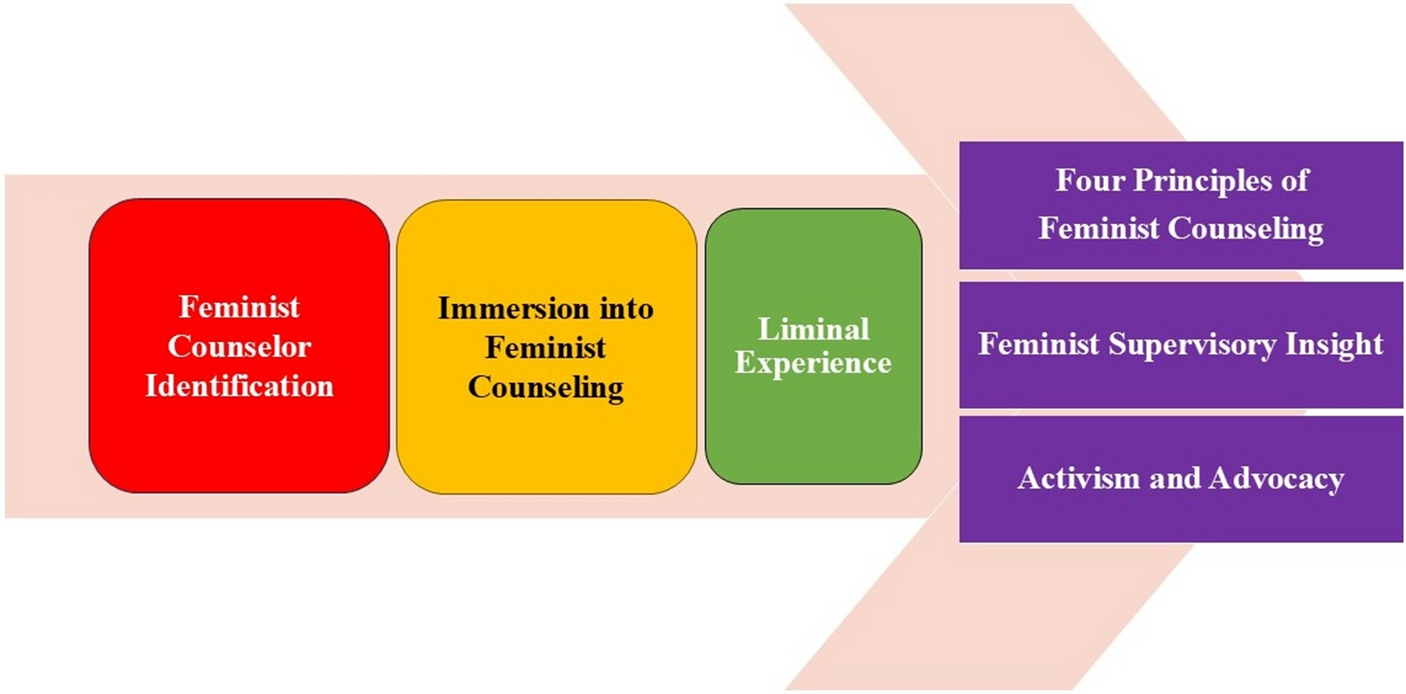
FindingsWe generated six overarching themes along with 15 sub-themes. The six themes were as follows: (a) Feminist Counselor Identification, (b) Immersion into Feminist Counseling, (c) Liminal Experience, (d) Four Principles of Feminist Counseling, (e) Feminist Supervisory Insight, and (f) Activism and Advocacy (see Table 2; Fig. 1).
Table 2 Themes and subthemesFig. 1 The alternative text for this image may have been generated using AI.Theme 1: Feminist Counselor Identification
When the participants described their journey to becoming feminist supervisors, they emphasized how personal experiences with sexism significantly influenced their early development as counselors, particularly in seeking self-validation and pursuing career goals. It was noteworthy that the participants differed in their primary professional identities: some prioritized their feminist identity first, while others identified primarily as counselors. Additionally, they were drawn to feminist counseling for its inherent strengths and alignment with their values, which they cited as the reason they ultimately identified as feminist supervisors.
Personal Experiences of SexismAll participants experienced some type of sexism. These experiences made them feel angry and that they were not being treated fairly. Hye-gyeong shared that, “[I felt I was] a bad person. Why am I angry all the time? … but after studying [feminist] counseling, I realized my anger was a reaction to the fact that I was mistreated. I was glad that I realized that.” Similarly, Sujin realized that feminism explained her experience of sexism in her childhood. “After reading the [feminist] book, my childhood experiences were explained more or less. Trivial but everyday discriminations, such as my experiences related to my younger brother, were finally explained.” Participants also reported that sexism remains across the generations. Jieun said, “I met girls who were younger than me, probably a couple of decades gap between me and them, but they still experience sexism and oppression at home.”
Prioritized Identification: Feminist First or Counselor FirstAlthough all participants identified themselves as feminist supervisors, their journey of becoming feminist supervisors differed in terms of early identification. Jieun and Hye-gyeong learned counseling first and then feminism. Hye-gyeong said, “It was 2009 when I started counseling, and I didn’t have any awareness about feminism then. … I started graduate school in 2011 and studied family counseling there. There was a chapter on feminist family counseling, which was my first time to learn [feminist counseling]”. Meanwhile, Sujin and Mijeong learned about feminism before they learned about counseling. Sujin stated, “For me, feminism comes first, counseling comes later.” Mijeong also said, “I wouldn’t study counseling psychology if there weren’t feminist counseling.”
Reasons To Choose Feminist CounselingParticipants decided to use feminist counseling due to the limitations of traditional counseling approaches and the strengths of the feminist approach. Jieun shared her experiences with the supervisors who used traditional counseling approaches. “When I presented a case of domestic violence, they conceptualized the case as a personality disorder.” and added, “I found that it didn’t help me to work with a supervisor whose perspective was very different from mine. Also, I felt it was humiliating my clients.” Participants reported that the feminist approach represented women’s perspectives. Hye-gyeong said, “Since [feminist counseling] could respect how women have lived, women’s situation can be seen through women’s perspectives.” Mijeong also highlighted the strength of the feminist approach: “[Feminist counseling] gives us the basis for saying that “It’s not your fault” when seeing the clients who are survivors of sexual violence. We don’t just say it without any evidence.”
Theme 2: Immersion into Feminist CounselingWhen discussing their journey to identify as feminist supervisors, the participants shared how they became immersed in feminist counseling. Two subthemes were created from their experiences: Inyeon and Korea Women’s Hot Line, which highlighted their initial engagement with feminist counseling and their deepening involvement in the field.
InyeonInyeon is an everyday term in Korea that describes a predestined or fated connection between people through cosmic or spiritual forces beyond one’s will or efforts (The Academy of Korean Studies, n.d.). When recalling how they became committed to feminist counseling, all participants noted the importance of Inyeon with other feminist colleagues. Jieun explained her pre-existing relationships with other feminists and how they led her into feminist counseling. She said,
I received a MBTI workshop with the president of the Korean Women’s Hotline. That became Inyeon and I went to give a lecture at the Women’s Hotline. Mina [pseudonym] is almost a celebrity in feminist studies in Korea and was working there. She knew me and we became close, so it turned out to be Inyeon and I became a member.
Similarly, other participants talked about the happenstance of their relationships and how those seemingly coincidences had fatefully led them to feminist counseling. Mijeong recalled that one of her friends became the first president of the Women’s Hotline, saying “I followed her doing feminist activism. I went there, received a counselor training, and did volunteer work.” Hye-gyeong also shared the unique setting of her graduate program by saying, “Fortunately, I learned from a professor who got trained by a feminist scholar in the United States. … Only a few graduate schools in Seoul teach feminism, but we have an individual course about feminism.”
Korean Women’s HotlineAlthough the Korean Women’s Hotline is a proper noun, we decided to use it as a subtheme because most participants shared how the Women’s Hotline and other grassroots feminist organizations played a pivotal role in their initial engagement with feminist activism. These organizations not only provided spaces for advocacy but also served as training grounds where participants gained hands-on exposure to feminist counseling. Jieun shared her experience of raising funds for “moving a [Intimate Partner Violence] shelter” and Sujin recalled her internship experiences regarding supporting victims of sex trafficking. Further, those experiences at the feminist activist organizations provided them with opportunities to be exposed to feminist counseling. Sujin said, “I made up my mind to do counseling after I received training about sexual violence counseling from the Women’s Hotline. I learned there that this is what counseling is like.”
Theme 3: Liminal ExperienceThe theme of Liminality reflects the participants’ experiences of committing to feminist counseling and supervision while feeling unsupported due to a lack of training opportunities, mentorship, and resources. As they did not adhere to traditional or mainstream counseling approaches, the participants faced significant challenges and were often forced to become pioneers in their field. Jieun described this liminal experience, stating, “[I am] on the border of this traditional counseling, institutional counseling, or the majority.”
Lack of ResourcesMost participants noted a lack of resources to learn and develop feminist counseling approaches. While receiving training from those who were not feminist supervisors, Sujin realized, “I came here to learn this [feminist counseling], but it’s not here either.” Hye-gyeong received negative feedback when she decided to present her cases based on feminist family therapy orientation. In addition, a shortage of feminist counselors and supervisors was highlighted as the reason for the lack of resources. Sujin explained, “I want to talk about the realistic limitations. There are no limitations from a theoretical point of view. Limitation comes from the fact that there are so few [feminist] counselors, trainers, and supervisors. That’s why there are so many difficulties.” Jieun shared her perspectives in a similar vein. She said, “Usually, for something to develop, there needs to be researchers to write papers, develop models, and distribute them from top to down. But there are no people spreading feminist counseling.” Moreover, this shortage of professionals resulted in limited networking opportunities. Mijeong noted, “I haven’t had any interaction with other feminist supervisors. … Feminist counselors themselves are rare, and feminist counseling supervisors are even rarer.” As a result of this lack of resources to learn and network, participants often felt doubt about their competencies as feminist supervisors. “Nobody taught me about feminist counseling. And it’s not something that I learned through a degree. So I’ve had doubts about whether there’s a lack of expertise within me.” shared Jieun.
Becoming a PioneerDue to limited available resources, participants had to push themselves to become pioneers in creating resources and being self-taught. Sujin shared,
The workshop [I developed] covered principles, theories, and various techniques used in feminist counseling. It also covered how to approach case conceptualization. Anyway, it wasn’t just me and I took on some of these responsibilities. I worked with other feminist counselors, and we went through this process of preparing and educating together. It wasn’t a one-time preparation but stretched over several months, with more experienced counselors providing feedback. So, through this process of developing the workshop, I’ve actually grown a lot.
Jieun also recalled her experience of writing a book about why feminist counseling and it offered her insights into “admitting [her] identity as a feminist counselor.”
Theme 4: Four Principles of Feminist CounselingAll participants emphasized the critical role of four principles of feminist counseling (Worell & Remer, 2002) to guide feminist supervision. The four principles—subthemes—are as follows: (a) Personal is political, (b) Egalitarian relationship, (c) Empowerment, and (d) Women’s perspectives are valued.
Personal Is PoliticalThe first principle, Personal is political, has been repeatedly remarked on by all participants. Jieun said this principle is an overarching philosophy because “Feminist counseling inherently views the roots of psychological distress as stemming from societal factors.” Hye-gyeong also emphasized the benefits of the first principle that “women’s experiences are newly interpreted and understood when societal and structural pressures are considered.”
Egalitarian RelationshipRegarding the second principle, Egalitarian relationship, Sujin shared her experiences observing her own supervisors, saying:
In fact, my supervisors have shown a lot of effort toward establishing an egalitarian relationship between supervisors and supervisees, and toward reducing power differentials between supervisors and supervisees, …(omitted)… which was immensely helpful in my growth as both a counselor and supervisor.
Meanwhile, she emphasized the flexibility in applying these principles by saying,
At first, we translated this principle from English into Korean as ‘counselors and clients are equal’, which was later revised. It’s more accurate to say that ‘we strive for equity.’ Acknowledging that we pursue equity, even though we may not achieve it, is realistic. This revision allows us to let go of unrealistic expectations.
EmpowermentParticipants emphasized all four principles were naturally connected. Mijeong said, “It’s important to consider how viewing things differently or understanding them differently can help empower the client.” In the egalitarian relationship, Jieun pointed out that “[Traditional] counseling has the sense of counselor fixing a client, but empowerment is about a client doing it themselves, breaking through on their own. In that process, a counselor is assisting clients to have power.”
Women’s Perspectives Are ValuedSujin pointed out that “being a woman causes being oppressed and marginalized, which is of the utmost importance from my perspective”. This marginalization is dismantled by recovering women’s perspectives as Jieun said, “Reframing from a woman’s perspective encourages self-description from a woman’s viewpoint. Indeed, many clients are suffering because they try to describe themselves from others’ perspectives.” Eventually, Hye-gyeong summarized the uniqueness of counseling under feminist supervision as, “rather than aiming to fix the client and diagnosing pathologically, it could be beneficial to explore alternative approaches together, acknowledging the way and effort that clients had strived to live.”
Comments (0)