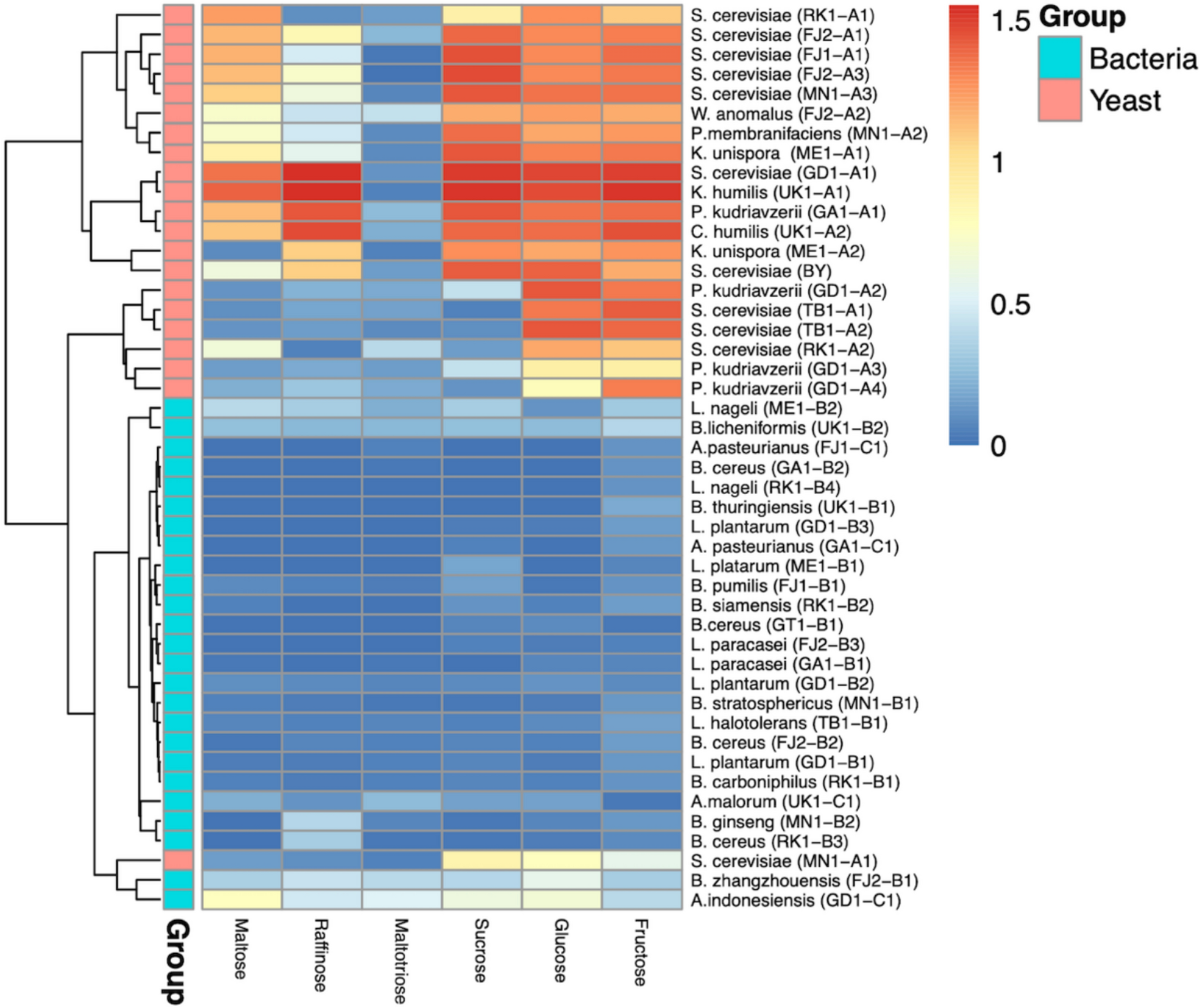
The capacity to utilize and ferment a variety of carbon sources is a key trait in sourdough making. From this study, all yeast isolates exhibited high specific growth rates on glucose and fructose, while the specific growth rate on maltotriose was notably lower (Fig. 1). Although maltotriose could be abundant in flour, it is much more complex than glucose and fructose and would require extracellular enzymes such as isomaltase to be available for the yeasts [18]. Among the yeast isolates, Saccharomyces cerevisiae strains from various locations dominated in their capability to utilize a wider range of carbon sources at high growth rates. Pichia kudriavzevii (GA1-A1) demonstrated the highest similarity to conventional yeast species, followed by K. humilis (UK1-A1) and C. humilis (UK1-A2), indicating the promising potential of non-conventional yeast species in the baking industry as potential sourdough starters. S. cerevisiae has been long domesticated and well adapted to the baking environment [19]. It is important to note that these isolated yeasts strains were well comparable to the baker’s yeast control strain. In comparison to previous studies, the performance of S. cerevisiae aligns with established findings, particularly regarding its preferential utilization of glucose and fructose. For instance, a study by Pinu, Edwards [20] demonstrated that S. cerevisiae EC1118 preferentially consumed glucose and fructose over other sugars during fermentation.
Yeast isolates obtained from the Francistown (FJ1-A1, FJ1-A2 and FJ2-A3) and Ratholo (RK1-A1) samples demonstrated a wide carbon assimilation range as they showed rapid growth in glucose, fructose, sucrose and maltose. Pichia kudriavzevii from GD1-A3 and GD1-A4 exhibited poor maltose assimilation, and this could be suggestive of possible reliance on a synergistic relationship with other associated microorganisms. Synergistic associations of microbial consortia in sourdough can alter metabolic pathways during fermentation [21]. A study by Caballero, Olguín [22] highlighted that although S. cerevisiae strains have enzymes for maltose uptake, the consumption rate might be slow. The isolates which showed the widest carbon assimilation and highest growth rates were from Tsabong (TB1-A1, TB1-A2), Gaborone (GA1-A1 and GD1-A1) as they exhibited high growth in glucose, fructose, sucrose, maltose and raffinose. Isolates from Maun (ME1-A1 and ME1-A2) had the least carbon assimilation range as they only showed high growth in glucose and fructose. Considering that microbial isolates from the same locations exhibited similar carbon assimilation ranges, this may indicate a biogeographical influence [13]. Additionally, other indirect geographical related factors such as preparation practices not only shape the biodiversity of sourdough microbiota but also influence their physiological capabilities [23, 24].
Sourdough starters represent a complex ecosystem, marked by intricate interactions among diverse yeast and bacterial species. Thoroughly isolating and characterizing these interactions presents a considerable challenge. The presence of LAB, AAB and other bacteria in sourdough cultures significantly influences the biodiversity and metabolic performance of the yeast isolates and the final bread. While co-culturing of yeast and LAB in sourdough has been shown to have no impact on yeast cell yield, co-fermentation significantly influences environmental factors such as availability of nutrients, synthesis of organic acids, pH reduction and changes of the rheological properties of sourdough [25]. Our findings revealed that most sourdough yeast and bacterial isolates can utilize a wide range of carbon sources, an important factor in sourdough production as readily available simple sugars are normally a limiting factor.
Gassing power (CO2 production rate) is another important attribute of a model baker’s yeast, which reduces the time taken to leaven dough, which is an important techno-economic factor [8, 15, 26]. Carbon dioxide is the primary byproduct of interest, focusing solely on its production in this study presents limitations, as it overlooks key metabolites such as organic acids and ethanol. In contrast, gas chromatography enables the detection of a broad spectrum of volatile compounds, providing a more comprehensive metabolic profile. We observed variations in the CO2 production rate, a key factor that influences the speed of dough leavening, with each isolate exhibiting a unique preference for its ideal carbon source. Generally, most sourdough yeasts preferentially ferment glucose and maltose as compared to fructose, synthetic dough and sucrose. S. cerevisiae (RK1-A2), K. unispora (MEI-A1) and S. cerevisiae (FJ1-A1) exhibited the highest fermentation capacity in the presence of maltose, while P. kudriavzevii (GD1-A4) and P. kudriavzevii (GD1-A3) did not show any significant fermentation of maltose because no gas production or visible growth was observed in maltose-containing media under test conditions, indicating an inability to ferment maltose. Even though P. kudriavzevii (GD1-A3) could not ferment maltose, the strain demonstrated high capability to ferment glucose along with P. kudriavzevii (GD1-A2), W. anomalus (FJ2-A2) and S. cerevisiae (FJ2-A3). All yeast isolates could ferment glucose and fructose, except for P. kudriavzevii (GA1-A1), S. cerevisiae (RK1-A1), S. cerevisiae (FJ1-A1) and S. cerevisiae (GD1-A1) which were not able to ferment fructose. The strain S. cerevisiae (MN1-A3) from Mokatse (a small village near Gaborone in Botswana) was among the isolates that could ferment all the sugars, and it demonstrated the highest fermentative performance in sucrose and synthetic dough. Isolates from Ratholo, Maun and Tsabong displayed higher fermentation capacity of synthetic dough highlighting their potential as starter cultures in baking and leavening products. The CO2 results were not entirely surprising, given the findings from the carbon assimilation tests. (Fig. 1) that showed that most isolated yeasts could utilize different carbon sources found in flour and so there was a higher chance of fermentation. Maltose is the most abundant carbon source found in flour [27], however Pichia kudriavzevii from Gaborone (GD1-A3 and GD1-A4) and United Kingdom (UK1-A1 and UK1-A2) preferred other carbon sources apart from maltose. This suggests that maltose, despite being the most abundant carbon source in flour, may not be the preferred carbon source for some yeasts [28].
On the other hand, LAB obtain energy through the process of sugar phosphorylation and are classified into two primary groups: homofermentative and facultative heterofermentative. Some bacteria can utilize both fermentation pathways and are referred to as facultative heterogeneous bacteria. Heterofermentative microorganisms are distinguished by their capacity to break down both hexoses and pentoses. They utilize the pentose phosphate pathway, which involves key enzymes such as ribose-5P epimerase and phosphoketolase. This pathway results in the production of lactate, carbon dioxide, and either ethanol or acetate as fermentation by products [29]. Carbon dioxide produced during this process is important for dough leavening, and the data generated by our study show varying patterns of carbon dioxide production by different microbial isolates. These patterns may be influenced by carbon source preferences and assimilation capabilities. Majority (14/21) of isolated bacteria could only produce bubbles when fermenting maltose, thus, not significant enough to raise the plunger. Similarly, for glucose fermentation, bubbles were observed for most (13/21) isolated bacteria, also not enough to lift the plunger. Also, for sucrose, fructose and synthetic dough fermentation, CO2 production by LAB and AAB was low. L. plantarum is a facultative heterofermentative strain well known for fermenting sugars to produce carbon dioxide, lactic acid, ethanol and acetic acid [30]. We noted that L. plantarum (GD1-B1, GD1-B2, GD1-B3and ME1-B1) could only produce carbon dioxide by producing bubbles when fermenting maltose and glucose. On the other hand, L.nageli showed ability to produce carbon dioxide in fructose fermentation. Fructophilic lactic acid bacteria (FLAB) are a newly identified group that includes certain species of Fructobacillus and Lactobacillus. Fructose is the optimal substrate for FLAB growth, and unlike other LAB, they exhibit very poor growth on glucose. Overall, the data suggests that our yeast isolates contributed more to dough leavening during fermentation as compared to LAB resulting from high CO2 production. While carbon dioxide is the primary byproduct of interest, other fermentation byproducts such as organic acids and volatile compounds, also play a significant role in shaping the characteristics of the final sourdough product. However, this study is limited to the analysis of carbon dioxide production.
Yeasts are known to perform most of the fermentation in sourdough as they are the main contributors to dough leavening [8, 15]. However, yeasts can experience many baking associated stresses at the onset, during and at the end of the fermentation processes. The tolerance of sourdough isolates to baking-associated stresses was assessed quantitatively. The sourdough environment is characterised by osmotic stress from the high sugar and salt concentration during the early stage of fermentation [31, 32]. The presence of salts can enhance microbial growth, however elevated concentrations (0.5 M, 0.75 M, 1 M, 1.25 M, 1.50 M and 1.75 M), may result in osmotic stress and ion toxicity. The sourdough associated yeast isolates exhibited tolerance to osmotic stress as they all showed growth at 1.5 M sodium chloride. Strains of S. cerevisiae (FJ1-A1), P. membranifaciens (MN1-A2), K. unispora (ME1-A2) showed less growth at 0.75 M to 1.5 M NaCl concentrations, indicating lower tolerance to osmotic stress compared to the other strains. The baker’s conventional yeast showed poor growth at all concentrations of sodium chloride used, as compared to all other isolated yeasts. This is in agreement with the findings of [8], where we reported the poor performance of conventional baker’s yeast at high sodium chloride concentrations. We have noted that our NaCl tolerance results align with previous sourdough studies. Notably K. unispora and C. humulis have been shown to have tolerance to high osmotic stress.
Oxidative stress tolerance was assessed, as yeasts encounter reactive oxygen species (ROS) during both dough fermentation and propagation [33]. In this study the sourdough associated yeasts isolates were exposed to varying concentrations of hydrogen peroxide to monitor their tolerance to oxidative stress. The yeast isolates exhibited diverse degrees of tolerance to oxidative stress with strains from Gaborone (GA1-A1 and GD1-A1) and UK (UK1-A1 and UK1-A2) having tolerance to high hydrogen peroxide concentration (up to 5 mM). The non-conventional K. humilis strain exhibited better tolerance to oxidative stress (5 Mm) as compared to other isolated yeasts. However, other non-conventional yeasts such as P. kudriavzevii, P. membranificiens and W. anomalus were among the least oxidative stress tolerant strains. These findings highlight the species-specific variability in stress tolerance among sourdough yeasts, emphasizing the need to consider individual strain robustness when selecting candidates for sourdough fermentation.
To overcome stress and thrive in different stressful conditions, LAB and yeasts have evolved a series of adaptation mechanisms [34, 35]. Metabolic versatility, such as preferential utilization of abundant sugars and production of fermentation metabolites, along with synergistic interactions between yeasts and bacteria, further support their persistence and functionality in the sourdough ecosystem. Apart from metabolism related stresses such as oxidative stress and osmotic stress, sourdough microorganisms are also exposed to environmental stresses such as thermal stress. Downstream processing for the preparation of biomass involving drying, storage and rehydration exerts thermal stress. Most of the yeast isolates could grow well at 37 °C except S. cerevisiae (TB1-A1) from Tsabong whereas only two P. kudriavzerii (GD1-A3 and GD1-A4) could withstand high temperatures of up to 42 °C which is known to be too high for yeasts to withstand. We observed that among the bacterial isolates, most isolates grew at 37 °C except for only 4 isolates (B. thuringiensis (UK1-B1), B. stratosphericus (MN1-B1), L. plantarum (ME1-B1 and B. lichenformis (UK1-)). The few strains that tolerated temperature up to 42 °C, were dominated by Bacillus spp. along with L. paracasei (GA1-B2) and A. pasteurianus (GA1-C1). Since sourdough is incubated at room temperature, Botswana’s elevated daily temperatures could result in elevated incubation temperatures for the dough. Furthermore, the fermentation process generates heat, thus sourdough microorganisms should tolerate elevated temperatures.
Our results show that the majority of the isolated sourdough bacteria can withstand different stressful conditions but at low growth rates as compared to yeasts. Both LAB and AAB isolates could not tolerate more than 3 mM of hydrogen peroxide. The strains that grew beyond that concentration were considered to have high tolerance to oxidative stress and they included L. plantarum (GD1-B2), B. gingseng (MN1-B2), B. carboniphilus (RK1-B1), B. siamensis (RK1-B2), B. thurigiensis (UK1-B1) and B. licheniformis (UK1-B2). Bacterial isolates from Mokatse, Gaborone, Ratholo and United Kingdom showed high oxidative stress tolerance. This may represent an adaptation to the sourdough environment, enabling them to survive and enhance the quality of the bread. Studies on S. cerevisiae and L. helveticus have shown that these microorganisms synthesize unsaturated fatty acids in their membranes which detoxify hydrogen peroxide and protect cells from oxidative stress [36].
As fermentation progresses, it results in accumulation of ethanol, thus the microorganism are expected to tolerate varying degrees of ethanol stress. The results (Fig. 3) show that majority of the yeast isolates were moderately tolerant to up to 10% (v/v) ethanol concentration. Of all the isolates tested, only S. cerevisiae (FJ2-A1) exhibited poor growth up to 10% (v/v) ethanol, with no growth observed at higher concentrations. Ethanol tolerance in bread making is an important attribute as it can prevent stuck fermentations and also helps reduce microbial contamination by antimicrobial activity. Our results further show that majority of the LAB and AAB isolates could not tolerate ethanol concentrations beyond 4% (v/v), with the exception of L. paracasei (FJ2-B3), B. stratosphericus (MN1-B1), L. plantarum (GD1-B2), B. ginseng (MN1-B2), B. carboniphilus (RK1-B1), B. siamensis (RK1-B2), B. cereus (RK1-B3), L. parabachnri (ME1-B1), L. plantarum (GT1-B1), and B. thurigiensis (UK1-B1). The bacterial isolates with high ethanol stress tolerance were largely dominated by species of Bacillus genus. The same isolated LAB and AAB from this study showed a similar pattern when exposed to acetic acid and lactic acid tolerance of 1% (v/v) acetic acid and 1% (v/v) lactic acid. Bacterial isolates exhibiting higher tolerance to oxidative and ethanol stress, including B. cereus (FJ2-B1), B. ginseng (MN1-B2), L. plantarum (GD1-B1), L. plantarum (GD1-B2), B. carboniphilus (RK1-B1), B. siamensis (RK1-B2), B. cereus (RK1-B3), B. thurigiensis (UK1-B1), B. licheniformis (UK1-B2), A. malorum (UK1-C1) (Fig. 3A), also demonstrated tolerance to both 1% (v/v) acetic acid and 1% (v/v) lactic acid.
By utilizing principal component analysis (PCA), we were able to identify distinct stress tolerance profiles within the sourdough microbiota. We highlight that certain isolates exhibited high tolerance to heat but were sensitive to osmotic stress, while others showed broad resistance across multiple stress conditions, including ethanol and oxidative stress. These differences suggest potential functional diversity among strains, which may influence their suitability for specific fermentation applications. We notice Group A clustering isolates that are sensitive to almost all stressors under investigation and Group B forming a cluster with isolates that are sensitive to ethanol and oxidative stress. Strains exhibiting high osmotic or ethanol tolerance may be better suited to later stages of sourdough fermentation, where sugar and metabolite concentrations are elevated. Conversely, strains with higher thermal tolerance may be more resilient to process-related stresses such as baking conditions. Figure 3B provides a visual representation of these clusters, highlighting the diverse adaptations of these microorganisms. As expected, the yeasts formed a distinct cluster from bacteria based on their different roles and peculiar characteristics in sourdough processing (Fig. 3C). However, there were some outlier groups, suggesting diverse functions of traditional Botswana sourdough populations. In our previous study [13], we reported on the presence of potentially novel populations. Further research is needed to characterize these microorganisms and elucidate their contribution to the fermentation process of Botswana’s sourdough bread. Various complementary approaches such as gene expression and proteomics could be used in the future to further support the findings of the study. It is also notable that future studies should incorporate pH monitoring and control to better understand the effects of stressors on microbial performance during the production of sourdough.

Comments (0)