Over the past decade, advancements in neurocritical care and broader acceptance of organ donation have led to a global increase in DCD organ donors [26]. However, despite the efforts by the transplant community to better understand outcome-determining parameters, optimize allocation strategies, and refine organ recovery practices, the rate of liver transplants has risen more modestly than anticipated, primarily due to limited utilization of DCD donors [26]. Furthermore, contemporary DCD liver transplantation practices exhibit considerable geographical variability in donor management, procurement techniques, recipient selection and utilization of perfusion technologies, resulting in fluctuating rates of organ acceptance, retrieval and implantation across different countries [27, 28].
This study provides a comprehensive analysis of the trends and outcomes associated with DCD liver transplantation at a high-volume Italian transplant center over an eight-year period. Our findings align with the global rise in donations after cardiovascular determination of death [3, 26, 27], demonstrating a tenfold increase in the annual rate of DCD liver transplants during the study period (Fig. 1). Moreover, although not included in this study, the year 2024 saw a further increase in DCD liver transplantations, accounting for nearly one-third of all liver transplants performed that year (35/109, 32.1%).
Consistent with the study hypothesis, donor and recipient profiles underwent substantial changes throughout the study period, reflecting accumulated experience and advancements in organ reconditioning. Recipients transplanted in the later period more frequently presented with severe end-stage liver disease (as classified by the Child-Pugh score) and faced a higher risk of perioperative mortality and graft loss, as indicated by LTRS and P-SOFT scores. Additionally, although not statistically significant, DCD allografts were successfully employed in one case of urgent retransplantation and another case of combined liver-kidney transplant during the later period.
Donor characteristics also changed markedly over time. In the later period, the median donor age increased to 72 years – ten years higher than in the initial period. Notably, this phase included a successful DCD liver transplant from an 86-year-old donor. The proportion of ECD and the number of extended criteria per donor also rose significantly, resulting in higher DRI and ET-DRI scores. Histological allograft characteristics evolved as well, with a higher prevalence of Ishak stage 2–3 fibrosis among allografts transplanted in the later period. This finding in our opinion is mainly related to the increased donor age in the later period, being donor age ≥ 65 years the most common feature for donor characterization as ECD in the whole study population and in the later cohort in particular (58.7% vs. 37%, p = 0.041).
Interestingly, a considerable proportion of transplants in this cohort would be classified as futile according to the UK DCD risk score. This outcome was anticipated, given that prolonged fWIT (> 30 min) is one of the strongest predictors of graft failure in this scoring system and that Italian legislation highly conditions fWIT duration; in fact, only two cases in the entire study had a fWIT ≤ 30 min [20]. This finding remarks the great potential of NRP for allograft reconditioning in the context of cardiovascular death determination: extracorporeal support in facts allows the utilization of grafts with prolonged fDWIT, whose super-rapid procurement would have otherwise resulted in almost certain transplant failure. The percentage of potentially futile transplants – by means of UK DCD Risk Score – increased in the later period (69.5% vs. 55.2%), although the difference failed to reach statistical significancy.
Despite the progressive increase in donor and recipient risk factors, liver transplant outcomes remained substantially stable between the initial and later period, with comparable rates of organ dysfunction, surgical complications, hospital stay and graft survival. Given the higher marginality of donors in the later period, the preservation of similar allograft functional outcomes was likely influenced by prolonged HOPE reconditioning in this cohort (138 vs. 70 min, p < 0.001) and shorter ischemia time (341 vs. 390 min, p = 0.002). Notably, both HOPE duration and ischemia time demonstrated a mild linear with the time elapsed since the inception of the DCD program (positive and negative, respectively). The efficacy of prolonged HOPE treatment and ischemia minimization in mitigating ischemia-reperfusion injury is further supported by the lower SGPT flare observed during the first post-transplant week in the later period.
Over the study period, greater confidence in organ perfusion techniques and donation management led to logistical adjustments aimed at minimizing ischemia times and extending HOPE duration. This shift in practice was primarily supported by the findings of Dondossola et al. [29], who demonstrated that prolonged cold ischemia time has detrimental effects on graft function in liver transplantation using marginal grafts, even when reconditioned with HOPE. Notably, the perfusion duration observed in the later period aligns with findings by Eden et al., who recently reported excellent survival rates in a large international cohort of DBD and DCD liver transplants treated with HOPE, supporting its routine implementation in clinical practice [30]. Moreover, although the optimal duration of hypothermic perfusion remains debated, HOPE prolongation has been shown to maintain transplant outcomes while reducing the risk of acute kidney injury, as evidenced by De Carlis et al. [31]
The stability of post-operative complication rates, PGNF, and retransplantation rates across both periods further underscores the feasibility and safety of expanding the DCD donor pool, even under challenging conditions such as the prolonged asystolic periods mandated by the Italian legislation. Notably, the rates of allograft dysfunction and biliary complications observed in this study were significantly lower than those reported in the literature [5, 32], highlighting the potential benefits of sequential normothermic regional perfusion (NRP) and end-ischemic ex situ machine perfusion in reconditioning DCD and EC-DCD liver allografts, as previously documented in the Italian clinical setting [6, 33].
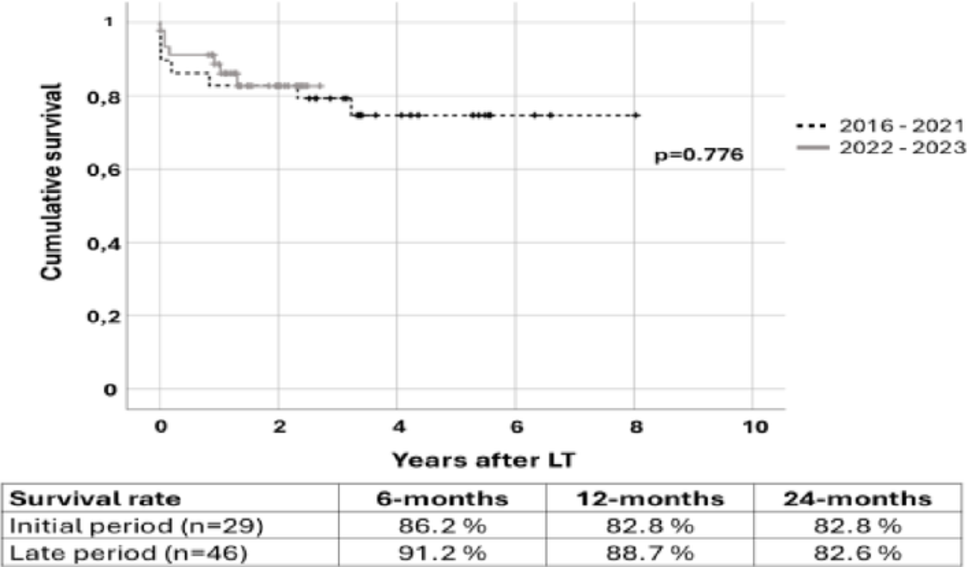
The progressive shift towards a less restrictive utilization of DCD liver allografts and the increasing marginality of donors observed in this study suggest that our center’s policies and practices have evolved, implementing allograft reconditioning with accumulated experience. Consequently, donor and recipient risk profiles (i.e. LTRS, P-SOFT score, DRI and ET-DRI) exhibited a mild yet significant linear correlation with the time that elapsed since the inception of the DCD liver transplant program. Similarly, HOPE duration and ischemia time demonstrated a linear correlation with time, reflecting a strategic shift toward prolonged hypothermic perfusion and minimized ischemia, coherently with the findings of Dondossola et al. [29] These findings, together with the increasing severity of recipients’ liver dysfunction and growing marginality of donors, align with other reports highlighting the broader and more versatile use of DCD allografts in liver transplantation over time [3], particularly when organs can be effectively reconditioned to mitigate ischemia-reperfusion injury. Overall, the findings from eight years of DCD liver transplantation practice demonstrate that donation after cardiovascular determination of death has not only expanded the donor pool but has also evolved from an initially perceived marginal practice to a more established and routine source of allografts, whose increasing marginality benefits from routine treatment with sequential NRP and extended end-ischemic HOPE. We hypothesize that the implementation of a more effective reconditioning strategy—particularly with respect to the duration of hypothermic oxygenated perfusion (HOPE)—accounts for the comparability of biliary complication rates and survival outcomes throughout the study period, despite the progressive increase in donor and recipient marginality. Although the one-year survival rate was marginally below 90%, the survival curve was adversely influenced by five early patient deaths unrelated to graft function, which had a disproportionate effect on survival estimates given the limited sample size.
These results show that the progressive expansion of DCD allocation in and Italian-based transplant setting has clearly contributed to increased transplant activity. In particular, the integration of NRP and end-ischemic HOPE has proven effective in offsetting the intrinsic risks associated with prolonged functional warm ischemia, thereby allowing safe expansion toward older and more marginal donors.
Limitations
The observational nature and monocentric design of this study limit the generalizability of its conclusions, particularly given the unique characteristics of the Italian clinical setting and legislation compared to other countries [6, 28]. Nonetheless, despite the higher technical complexity of donation after cardiovascular determination of death in Italy, Italian DCD liver transplants have demonstrated comparable outcomes when included in international multicenter case series [8, 28, 30]. Additionally, the study design resulted in a limited follow-up period for patients in the later cohort, although a minimum follow-up of twelve months was ensured for all participants.
Conclusions
This study highlights the significant evolution of DCD liver transplantation practices at our center, demonstrating a linear correlation between time since program inception and increasing donor and recipient complexity. Furthermore, the stability of transplant outcomes despite growing donor- and recipient-related risks highlights that DCD liver allografts are more versatile and less marginal than initially feared. As global DCD liver transplantation practices continue to exhibit significant geographical variability, evaluating DCD donor potential in diverse clinical settings can challenge historical perceptions of their marginality. In this sense, NRP and end-ischemic HOPE represent a valuable and effective strategy for reconditioning DCD allografts, enhancing their utilization in high-risk donor and recipient scenarios. Future research should focus on refining risk stratification and exploring novel preservation technologies to optimize high-risk DCD donor utilization. Additionally, long-term multicenter studies could further validate these findings across diverse clinical settings and guide the development of standardized protocols for DCD donor optimization worldwide.



Comments (0)