This study reporting one of the largest single-center PRRA cohorts with long-term follow-up is distinctive in that most patients were treated for refractory DS.
Management of Dumping Syndrome
Initial treatment of DS focuses on dietary modifications and viscosity-enhancing agents like pectin or guar gum [11, 12]. Pharmacologic options such as acarbose, diaxozid or somatostatin analogues may can be considered in cases unresponsive to dietary interventions, although with mixed efficacy [11, 12, 16, 17]. The use of GLP-1 analogues for the treatment of dumping syndrome and postprandial hypoglycemia is an emerging approach; however, current evidence remains limited and is largely derived from case reports [17]. In severe and refractory cases, surgical or endoscopic interventions may be necessary [11, 12].
In our cohort, nearly two-thirds of all patients reported improvement in the severity and/or frequency of DS symptoms following PRRA, with approximately 11% experiencing complete resolution. This improvement was sustained over a mean follow-up period of 46.6 ± 40.0 months, indicating a durable therapeutic benefit. These findings reinforce and expand upon early data from a recent prospective study conducted at our institution that specifically focused on dumping syndrome [14]. Nevertheless, interpretation is limited by the retrospective design and the reliance on patient-reported DS-related symptoms, which may not fully capture objective changes in symptom severity following PRRA, Notably, 16.1% of patients in our cohort had a history of GLP1-receptor agonist use prior to PRRA, suggesting perceived clinical benefit despite the currently limited level of evidence. A single center study focusing on PRRA for recurrent weight gain reported DS improvement in a subgroup of patients in 75% of patients and resolution in 58% of patients one year postoperatively [13]. However, these Swiss cohorts were smaller, had shorter follow-up, and included patients with lower baseline BMIs, potentially reflecting a less severely affected population compared to that typically encountered in Germany.
Endoscopic alternatives such as transoral outlet reduction (TORe) have also demonstrated symptom resolution rates of 57% and improvement in up to 75% of cases at 1–2 years [18]. However, these findings are limited by shorter follow-up durations and smaller cohorts. Notably, patients with suboptimal clinical response to TORe in one study were subsequently referred for PRRA, suggesting that PRRA may be an effective secondary option. In cases of severe, intractable DS, bypass reversal represents an established treatment option, albeit with distinct limitations, including persistent DS symptoms, recurrent weight gain and gastroesophageal reflux disease [19]. An alternative option in patients with clinically significant recurrent weight gain is conversion to biliopancreatic diversion with duodenal switch (BPD/DS); however, available evidence remains limited, and given the technical complexity and perioperative risk profile, less invasive treatment strategies should be considered fist [20, 21].
As symptom burden and impact on quality of life (QoL) are highly individualized—and patients often adapt through coping strategies—improvements in symptom severity and reductions in daily living restrictions can lead to substantial increases in overall satisfaction, even in the presence of persistent DS symptoms.
Recurrent Weight Gain and Suboptimal Clinical Response to RYGB
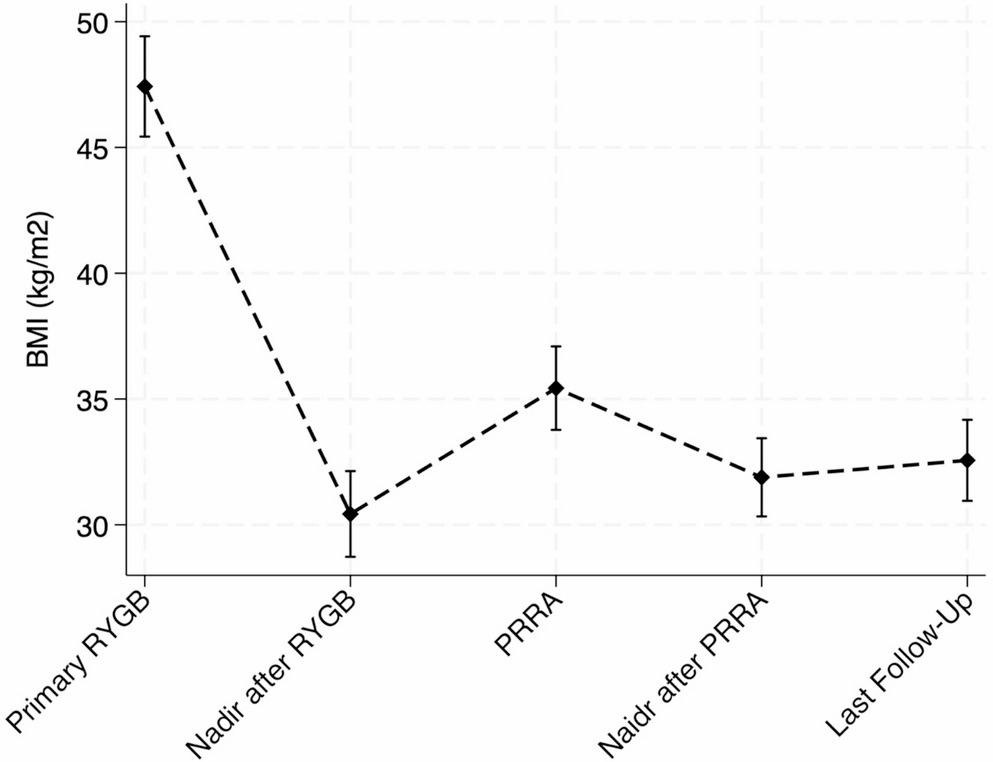
Suboptimal clinical response and recurrent weight gain remain common challenges after RYGB, with some studies estimating that up to 50% of patients may require revisional bariatric surgery [22, 23]. Although definitions vary across studies, suboptimal response is typically defined as %TWL < 20%, whereas recurrent weight gain is commonly defined as an increase in BMI of ≥ 5 kg/m² from nadir. In our cohort, only one patient met the criteria for primary suboptimal clinical response, however, 48% of patients demonstrated recurrent weight gain at the time of PRRA. Post-PRRA, approximately half of all patients experienced renewed weight loss, and nearly one-third achieved long-term weight stability. These outcomes are consistent with previous reports suggesting modest but clinically meaningful weight loss following PRRA [9, 10, 13]. TORe as another less invasive treatment option, may demonstrate greater short-term weight loss, but has also been associated with recurrent weight gain over the subsequent two years and long-term data remains limited [18, 24]. Thus, the available evidence suggests that the long-term efficacy of PRRA may be comparable—or even superior—to that of TORe. Established, although more aggressive, surgical treatment options for suboptimal clinical response or recurrent weight gain include conversion to distal gastric bypass (DRYGB) or BPD/DS [20, 21]. Reported weight loss outcomes reach up to 76% %EWL at 3 years after conversion to BPD/DS and up to 52.2% %EWL following DRYGB. However, these procedures are technically demanding and are associated with a substantially increased risk of malnutrition and long-term complications. Moreover, they may not adequately address coexisting dumping syndrome symptoms.
Recent advances in obesity pharmacotherapy have shown promising results not only in the treatment of obesity itself, but also in managing recurrent weight gain following MBS [25]. However, the overall body of evidence remains limited, and high-quality prospective data are particularly lacking.
Patient Satisfaction and Adverse Events
This study placed particular emphasis on patient-reported outcomes, including QoL and side effects such as dysphagia and vomiting. Despite 23.4% of patients reporting weekly regurgitation or vomiting and 8.8% describing severe dysphagia, overall satisfaction remained high. Since severe DS was the most common indication for PRRA, it is important to highlight that despite the ring-associated side effects and often persistent, though significantly alleviated, DS symptoms, 69.7% of patients reported a good to very good QoL at final follow-up, while only 6% reported poor QoL. Nevertheless, interpretation of these findings is limited by the retrospective study design and the use of the BAROS score, which may lack sensitivity for detecting procedure-related adverse symptoms following PRRA. Early ring-related complications were infrequent. Two patients (3.2%) required surgical revision within 30 days—one for a local abscess and one for mechanical bowel obstruction. Both cases were managed laparoscopically, with ring removal in one. At long-term follow-up, the ring had been removed in 25.8% of patients, most commonly due to dysphagia. These removal rates and indications are in line with findings from a multicenter study of 79 PRRA patients [9].
Limitations
This study has several limitations. First, its retrospective design, along with the reliance on electronic health records and patient-reported data, introduces potential selection and reporting biases. Most patients in our cohort underwent PRRA primarily for severe DS, which may not reflect the broader population undergoing revisional or conversion bariatric procedures. Second, the absence of standardized, serial assessments of DS using validated instruments, such as the Sigstad or Arts dumping scores, limits our ability to quantitatively evaluate changes in DS severity over time. Reliance on patient-reported DS-related symptoms may further introduce reporting bias. Similarly, the lack of repeated, formal QoL questionnaires restricts a more detailed analysis of temporal trends in patient-reported outcomes. Moreover, the QoL questionnaire used in this study was not disease-specific and was not originally designed to assess dumping syndrome–related symptoms or dysphagia following banded procedures. Consequently, the reported QoL outcomes may not fully reflect the true clinical improvement following PRRA, and the treatment effect may therefore be overestimated. Third, sociodemographic and ethnic data were not collected, limiting the generalizability of our findings across diverse populations. Nevertheless, aside from a slightly higher mean BMI at the time of the index RYGB, our cohort appears broadly representative when compared to previously published studies on PRRA.


Comments (0)