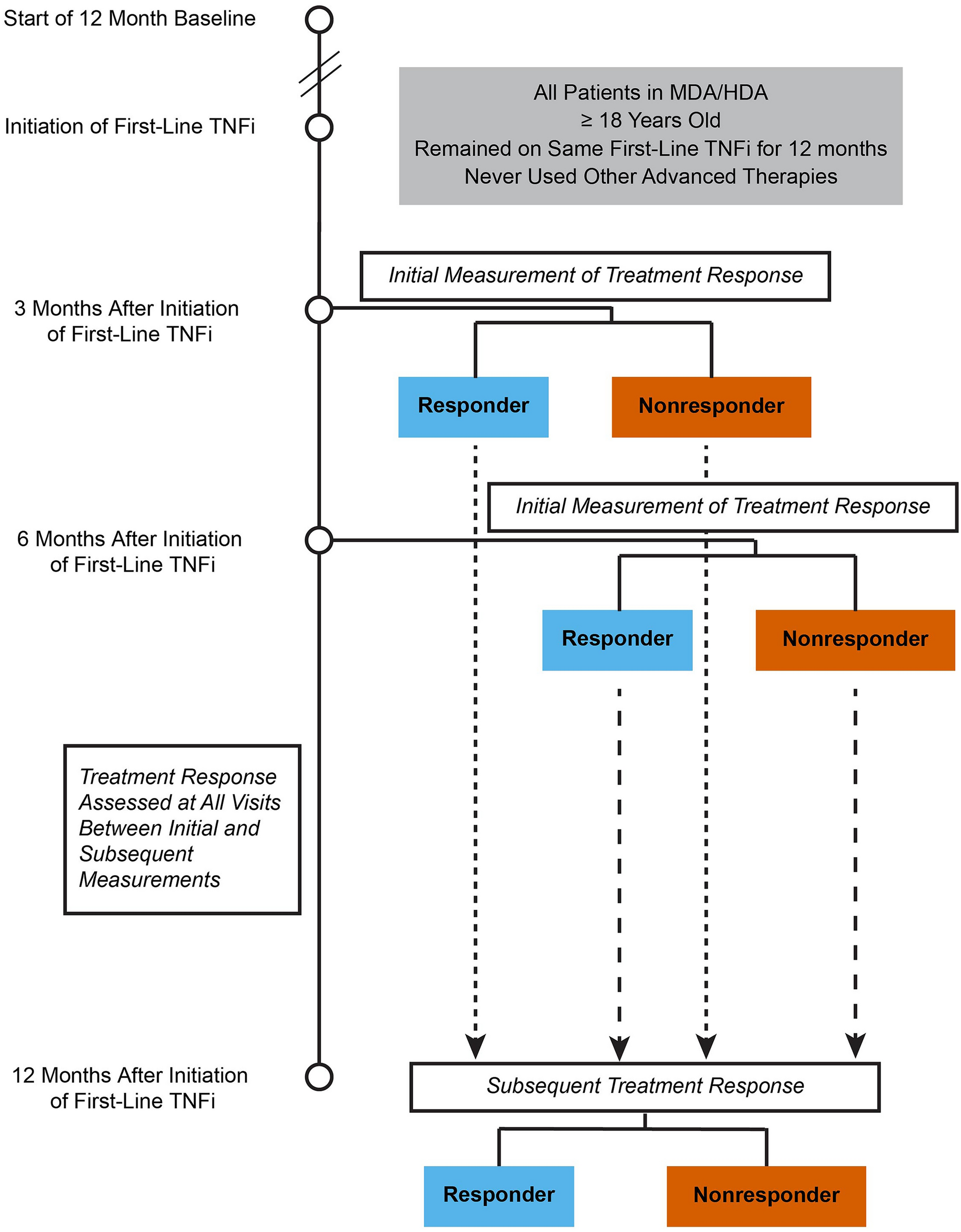
Despite guidelines that recommend re-evaluating a treatment target within 3 to 6 months of initiation [7, 8], real-world studies show that many patients with RA treated with a TNFi in the first line of advanced therapy fail to achieve the recommended treatment target of LDA/remission within this timeline [14,15,16,17,18] and may remain on the same treatment for 12 months or more [14, 18]. However, the likelihood that a patient will subsequently achieve a treatment target while remaining on the same TNFi after initially not achieving a treatment target is not well understood.
In this real-world, retrospective cohort study of patients with RA, between 50% and 65% of patients failed to achieve an initial treatment target after 3 or 6 months of treatment with a first-line TNFi. Among these patients, between 73% and 80% also failed to achieve a treatment target after 12 months. For patients who achieved a treatment target at either 3 or 6 months after initiating a first-line TNFi, most patients were able to maintain this response at 12 months. However, between 16% and 22% of these initially responsive patients reported a loss of treatment response at 12 months, with even more patients reporting a loss of treatment response at one or more visits between the initial assessment and 12 months. Together, these results show that an initial response to treatment may serve as a reliable indicator of whether a patient will subsequently achieve a treatment target while remaining on the same therapy.
For patients with RA, quickly achieving remission or LDA can greatly improve their quality of life, decrease healthcare costs, and reduce pain levels [24, 25]. Thus, following the recommended goal-directed treatment strategy is critical to optimize therapy [5, 7, 8, 26, 27]. To minimize joint damage and severe symptoms, clinicians may set a less stringent target of LDA for patients with severe, highly active, and/or polyrefractory disease versus remission for patients with MDA [27]. This study assessed two different treatment targets: achievement of LDA/remission in CDAI and achievement of a MCID in CDAI. Including an assessment of MCID in CDAI provided the opportunity to assess the likelihood of subsequently achieving and maintaining a less stringent treatment response. However, more than half of all patients failed to achieve MCID in CDAI at the initial assessment 3 or 6 months post-index. Furthermore, among initial nonresponders, the majority of patients did not achieve MCID in CDAI at 12 months. These results suggest that even modest improvements in clinical outcomes, which will typically be gained early in the course of therapy, such as achievement of MCID in CDAI, may not be achieved by all patients who initiate a first-line TNFi. Furthermore, failure to initially achieve even a modest treatment target while utilizing a first-line TNFi may reliably indicate an inability to achieve a target in the future. Together, these results provide evidence that clinicians should consider switching therapies sooner if a patient fails to achieve a low-level treatment response at an initial assessment.
In addition to choosing an appropriate treatment target, clinicians must also determine the treatment interval for assessing achievement of the target [27]. In this study, the rate of initially achieving a treatment target was similar between patients evaluated at 3 months after initiating a first-line TNFi and patients evaluated 6 months after initiating a first-line TNFi. Likewise, the subsequent response rates at 12 months for initial responders and nonresponders were similar between the 3-month and 6-month cohorts. While clinicians may choose to follow the recommended 3- to 6-month timeline or tailor their treatment strategy for each patient, these results show that assessing a treatment target 3 months after initiation appears to be sufficient time to predict if a first-line TNFi will be effective.
Despite evidence-based recommendations from ACR and EULAR to follow a goal-directed treatment strategy [7, 8], this and other real-world studies reveal that patients are remaining on treatment with first-line TNFis despite failing to achieve a treatment target [14, 18]. Several studies have offered reasons for the gap between these guidelines and real-world clinical practice, such as clinical inertia, patient preference, a fear of worsening symptoms or side effects, and barriers in healthcare and/or insurance structure [26,27,28,29,30]. Still, some have suggested that outside of the EMR or survey data analyzed, physicians may follow a goal-directed treatment strategy while incorporating patient preference [27]. One study found that engaging patients in the decision to set a treatment target and the strategy to modify treatment as needed led to greater success in achieving a target and higher rates of satisfaction [26]. By informing patients of the effectiveness of a goal-directed treatment regimen, as evidenced by this study, both clinicians and patients may be better at weighing the risks and benefits of a given treatment.
For patients who did not achieve LDA/remission after 3 months of treatment with a first-line TNFi, those with concomitant use of methotrexate at 3 months were significantly more likely to achieve LDA/remission at 12 months. Conversely, patients who were smokers, those with concomitant use of opioids at 3 months, and those with a higher 3-month CDAI score were significantly less likely to achieve LDA/remission at 12 months. However, for patients who did not achieve LDA/remission after 6 months of treatment with a first-line TNFi, the 6-month CDAI score was the only predictor significantly associated with achieving LDA/remission at 12 months. While this analysis was exploratory, the results suggest that some factors earlier in the course of treatment may influence a future treatment response. However, after 6 months of treatment without achieving a response, there is less opportunity to modify the response trajectory. Future research into factors that can predict a subsequent treatment response after an initial lack of response, such as seropositivity and the dosage of concomitant medications, could lead to earlier intervention and reduce the burden of disease.
We also found that between 19% and 27% of patients who initially responded to treatment were unable to maintain this response through 12 months. This finding is consistent with clinical and real-world studies of patients that report a secondary loss of response in patients treated with TNFis [31, 32]. The cause of the secondary loss of response can vary and may depend on patient demographic factors, like a history of smoking and body mass index. Additionally, immunogenicity to TNFis can induce anti-drug antibodies (ADAs), which in complex with TNF inhibitors can impact circulating drug levels. Prior research has shown that patients treated with adalimumab who develop ADAs were less likely to achieve minimal disease activity or remission [33]. Furthermore, studies have shown that the use of concomitant csDMARDs may decrease the formation of ADAs and is associated with improved clinical outcomes [34].
While the pattern of treatment responses observed in the current study is informative, the study design poses some limitations. It is possible that clinicians continued to prescribe the same TNFi for reasons other than effectiveness, including contraindications for other medications, concerns about side effects, or challenges with cost and insurance reimbursement [26, 35]. This study specifically examined the treatment responses of patients who used the same first-line TNFi for 12 months, which inherently restricts the patient population and potentially limits the comparability of this study with other real-world or clinical data that followed patients after a treatment switch. By excluding patients who switched therapy within a 12-month period, this study cannot report on any subsequent treatment responses for these patients, nor the reason(s) for discontinuing a first-line TNFi. However, it is reasonable to assume that patients and their prescribing physician could also choose to switch from a first-line TNFi to another therapy for causes beyond effectiveness.
Additionally, this study specifically analyzed CDAI as the treatment response, which does not require a laboratory test and could therefore be quickly and simply assessed [36, 37]. Our results were consistent with another study of patients treated with a TNFi that found that approximately 60% of patients who did not achieve a response in CDAI at 6 months also did not achieve a response at 12 months [14]. This study also found that patients with an inadequate response at 12 months also reported numerically smaller improvements in patient-reported outcomes compared to patients who were able to achieve a response by 12 months. However, not all physicians use CDAI as a measure of disease activity, which may have limited the availability of patients for this study and impact the applicability and generalizability of these results. Certain types of patients, such as those with high levels of disease activity who require frequent monitoring, may receive CDAI assessments more frequently, which could bias the study population. While we note that the comparability of CDAI to other measurements of disease activity such as Disease Activity Score using 28 joint counts (DAS28) and Simplified Disease Activity Index (SDAI) has been shown in previous research, future work could replicate the structure of this study to examine the subsequent achievement of treatment targets in patients according to an initial response in other routinely collected measures of disease activity [36, 37].
While the OM1 RA Registry follows over 200,000 patients longitudinally with clinical, laboratory, and other linked data, the use of a single registry may have introduced selection bias into our patient cohorts. Furthermore, as with other studies utilizing real-world data, the variables available for analysis were collected during the course of routine clinical practice and may be incomplete or inconsistent between healthcare encounters. While this study reported that some patients were using medications like csDMARDs, steroids, statins, and opioids concomitantly with the first-line TNFi, the data did not indicate the type, start date of the medication, or dosage, all of which could impact treatment response. In fact, because the majority of medication information in the OM1 RA Registry is based on prescriptions entered into EMRs, rather than pharmacy claims, the prescribed medications in the EMR may not mean that the medication was filled and/or taken by patients as directed. Furthermore, this study was not designed to capture safety events from the EMR. However, it is reasonable to conclude that any treatment-emergent safety events that did occur, whether in initial responders or nonresponders, were not serious enough to warrant discontinuation of treatment with the first-line TNFi, as all patients in the study were required to remain on the same first-line TNFi for 12 months. By limiting our study population in this way, it is possible that we have biased the population to include only patients for whom TNFis are well tolerated.
With the availability of other advanced therapies, clinicians are now able to consider other options, including other bDMARDs and tsDMARDs, after an initial failure to achieve a treatment target with a TNFi. Given this choice, particular attention has been given to evaluating the effectiveness of cycling within the TNFi class or switching to a therapy with a different mechanism of action. There is a growing body of evidence from clinical and real-world studies that suggests switching to a different mechanism of action may result in better clinical outcomes for patients with an inadequate response after treatment with a TNFi [35, 38,39,40,41,42,43]. These results, along with those from this study, emphasize that early evaluation of a treatment target after initiating a first-line TNFi can allow for timely adjustments to the individualized treatment strategy required for a patient with RA.

Comments (0)